Waswa Lydiah M, Jordan Irmgard, Krawinkel Michael B, Keding Gudrun B
Department of Human Nutrition, Faculty of Health Sciences, Egerton University, Egerton, Kenya.
Center for international Development and Environmental Research, Justus Liebig University Giessen, Giessen, Germany.
Front Nutr. 2021 Mar 8;8:636872. doi: 10.3389/fnut.2021.636872. eCollection 2021.
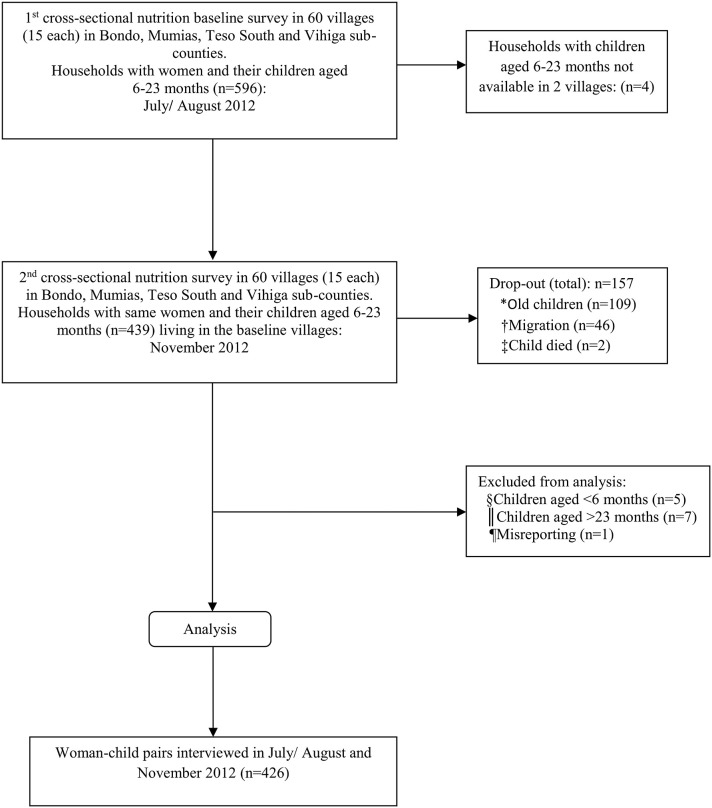
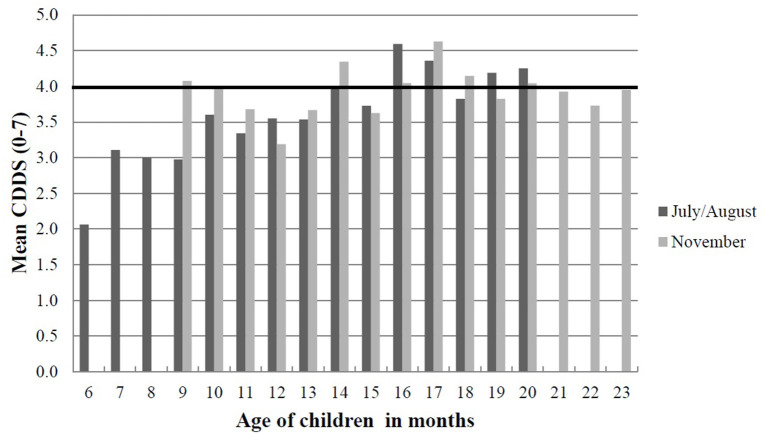
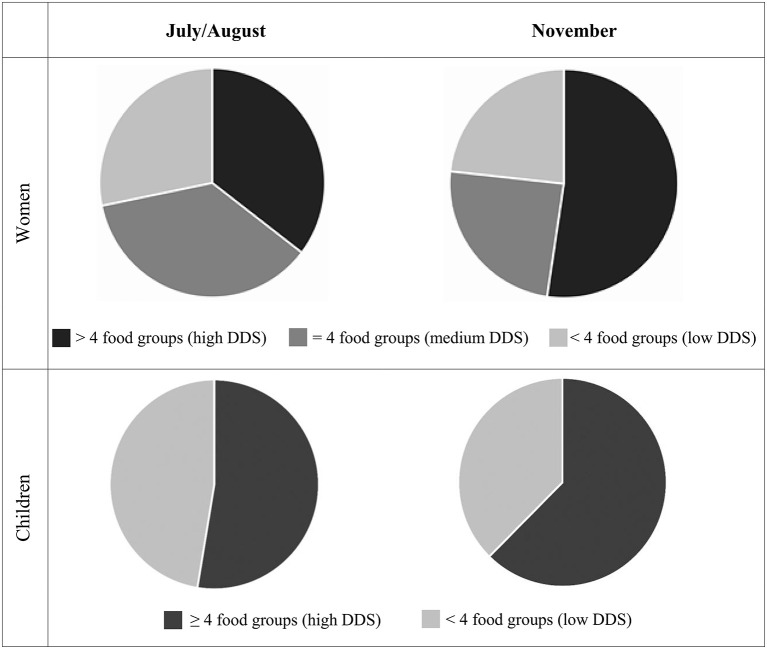
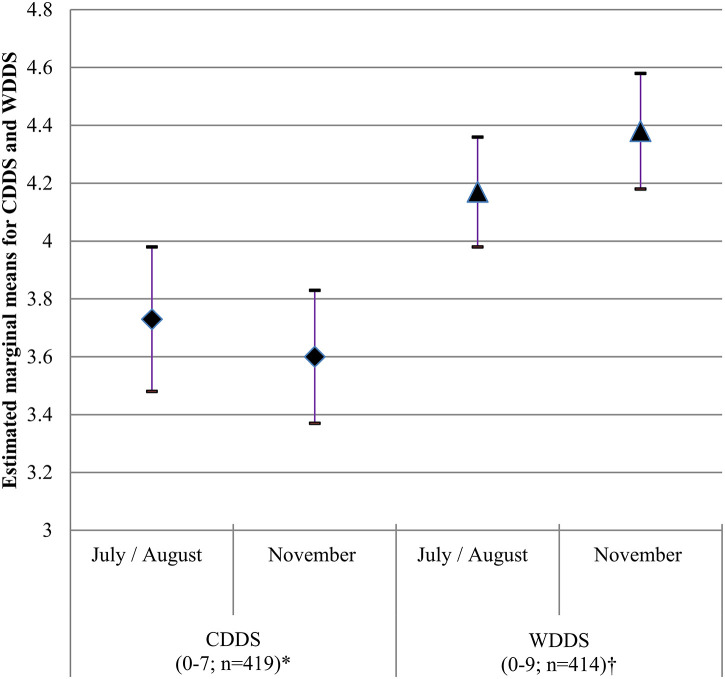
Seasonal variations in food availability and access contributes to inadequate nutrient intakes, particularly in low income countries. This study assessed the effect of seasonality on dietary diversity (DD) and nutrient intakes of women and children aged 6-23 months in a rural setting in Western Kenya. A longitudinal study was conducted among 426 mother-child pairs during the harvest and post-harvest seasons in 2012. Dietary intakes were assessed using 24-h dietary recalls and dietary diversity scores (DDS) and nutrient intakes calculated for both seasons. Effect of seasonality on women dietary diversity scores (WDDS) and children's dietary diversity scores (CDDS) were assessed using generalised linear mixed models (GLMM). The proportion of women consuming diets with high DDS (>4 out of 9 food groups) increased from 36.4 to 52.4% between the two seasons, with mean WDDS being significantly higher in November compared to July/August (4.62 ± 1.43 vs. 4.16 ± 1.14, < 0.001). A significantly higher proportion of children consumed foods from ≥4 out of 7 food groups in November compared to July/August (62.4 vs. 52.6%, = 0.004). Mean CDDS (3.91 vs. 3.61, = 0.004) was low but significantly higher in November compared to July/August. Estimated marginal mean WDDS increased from 4.17 to 4.38, and decreased for CDDS from 3.73 to 3.60 between the seasons. Seasonality had a small but significant effect on WDDS, = 0.008 but not on CDDS, = 0.293. Increase in CDDS in November was due to age and not seasonal effect. Higher women education and household food security were associated with higher WDDS and CDDS. Intakes of iron, calcium and vitamin E were higher among women in November and significantly different between the seasons. Agro-ecological zone, ethnic group and home gardening influenced nutrient intakes of the women. Seasonality had an effect on the DD of women but not of children, thus other factors apart from food availability influence the quality of children's diets during the complementary feeding period. With increasing age and transition to family foods, children's DD is expected to be affected by seasonality. Integrated interventions to alleviate seasonal food insecurity and strengthen rural households' resilience against seasonal deterioration in diet quality are recommended.
食物供应和获取的季节性变化导致营养摄入不足,在低收入国家尤其如此。本研究评估了季节性对肯尼亚西部农村地区6至23个月龄妇女和儿童饮食多样性(DD)及营养摄入的影响。2012年在收获季节和收获后季节对426对母婴进行了一项纵向研究。通过24小时饮食回顾法评估饮食摄入量,并计算饮食多样性得分(DDS)以及两个季节的营养摄入量。使用广义线性混合模型(GLMM)评估季节性对妇女饮食多样性得分(WDDS)和儿童饮食多样性得分(CDDS)的影响。两个季节中,饮食多样性得分高(9个食物组中超过4个)的妇女比例从36.4%增至52.4%,11月的平均WDDS显著高于7月/8月(4.62±1.43对4.16±1.14,<0.001)。与7月/8月相比,11月有显著更高比例的儿童食用了7个食物组中≥4个组的食物(62.4%对52.6%,=0.004)。平均CDDS(3.91对3.61,=0.004)较低,但11月显著高于7月/8月。两季之间,估计边际平均WDDS从4.17增至4.38,而CDDS从3.73降至3.60。季节性对WDDS有微小但显著的影响,=0.008,但对CDDS无影响,=0.293。11月CDDS的增加是由于年龄而非季节效应。妇女受教育程度较高和家庭粮食安全状况较好与较高WDDS和CDDS相关。11月妇女的铁、钙和维生素E摄入量较高,且两季之间有显著差异。农业生态区、种族群体和家庭园艺影响了妇女的营养摄入。季节性对妇女的饮食多样性有影响,但对儿童没有,因此在辅食添加期,除了食物供应外,其他因素也会影响儿童饮食质量。随着年龄增长和向家庭食物的过渡,预计儿童的饮食多样性会受到季节性影响。建议采取综合干预措施,缓解季节性粮食不安全状况,增强农村家庭抵御饮食质量季节性恶化的能力。