Institute for Human Genetics, University of California San Francisco, CA, USA.
Museum of Vertebrate Zoology, University of California Berkeley, CA, USA.
Genome Biol Evol. 2021 May 7;13(5). doi: 10.1093/gbe/evab066.
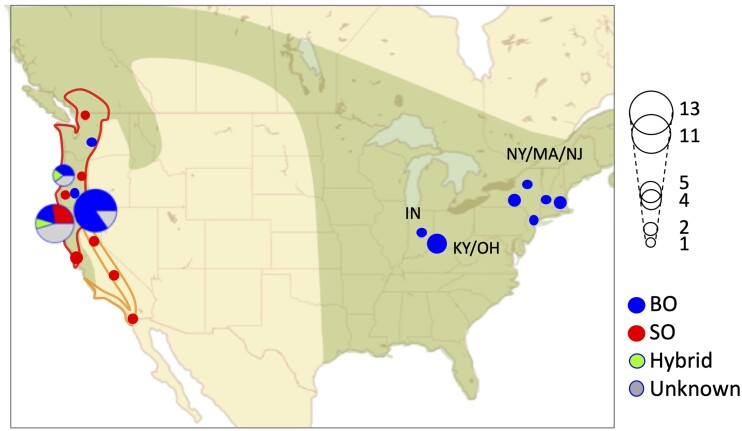
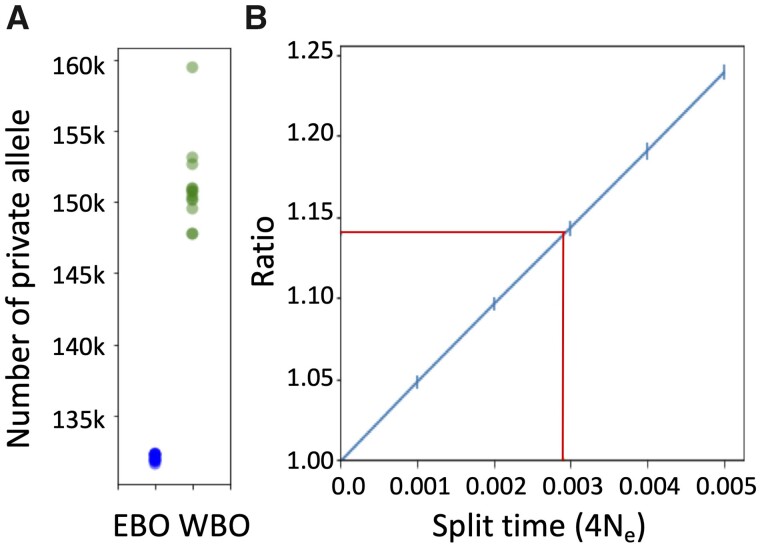
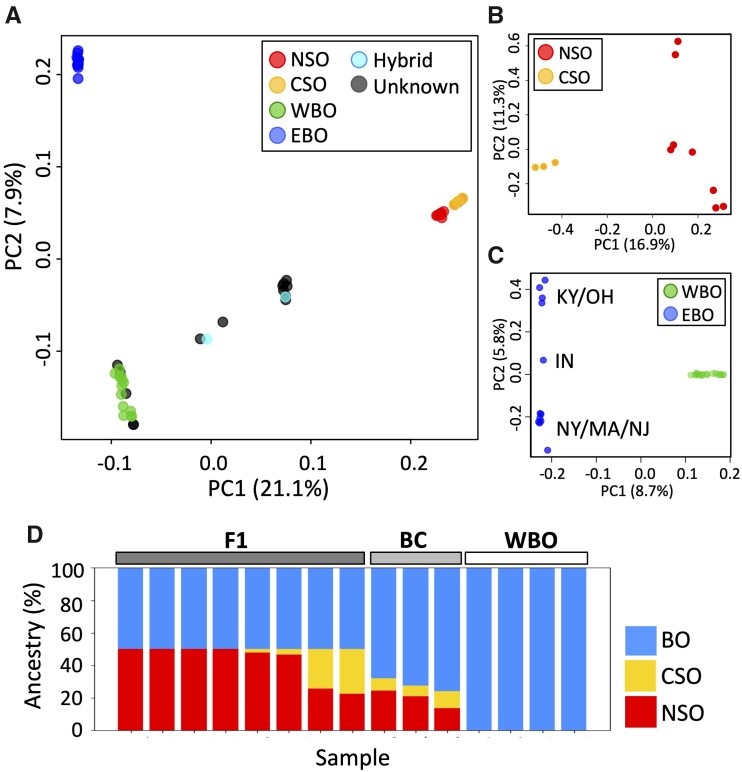
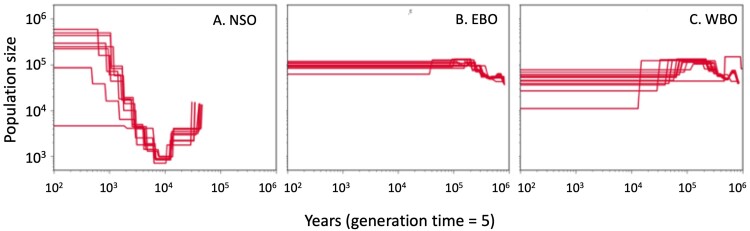
Spotted owls (SOs, Strix occidentalis) are a flagship species inhabiting old-growth forests in western North America. In recent decades, their populations have declined due to ongoing reductions in suitable habitat caused by logging, wildfires, and competition with the congeneric barred owl (BO, Strix varia). The northern spotted owl (S. o. caurina) has been listed as "threatened" under the Endangered Species Act since 1990. Here, we use an updated SO genome assembly along with 51 high-coverage whole-genome sequences to examine population structure, hybridization, and recent changes in population size in SO and BO. We found that potential hybrids identified from intermediate plumage morphology were a mixture of pure BO, F1 hybrids, and F1 × BO backcrosses. Also, although SO underwent a population bottleneck around the time of the Pleistocene-Holocene transition, their population sizes rebounded and show no evidence of any historical (i.e., 100-10,000 years ago) population decline. This suggests that the current decrease in SO abundance is due to events in the past century. Finally, we estimate that western and eastern BOs have been genetically separated for thousands of years, instead of the previously assumed recent (i.e., <150 years) divergence. Although this result is surprising, it is unclear where the ancestors of western BO lived after the separation. In particular, although BO may have colonized western North America much earlier than the first recorded observations, it is also possible that the estimated divergence time reflects unsampled BO population structure within central or eastern North America.
斑点猫头鹰(SO,Strix occidentalis)是一种标志性物种,栖息在北美洲西部的古老森林中。近几十年来,由于伐木、野火和与同种条纹猫头鹰(BO,Strix varia)的竞争导致适宜栖息地不断减少,其数量有所下降。北方斑点猫头鹰(S. o. caurina)自 1990 年以来一直被《濒危物种法》列为“濒危”物种。在这里,我们使用更新的 SO 基因组组装和 51 个高覆盖率的全基因组序列来研究 SO 和 BO 的种群结构、杂交和最近的种群数量变化。我们发现,从中性羽毛形态中鉴定出的潜在杂交种是纯 BO、F1 杂种和 F1×BO 回交的混合物。此外,尽管 SO 在更新世-全新世过渡时期经历了种群瓶颈,但它们的种群数量已经反弹,没有任何历史(即 100-10000 年前)种群减少的证据。这表明 SO 丰富度的当前减少是由于过去一个世纪的事件造成的。最后,我们估计西部和东部 BO 已经在遗传上分离了数千年,而不是以前假设的近期(即<150 年)分化。尽管这一结果令人惊讶,但目前还不清楚西部 BO 的祖先在分离后生活在哪里。特别是,尽管 BO 可能比第一次有记录的观察更早地殖民了北美西部,但估计的分歧时间也可能反映了北美中部或东部未采样的 BO 种群结构。