• 文献检索
  • 文档翻译
  • 深度研究
  • 学术资讯
  • Suppr Zotero 插件Zotero 插件
  • 邀请有礼
  • 套餐&价格
  • 历史记录
应用&插件
Suppr Zotero 插件Zotero 插件浏览器插件Mac 客户端Windows 客户端微信小程序
定价
高级版会员购买积分包购买API积分包
服务
文献检索文档翻译深度研究API 文档MCP 服务
关于我们
关于 Suppr公司介绍联系我们用户协议隐私条款
关注我们

Suppr 超能文献

核心技术专利:CN118964589B侵权必究
粤ICP备2023148730 号-1Suppr @ 2026

文献检索

告别复杂PubMed语法,用中文像聊天一样搜索,搜遍4000万医学文献。AI智能推荐,让科研检索更轻松。

立即免费搜索

文件翻译

保留排版,准确专业,支持PDF/Word/PPT等文件格式,支持 12+语言互译。

免费翻译文档

深度研究

AI帮你快速写综述,25分钟生成高质量综述,智能提取关键信息,辅助科研写作。

立即免费体验

COVID-19 大流行下的医疗保健网络安全挑战与应对策略:范围综述。

Health Care Cybersecurity Challenges and Solutions Under the Climate of COVID-19: Scoping Review.

机构信息

School of Computer Science, University of Nottingham, Nottingham, United Kingdom.

School of Computer Science and Informatics, De Montfort University, Leicester, United Kingdom.

出版信息

J Med Internet Res. 2021 Apr 20;23(4):e21747. doi: 10.2196/21747.

DOI:10.2196/21747
PMID:33764885
原文链接:https://pmc.ncbi.nlm.nih.gov/articles/PMC8059789/
Abstract

BACKGROUND

COVID-19 has challenged the resilience of the health care information system, which has affected our ability to achieve the global goal of health and well-being. The pandemic has resulted in a number of recent cyberattacks on hospitals, pharmaceutical companies, the US Department of Health and Human Services, the World Health Organization and its partners, and others.

OBJECTIVE

The aim of this review was to identify key cybersecurity challenges, solutions adapted by the health sector, and areas of improvement needed to counteract the recent increases in cyberattacks (eg, phishing campaigns and ransomware attacks), which have been used by attackers to exploit vulnerabilities in technology and people introduced through changes to working practices in response to the COVID-19 pandemic.

METHODS

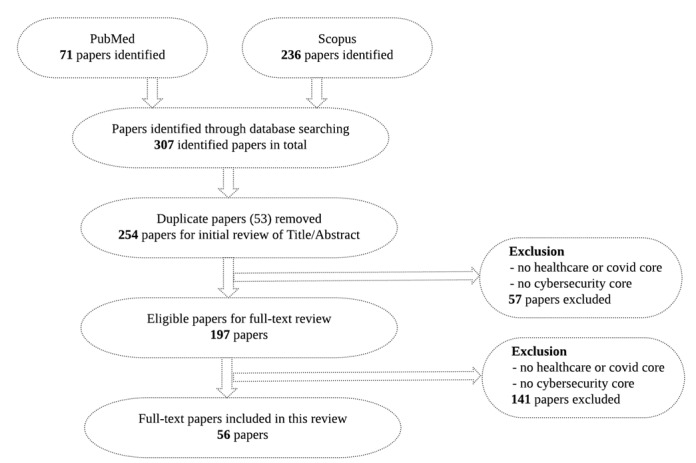
A scoping review was conducted by searching two major scientific databases (PubMed and Scopus) using the search formula "(covid OR healthcare) AND cybersecurity." Reports, news articles, and industry white papers were also included if they were related directly to previously published works, or if they were the only available sources at the time of writing. Only articles in English published in the last decade were included (ie, 2011-2020) in order to focus on current issues, challenges, and solutions.

RESULTS

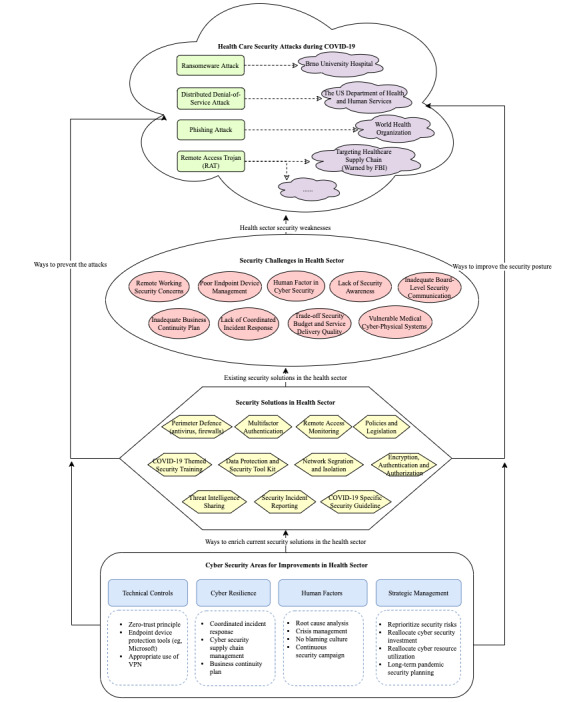
We identified 9 main challenges in cybersecurity, 11 key solutions that health care organizations adapted to address these challenges, and 4 key areas that need to be strengthened in terms of cybersecurity capacity in the health sector. We also found that the most prominent and significant methods of cyberattacks that occurred during the pandemic were related to phishing, ransomware, distributed denial-of-service attacks, and malware.

CONCLUSIONS

This scoping review identified the most impactful methods of cyberattacks that targeted the health sector during the COVID-19 pandemic, as well as the challenges in cybersecurity, solutions, and areas in need of improvement. We provided useful insights to the health sector on cybersecurity issues during the COVID-19 pandemic as well as other epidemics or pandemics that may materialize in the future.

摘要

背景

COVID-19 对医疗保健信息系统的弹性提出了挑战,这影响了我们实现全球健康和福祉目标的能力。大流行导致最近针对医院、制药公司、美国卫生与公众服务部、世界卫生组织及其合作伙伴以及其他机构的多次网络攻击。

目的

本综述旨在确定关键的网络安全挑战、卫生部门采用的解决方案以及需要改进的领域,以应对最近网络攻击的增加(例如,网络钓鱼活动和勒索软件攻击),攻击者利用这些攻击来利用技术和人员的漏洞,这些漏洞是通过应对 COVID-19 大流行而改变工作实践引入的。

方法

通过使用搜索公式“(covid 或 healthcare)AND cybersecurity”在两个主要科学数据库(PubMed 和 Scopus)中进行了范围界定审查。如果报告、新闻文章和行业白皮书与之前发表的作品直接相关,或者在撰写时是唯一可用的来源,则也将其包括在内。仅包括以英文发表的过去十年内的文章(即 2011-2020 年),以便重点关注当前的问题、挑战和解决方案。

结果

我们确定了网络安全的 9 个主要挑战、医疗保健组织为解决这些挑战而采用的 11 个关键解决方案,以及医疗保健部门网络安全能力需要加强的 4 个关键领域。我们还发现,大流行期间发生的最突出和最重要的网络攻击方法与网络钓鱼、勒索软件、分布式拒绝服务攻击和恶意软件有关。

结论

本范围界定综述确定了针对 COVID-19 大流行期间医疗保健部门的最具影响力的网络攻击方法,以及网络安全、解决方案和需要改进的领域面临的挑战。我们为医疗保健部门提供了在 COVID-19 大流行期间以及未来可能出现的其他流行病或大流行期间网络安全问题的有用见解。
https://cdn.ncbi.nlm.nih.gov/pmc/blobs/bcea/8059789/16aad70acc4f/jmir_v23i4e21747_fig2.jpg
https://cdn.ncbi.nlm.nih.gov/pmc/blobs/bcea/8059789/2e49a86cdc38/jmir_v23i4e21747_fig1.jpg
https://cdn.ncbi.nlm.nih.gov/pmc/blobs/bcea/8059789/16aad70acc4f/jmir_v23i4e21747_fig2.jpg
https://cdn.ncbi.nlm.nih.gov/pmc/blobs/bcea/8059789/2e49a86cdc38/jmir_v23i4e21747_fig1.jpg
https://cdn.ncbi.nlm.nih.gov/pmc/blobs/bcea/8059789/16aad70acc4f/jmir_v23i4e21747_fig2.jpg

相似文献

1
Health Care Cybersecurity Challenges and Solutions Under the Climate of COVID-19: Scoping Review.COVID-19 大流行下的医疗保健网络安全挑战与应对策略:范围综述。
J Med Internet Res. 2021 Apr 20;23(4):e21747. doi: 10.2196/21747.
2
Influence of Human Factors on Cyber Security within Healthcare Organisations: A Systematic Review.人为因素对医疗机构网络安全的影响:系统综述。
Sensors (Basel). 2021 Jul 28;21(15):5119. doi: 10.3390/s21155119.
3
Vulnerability to Cyberattacks and Sociotechnical Solutions for Health Care Systems: Systematic Review.医疗保健系统易受网络攻击及相关社会技术解决方案:系统评价。
J Med Internet Res. 2024 May 31;26:e46904. doi: 10.2196/46904.
4
Cybersecurity Interventions in Health Care Organizations in Low- and Middle-Income Countries: Scoping Review.中低收入国家医疗机构的网络安全干预措施:范围综述。
J Med Internet Res. 2024 Nov 20;26:e47311. doi: 10.2196/47311.
5
A deeper look into cybersecurity issues in the wake of Covid-19: A survey.新冠疫情后对网络安全问题的深入研究:一项调查。
J King Saud Univ Comput Inf Sci. 2022 Nov;34(10):8176-8206. doi: 10.1016/j.jksuci.2022.08.003. Epub 2022 Aug 11.
6
A Data Taxonomy for Adaptive Multifactor Authentication in the Internet of Health Care Things.面向医疗物联网自适应多因素认证的数据分类法。
J Med Internet Res. 2023 Aug 29;25:e44114. doi: 10.2196/44114.
7
We need to aim at the top: Factors associated with cybersecurity awareness of cyber and information security decision-makers.我们需要瞄准高端:与网络和信息安全决策者的网络安全意识相关的因素。
PLoS One. 2024 Oct 18;19(10):e0312266. doi: 10.1371/journal.pone.0312266. eCollection 2024.
8
Cybersecurity Awareness and Training (CAT) Framework for Remote Working Employees.远程工作员工的网络安全意识和培训 (CAT) 框架。
Sensors (Basel). 2022 Nov 9;22(22):8663. doi: 10.3390/s22228663.
9
Cybersecurity Risks in a Pandemic.大流行中的网络安全风险。
J Med Internet Res. 2020 Sep 17;22(9):e23692. doi: 10.2196/23692.
10
Maybe If We Turn It Off and Then Turn It Back On Again? Exploring Health Care Reform as a Means to Curb Cyber Attacks.也许我们可以关闭它,然后再重新打开它?探索医疗改革以遏制网络攻击。
J Law Med Ethics. 2019 Dec;47(4_suppl):91-102. doi: 10.1177/1073110519898046.

引用本文的文献

1
Acceptability and Feasibility of a Prototype Regional Disaster Teleconsultation System for COVID-19 Pandemic Response: Pilot Field Test.用于应对 COVID-19 大流行的区域灾害远程会诊系统原型的可接受性和可行性:现场试点测试
JMIR Form Res. 2025 Aug 19;9:e73078. doi: 10.2196/73078.
2
Improving Vulnerability Management for Security-by-Design of Medical Devices.改进医疗设备设计安全的漏洞管理。
Sensors (Basel). 2025 Jul 16;25(14):4418. doi: 10.3390/s25144418.
3
Multimodal AI in Biomedicine: Pioneering the Future of Biomaterials, Diagnostics, and Personalized Healthcare.

本文引用的文献

1
Have You Been a Victim of COVID-19-Related Cyber Incidents? Survey, Taxonomy, and Mitigation Strategies.你是否成为过与新冠疫情相关的网络事件的受害者?调查、分类法及缓解策略
IEEE Access. 2020 Jun 30;8:124134-124144. doi: 10.1109/ACCESS.2020.3006172. eCollection 2020.
2
Chaotic-map based authenticated security framework with privacy preservation for remote point-of-care.基于混沌映射的具有隐私保护功能的远程医疗认证安全框架。
Multimed Tools Appl. 2021;80(11):17103-17128. doi: 10.1007/s11042-020-10134-x. Epub 2020 Nov 12.
3
The Internet of Things: Impact and Implications for Health Care Delivery.
生物医学中的多模态人工智能:开创生物材料、诊断和个性化医疗的未来。
Nanomaterials (Basel). 2025 Jun 10;15(12):895. doi: 10.3390/nano15120895.
4
Media Framing and Portrayals of Ransomware Impacts on Informatics, Employees, and Patients: Systematic Media Literature Review.媒体对勒索软件对信息学、员工和患者影响的框架构建与描述:系统性媒体文献综述
J Med Internet Res. 2025 Apr 8;27:e59231. doi: 10.2196/59231.
5
Opportunistic access control scheme for enhancing IoT-enabled healthcare security using blockchain and machine learning.基于区块链和机器学习的用于增强物联网医疗保健安全性的机会访问控制方案
Sci Rep. 2025 Mar 4;15(1):7589. doi: 10.1038/s41598-025-90908-1.
6
Digital Health Technology in Diabetes Management in the Asia-Pacific Region: A Narrative Review of the Current Scenario and Future Outlook.亚太地区糖尿病管理中的数字健康技术:当前现状与未来展望的叙述性综述
Diabetes Ther. 2025 Mar;16(3):349-369. doi: 10.1007/s13300-025-01692-0. Epub 2025 Feb 10.
7
Consideration of Cybersecurity Risks in the Benefit-Risk Analysis of Medical Devices: Scoping Review.医疗设备获益-风险分析中的网络安全风险考量:范围综述
J Med Internet Res. 2024 Dec 24;26:e65528. doi: 10.2196/65528.
8
Cybersecurity Interventions in Health Care Organizations in Low- and Middle-Income Countries: Scoping Review.中低收入国家医疗机构的网络安全干预措施:范围综述。
J Med Internet Res. 2024 Nov 20;26:e47311. doi: 10.2196/47311.
9
Adversarial Examples on XAI-Enabled DT for Smart Healthcare Systems.人工智能增强 DT 模型在智慧医疗系统中的对抗样本
Sensors (Basel). 2024 Oct 27;24(21):6891. doi: 10.3390/s24216891.
10
Progress Achieved, Landmarks, and Future Concerns in Biomedical and Health Informatics.生物医学与健康信息学的进展、里程碑及未来关注点
Healthcare (Basel). 2024 Oct 15;12(20):2041. doi: 10.3390/healthcare12202041.
物联网:对医疗保健服务的影响及启示
J Med Internet Res. 2020 Nov 10;22(11):e20135. doi: 10.2196/20135.
4
REVISITING HEALTH INFORMATION TECHNOLOGY ETHICAL, LEGAL, and SOCIAL ISSUES and EVALUATION: TELEHEALTH/TELEMEDICINE and COVID-19.重新审视健康信息技术的伦理、法律和社会问题及评估:远程医疗/远程医学和 COVID-19。
Int J Med Inform. 2020 Nov;143:104239. doi: 10.1016/j.ijmedinf.2020.104239. Epub 2020 Jul 31.
5
Cybersecurity Risks in a Pandemic.大流行中的网络安全风险。
J Med Internet Res. 2020 Sep 17;22(9):e23692. doi: 10.2196/23692.
6
Increasing access to care: telehealth during COVID-19.增加医疗服务可及性:新冠疫情期间的远程医疗
J Law Biosci. 2020 Jun 16;7(1):lsaa043. doi: 10.1093/jlb/lsaa043. eCollection 2020 Jan-Jun.
7
Cybersecurity of Hospitals: discussing the challenges and working towards mitigating the risks.医院的网络安全:探讨挑战并努力降低风险。
BMC Med Inform Decis Mak. 2020 Jul 3;20(1):146. doi: 10.1186/s12911-020-01161-7.
8
Healthcare Challenges in the Era of Cybersecurity.网络安全时代的医疗保健挑战。
Health Secur. 2020 May/Jun;18(3):228-231. doi: 10.1089/hs.2019.0123.
9
Risk management-based security evaluation model for telemedicine systems.基于风险管理的远程医疗系统安全评估模型。
BMC Med Inform Decis Mak. 2020 Jun 10;20(1):106. doi: 10.1186/s12911-020-01145-7.
10
Trends and best practices in health care cybersecurity insurance policy.医疗保健网络安全保险政策的趋势和最佳实践。
J Healthc Risk Manag. 2020 Oct;40(2):10-14. doi: 10.1002/jhrm.21414. Epub 2020 May 22.