Institute for Regenerative Medicine, University of Zürich, Zürich, Switzerland.
Department of Psychiatry and Psychotherapy, Universitätsklinikum Erlangen, and Friedrich - Alexander Universität Erlangen-Nürnberg, Erlangen, Germany.
Alzheimers Res Ther. 2021 Mar 25;13(1):65. doi: 10.1186/s13195-021-00805-8.
To assess the performance of plasma neurofilament light (NfL) and phosphorylated tau 181 (p-tau181) to inform about cerebral Alzheimer's disease (AD) pathology and predict clinical progression in a memory clinic setting.
Plasma NfL and p-tau181, along with established cerebrospinal fluid (CSF) biomarkers of AD pathology, were measured in participants with normal cognition (CN) and memory clinic patients with cognitive impairment (mild cognitive impairment and dementia, CI). Clinical and neuropsychological assessments were performed at inclusion and follow-up visits at 18 and 36 months. Multivariate analysis assessed associations of plasma NfL and p-tau181 levels with AD, single CSF biomarkers, hippocampal volume, and clinical measures of disease progression.
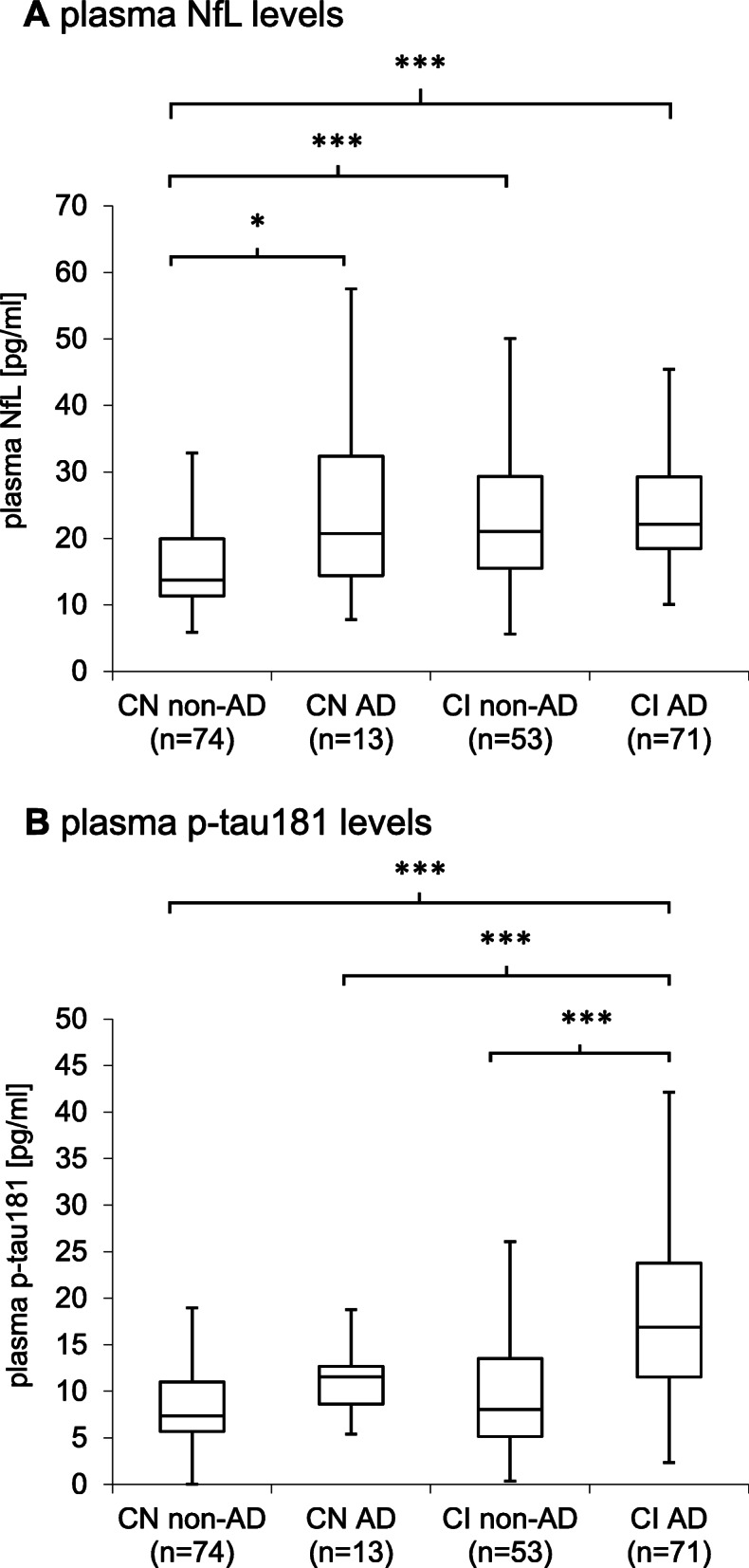
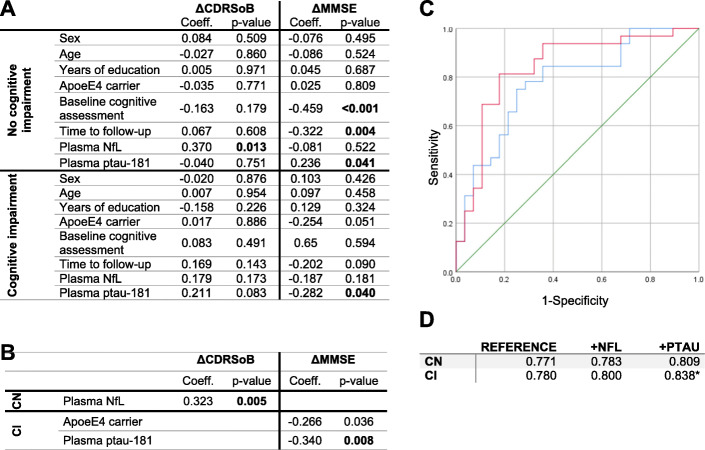
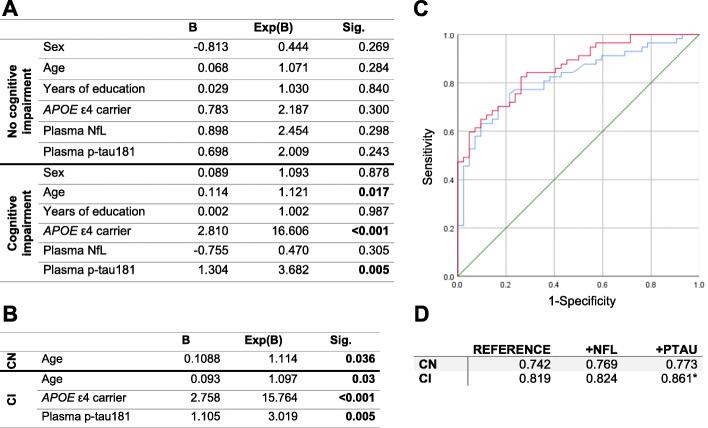
Plasma NfL levels were higher in CN participants with an AD CSF profile (defined by a CSF p-tau181/Aβ > 0.0779) as compared with CN non-AD, while p-tau181 plasma levels were higher in CI patients with AD. Plasma NfL levels correlated with CSF tau and p-tau181 in CN, and with CSF tau in CI patients. Plasma p-tau181 correlated with CSF p-tau181 in CN and with CSF tau, p-tau181, Aβ, and Aβ/Aβ in CI participants. Compared with a reference model, adding plasma p-tau181 improved the prediction of AD in CI patients while adding NfL did not. Adding p-tau181, but not NfL levels, to a reference model improved prediction of cognitive decline in CI participants.
Plasma NfL indicates neurodegeneration while plasma p-tau181 levels can serve as a biomarker of cerebral AD pathology and cognitive decline. Their predictive performance depends on the presence of cognitive impairment.
评估血浆神经丝轻链(NfL)和磷酸化 tau181(p-tau181)在告知大脑阿尔茨海默病(AD)病理学和预测记忆诊所环境中的临床进展方面的性能。
在认知正常(CN)的参与者和认知障碍(轻度认知障碍和痴呆,CI)的记忆诊所患者中测量了血浆 NfL 和 p-tau181 以及 AD 病理学的既定脑脊液(CSF)生物标志物。在纳入时以及 18 和 36 个月的随访时进行了临床和神经心理学评估。多变量分析评估了血浆 NfL 和 p-tau181 水平与 AD、单个 CSF 生物标志物、海马体积和疾病进展的临床指标的相关性。
与 CN 非 AD 相比,具有 AD CSF 特征(定义为 CSF p-tau181/Aβ>0.0779)的 CN 参与者的血浆 NfL 水平较高,而 CI 患者的 p-tau181 血浆水平较高。在 CN 中,血浆 NfL 水平与 CSF tau 和 p-tau181 相关,在 CI 患者中与 CSF tau 相关。血浆 p-tau181 在 CN 中与 CSF p-tau181 相关,在 CI 参与者中与 CSF tau、p-tau181、Aβ 和 Aβ/Aβ 相关。与参考模型相比,在 CI 患者中添加血浆 p-tau181 可改善 AD 的预测,而添加 NfL 则不能。在参考模型中添加 p-tau181 但不添加 NfL 水平可改善 CI 参与者认知能力下降的预测。
血浆 NfL 表明神经退行性变,而血浆 p-tau181 水平可以作为大脑 AD 病理学和认知衰退的生物标志物。它们的预测性能取决于认知障碍的存在。