Department of Neuroscience, Psychology, Drug Research and Child Health, University of Florence, Azienda Ospedaliero-Universitaria Careggi, Largo Brambilla, 3, 50134, Florence, Italy.
Vita-Salute San Raffaele University, Milan, Italy.
Sci Rep. 2024 May 17;14(1):11307. doi: 10.1038/s41598-024-61655-6.
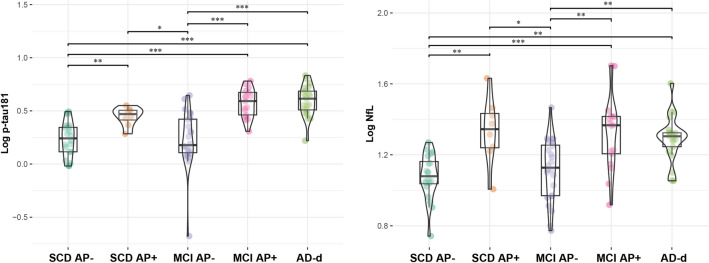
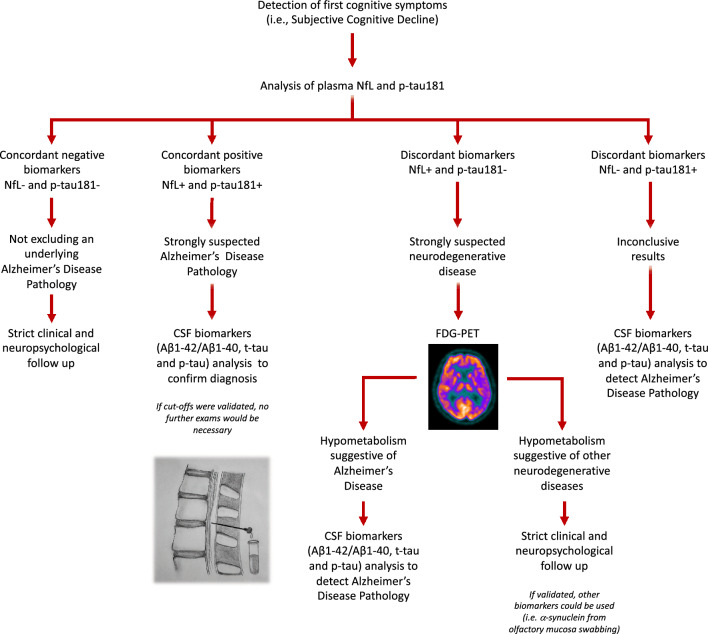
We aimed to assess diagnostic accuracy of plasma p-tau181 and NfL separately and in combination in discriminating Subjective Cognitive Decline (SCD) and Mild Cognitive Impairment (MCI) patients carrying Alzheimer's Disease (AD) pathology from non-carriers; to propose a flowchart for the interpretation of the results of plasma p-tau181 and NfL. We included 43 SCD, 41 MCI and 21 AD-demented (AD-d) patients, who underwent plasma p-tau181 and NfL analysis. Twenty-eight SCD, 41 MCI and 21 AD-d patients underwent CSF biomarkers analysis (Aβ1-42, Aβ1-42/1-40, p-tau, t-tau) and were classified as carriers of AD pathology (AP+) it they were A+/T+ , or non-carriers (AP-) when they were A-, A+/T-/N-, or A+/T-/N+ according to the A/T(N) system. Plasma p-tau181 and NfL separately showed a good accuracy (AUC = 0.88), while the combined model (NfL + p-tau181) showed an excellent accuracy (AUC = 0.92) in discriminating AP+ from AP- patients. Plasma p-tau181 and NfL results were moderately concordant (Coehn's k = 0.50, p < 0.001). Based on a logistic regression model, we estimated the risk of AD pathology considering the two biomarkers: 10.91% if both p-tau181 and NfL were negative; 41.10 and 76.49% if only one biomarker was positive (respectively p-tau18 and NfL); 94.88% if both p-tau181 and NfL were positive. Considering the moderate concordance and the risk of presenting an underlying AD pathology according to the positivity of plasma p-tau181 and NfL, we proposed a flow chart to guide the combined use of plasma p-tau181 and NfL and the interpretation of biomarker results to detect AD pathology.
我们旨在评估血浆 p-tau181 和 NfL 单独及联合区分携带阿尔茨海默病(AD)病理学的主观认知下降(SCD)和轻度认知障碍(MCI)患者与非携带者的诊断准确性;提出一种解释血浆 p-tau181 和 NfL 结果的流程图。我们纳入了 43 名 SCD、41 名 MCI 和 21 名 AD 痴呆(AD-d)患者,他们接受了血浆 p-tau181 和 NfL 分析。28 名 SCD、41 名 MCI 和 21 名 AD-d 患者接受了 CSF 生物标志物分析(Aβ1-42、Aβ1-42/1-40、p-tau、t-tau),并根据 A/T(N) 系统被分类为 AD 病理学携带者(AP+),如果他们是 A+/T+,或非携带者(AP-),如果他们是 A-、A+/T-/N-或 A+/T-/N+。血浆 p-tau181 和 NfL 单独具有良好的准确性(AUC=0.88),而联合模型(NfL+p-tau181)在区分 AP+与 AP-患者方面具有出色的准确性(AUC=0.92)。血浆 p-tau181 和 NfL 结果中度一致(Cohen's k=0.50,p<0.001)。基于逻辑回归模型,我们考虑两个生物标志物来估计 AD 病理学的风险:如果 p-tau181 和 NfL 均为阴性,则为 10.91%;如果只有一个生物标志物为阳性(分别为 p-tau181 和 NfL),则为 41.10%和 76.49%;如果 p-tau181 和 NfL 均为阳性,则为 94.88%。考虑到中度一致性以及根据血浆 p-tau181 和 NfL 的阳性率出现潜在 AD 病理学的风险,我们提出了一个流程图,以指导联合使用血浆 p-tau181 和 NfL 并解释生物标志物结果以检测 AD 病理学。