Department of Neurobiology, Harvard Medical School, Boston, MA 02115.
Center for Autoimmune Genomics and Etiology, Cincinnati Children's Hospital Medical Center, Cincinnati, OH 45229.
Proc Natl Acad Sci U S A. 2021 Mar 30;118(13). doi: 10.1073/pnas.2025530118.
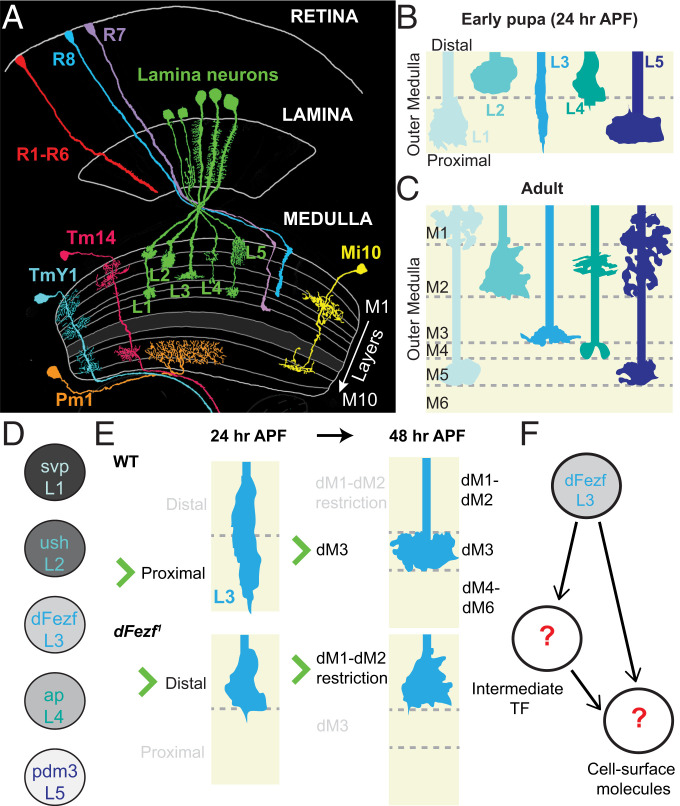
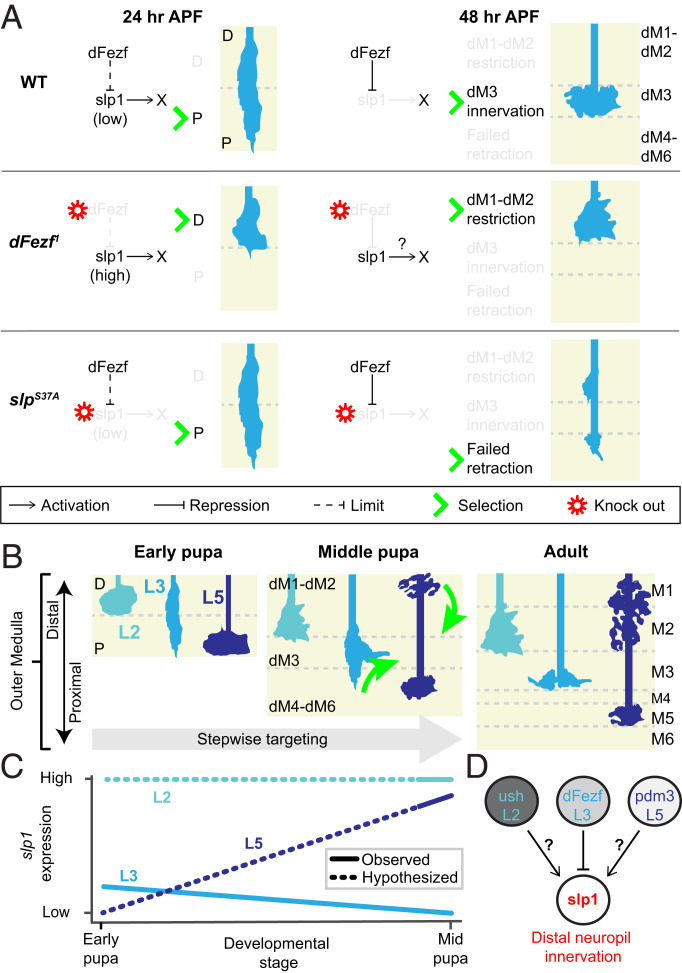
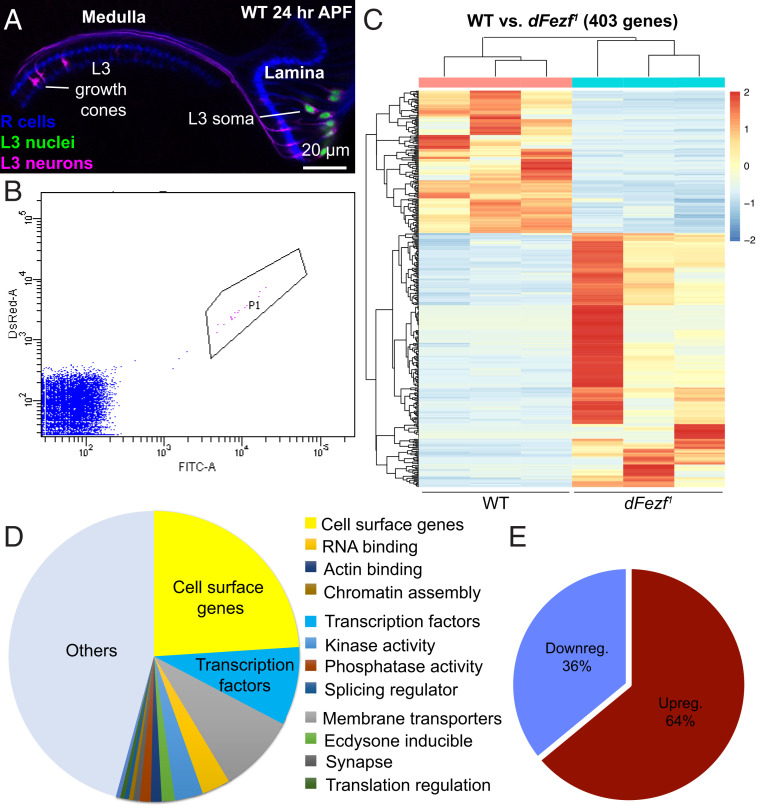
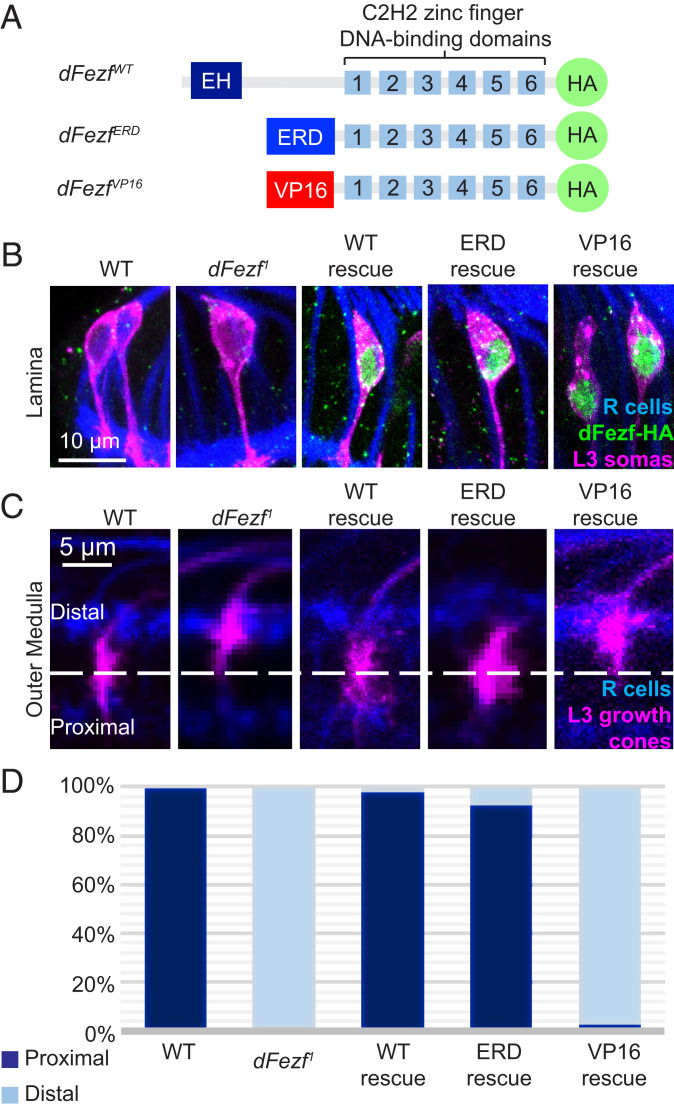
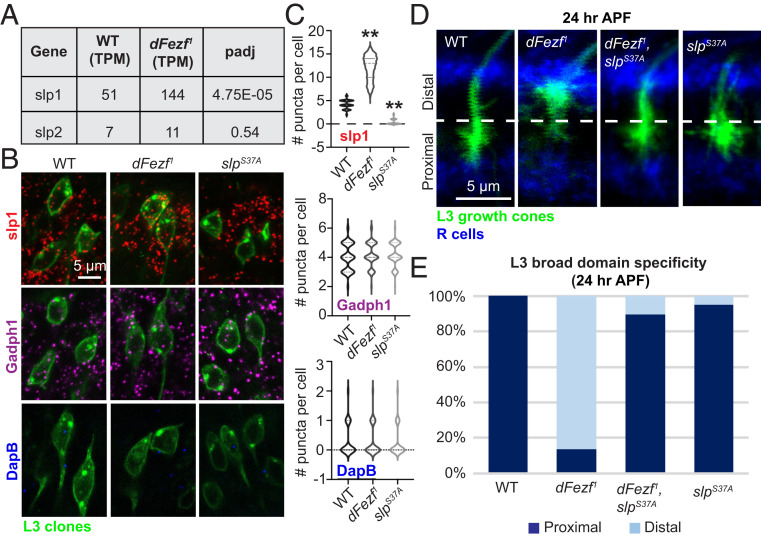
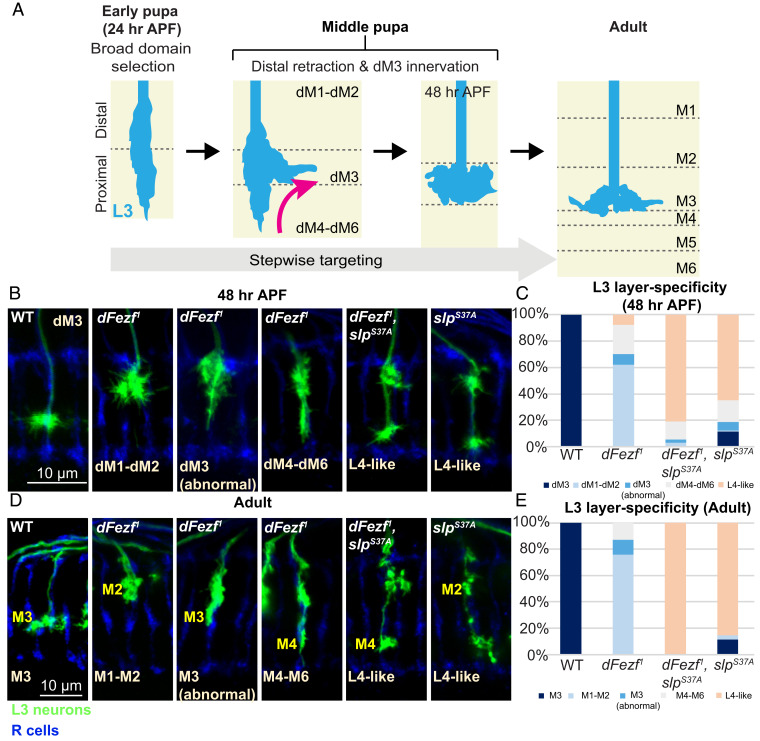
The layered compartmentalization of synaptic connections, a common feature of nervous systems, underlies proper connectivity between neurons and enables parallel processing of neural information. However, the stepwise development of layered neuronal connections is not well understood. The medulla neuropil of the visual system, which comprises 10 discrete layers (M1 to M10), where neural computations underlying distinct visual features are processed, serves as a model system for understanding layered synaptic connectivity. The first step in establishing layer-specific connectivity in the outer medulla (M1 to M6) is the innervation by lamina (L) neurons of one of two broad, primordial domains that will subsequently expand and transform into discrete layers. We previously found that the transcription factor dFezf cell-autonomously directs L3 lamina neurons to their proper primordial broad domain before they form synapses within the developing M3 layer. Here, we show that dFezf controls L3 broad domain selection through temporally precise transcriptional repression of the transcription factor (sloppy paired 1). In wild-type L3 neurons, is transiently expressed at a low level during broad domain selection. When is deleted, expression is up-regulated, and ablation of fully rescues the defect of broad domain selection in -null L3 neurons. Although the early, transient expression of is expendable for broad domain selection, it is surprisingly necessary for the subsequent L3 innervation of the M3 layer. DFezf thus functions as a transcriptional repressor to coordinate the temporal dynamics of a transcriptional cascade that orchestrates sequential steps of layer-specific synapse formation.
突触连接的分层分区是神经系统的一个共同特征,它是神经元之间正确连接的基础,并能够实现神经信息的并行处理。然而,分层神经元连接的逐步发展还不是很清楚。视觉系统的髓质神经胶,由 10 个离散的层(M1 到 M10)组成,其中处理着不同视觉特征的神经计算,它是理解分层突触连接的一个模型系统。在外髓质(M1 到 M6)建立特定于层的连接的第一步是由层(L)神经元支配两个广泛的原始域之一,这两个原始域随后会扩展并转化为离散的层。我们之前发现转录因子 dFezf 自主地将 L3 层神经元引导到它们适当的原始广泛域,然后在发育中的 M3 层内形成突触。在这里,我们表明 dFezf 通过对转录因子(疏松配对 1)的时间精确转录抑制来控制 L3 广泛域的选择。在野生型 L3 神经元中,在广泛域选择期间, 以低水平短暂表达。当 缺失时, 表达上调,并且 缺失完全挽救了 -null L3 神经元中广泛域选择的缺陷。尽管 早期、短暂的表达对于广泛域选择是可有可无的,但它对于随后 L3 对 M3 层的支配却是出乎意料的必要。因此,DFezf 作为一种转录抑制剂,协调了一个转录级联的时间动态,该级联协调了特定于层的突触形成的顺序步骤。