Vázquez-Sánchez Sara, Poveda Jonay, Navarro-García José Alberto, González-Lafuente Laura, Rodríguez-Sánchez Elena, Ruilope Luis M, Ruiz-Hurtado Gema
Cardiorenal Translational Laboratory, Institute of Research i+12, Hospital Universitario 12 de Octubre, Madrid, Spain.
CIBER-CV, Hospital Universitario 12 de Octubre, Madrid, Spain.
Front Physiol. 2021 Mar 9;12:632260. doi: 10.3389/fphys.2021.632260. eCollection 2021.
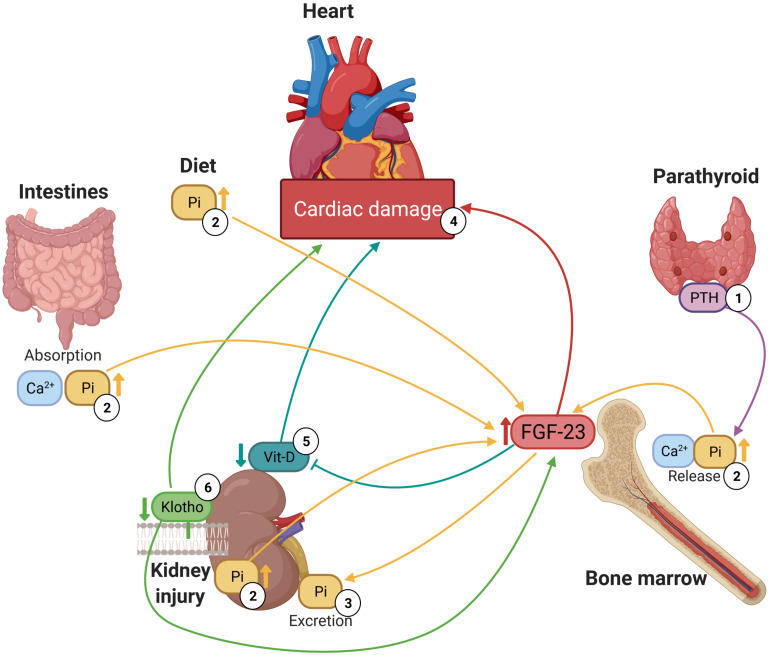
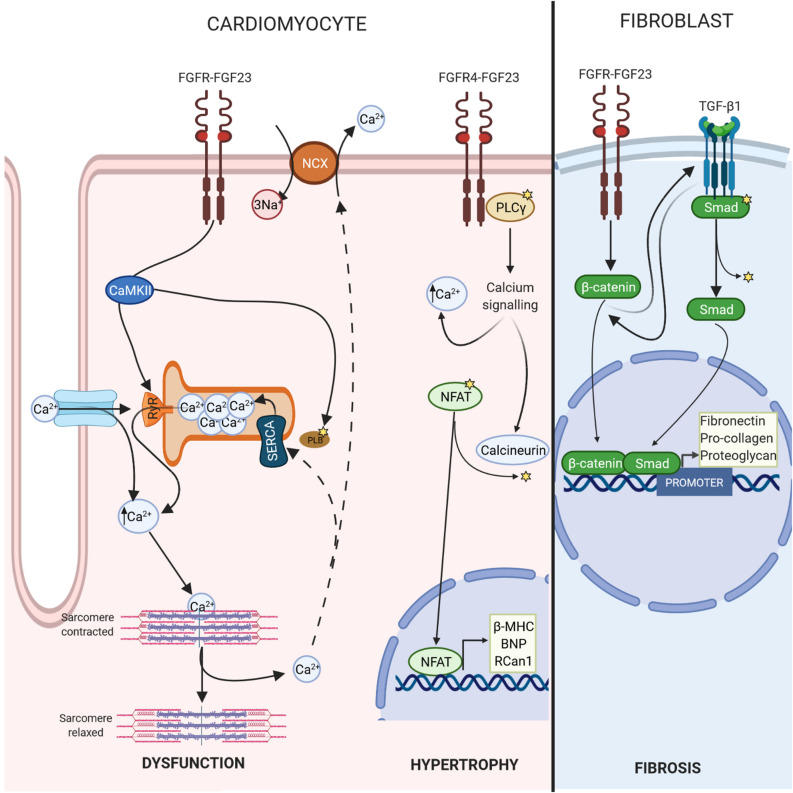
Fibroblast growth factor-23 (FGF)-23 is a phosphaturic hormone involved in mineral bone metabolism that helps control phosphate homeostasis and reduces 1,25-dihydroxyvitamin D synthesis. Recent data have highlighted the relevant direct FGF-23 effects on the myocardium, and high plasma levels of FGF-23 have been associated with adverse cardiovascular outcomes in humans, such as heart failure and arrhythmias. Therefore, FGF-23 has emerged as a novel biomarker of cardiovascular risk in the last decade. Indeed, experimental data suggest FGF-23 as a direct mediator of cardiac hypertrophy development, cardiac fibrosis and cardiac dysfunction via specific myocardial FGF receptor (FGFR) activation. Therefore, the FGF-23/FGFR pathway might be a suitable therapeutic target for reducing the deleterious effects of FGF-23 on the cardiovascular system. More research is needed to fully understand the intracellular FGF-23-dependent mechanisms, clarify the downstream pathways and identify which could be the most appropriate targets for better therapeutic intervention. This review updates the current knowledge on both clinical and experimental studies and highlights the evidence linking FGF-23 to cardiovascular events. The aim of this review is to establish the specific role of FGF-23 in the heart, its detrimental effects on cardiac tissue and the possible new therapeutic opportunities to block these effects.
成纤维细胞生长因子-23(FGF)-23是一种参与矿物质骨代谢的排磷激素,有助于控制磷酸盐稳态并减少1,25-二羟维生素D的合成。最近的数据突出了FGF-23对心肌的相关直接作用,而血浆中高浓度的FGF-23与人类不良心血管结局相关,如心力衰竭和心律失常。因此,在过去十年中,FGF-23已成为心血管风险的一种新型生物标志物。确实,实验数据表明FGF-23通过特异性心肌FGF受体(FGFR)激活,是心脏肥大发展、心脏纤维化和心脏功能障碍的直接介质。因此,FGF-23/FGFR途径可能是减轻FGF-23对心血管系统有害作用的合适治疗靶点。需要更多研究来充分了解细胞内FGF-23依赖性机制,阐明下游途径,并确定哪些可能是更好治疗干预的最合适靶点。本综述更新了关于临床和实验研究的当前知识,并突出了将FGF-23与心血管事件联系起来的证据。本综述的目的是确定FGF-23在心脏中的具体作用、其对心脏组织的有害影响以及阻断这些影响的可能新治疗机会。