Zhang Hongbin, Ma Jianfei, Liu Fei, Zhang Jun
Department of Cardiology, Cangzhou Central Hospital, Cangzhou, Hebei 061001, P.R. China.
Exp Ther Med. 2021 May;21(5):477. doi: 10.3892/etm.2021.9908. Epub 2021 Mar 12.
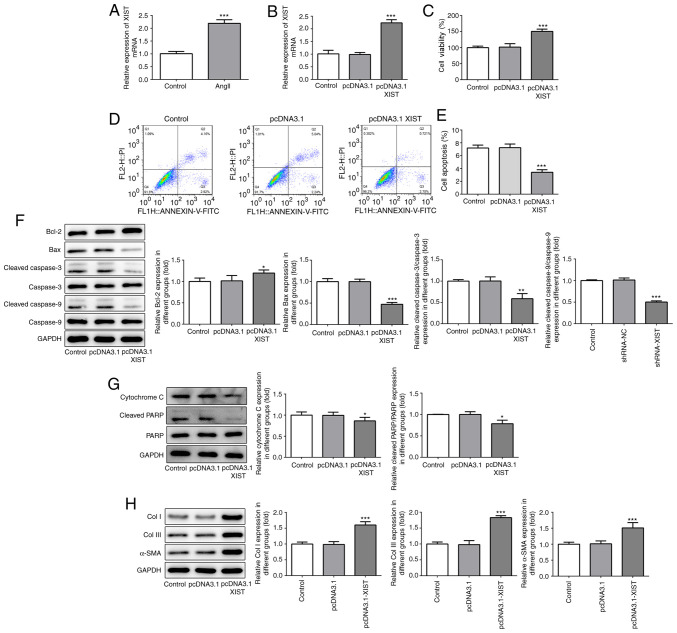
Acute myocardial infarction (AMI) is characterized by cardiomyocyte death followed by myocardial fibrosis, eventually leading to heart failure. Long non-coding (lnc)RNA X-inactive specific transcript (XIST) serves a vital role in the regulation of fibrosis. The aim of the present study was to determine whether myocardial fibrosis may be regulated by XIST and to elucidate the underlying mechanism. The relative mRNA expression levels of the target genes were evaluated using reverse transcription-quantitative polymerase chain reaction. Cell viability and apoptosis were determined using a Cell Counting Kit-8 assay and flow cytometry, respectively. The apoptosis and fibrosis-related protein expression levels were detected using western blot analysis. Finally, the interaction between XIST and microRNA (miR)-155-5p was analyzed using a luciferase reporter assay. XIST-overexpression increased proliferation and the expression level of the fibrosis-related proteins in the human cardiac fibroblast cells (HCFs). XIST directly targeted miR-155-5p and downregulated its expression, while miR-155-5p downregulation abolished the effect of XIST-silencing on cell viability and the expression level of the fibrosis-related proteins in the HCFs. XIST promoted cell proliferation and the expression level of fibrosis-related proteins by sponging miR-155-5p. Therefore, XIST may represent a novel effective target for AMI treatment.
急性心肌梗死(AMI)的特征是心肌细胞死亡,随后发生心肌纤维化,最终导致心力衰竭。长链非编码(lnc)RNA X染色体失活特异性转录本(XIST)在纤维化调节中起重要作用。本研究的目的是确定心肌纤维化是否受XIST调节,并阐明其潜在机制。使用逆转录-定量聚合酶链反应评估靶基因的相对mRNA表达水平。分别使用细胞计数试剂盒-8检测法和流式细胞术测定细胞活力和凋亡情况。使用蛋白质印迹分析检测凋亡和纤维化相关蛋白的表达水平。最后,使用荧光素酶报告基因检测法分析XIST与微小RNA(miR)-155-5p之间的相互作用。XIST过表达增加了人心脏成纤维细胞(HCFs)的增殖和纤维化相关蛋白的表达水平。XIST直接靶向miR-155-5p并下调其表达,而miR-155-5p下调消除了XIST沉默对HCFs细胞活力和纤维化相关蛋白表达水平的影响。XIST通过吸附miR-155-5p促进细胞增殖和纤维化相关蛋白的表达水平。因此,XIST可能是AMI治疗的一个新的有效靶点。