Furubayashi Nobuki, Hori Yoshifumi, Morokuma Futoshi, Tomoda Toshihisa, Negishi Takahito, Inoue Tomohiro, Kumagai Masatoshi, Kuroiwa Kentaro, Tokuda Noriaki, Nakamura Motonobu
Department of Urology, National Hospital Organization Kyushu Cancer Center, Fukuoka 811-1395, Japan.
Department of Urology, Miyazaki Prefectural Miyazaki Hospital, Miyazaki 880-8510, Japan.
Mol Clin Oncol. 2021 May;14(5):91. doi: 10.3892/mco.2021.2253. Epub 2021 Mar 8.
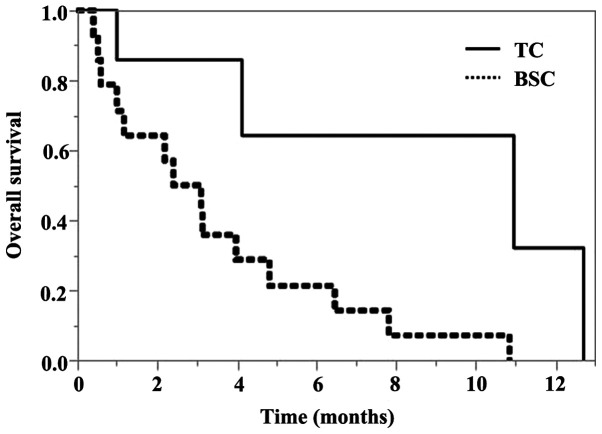
Pembrolizumab has been available for the treatment of radical resectable urothelial carcinoma (UC) when it is exacerbated after chemotherapy since December 2017 in Japan. However, the efficacy of chemotherapy for cases progressing after pembrolizumab is unclear. The present study compared the outcomes and toxicities in patients with metastatic UC after failure of platinum-based chemotherapy and pembrolizumab, who were selected to receive paclitaxel and carboplatin (TC) chemotherapy, with those in patients who received the best supportive care (BSC). A total of 36 patients received pembrolizumab for metastatic UC at four institutions between January 2018 and August 2019. Of the 21 patients who progressed after pembrolizumab, 7 received TC chemotherapy (TC group) and 14 selected BSC (BSC group). The median observation period was 4.1 months. The 7 aforementioned patients who received TC chemotherapy (4 male and 3 female; median age, 62 years; range, 57-79 years) were analyzed in the present study. The ECOG performance status was 0 in three patients, 1 in one patient, 2 in two patients and 3 in one patient. Two patients had upper urinary tract UC, two had bladder UC and three had both types of UC. Six patients had visceral metastasis. The number of chemotherapy regimens before pembrolizumab was one in four patients, two in two patients and three in one patient. The objective response rate was 28.6% (partial response, 2 patients; stable disease, 4 patients; progressive disease, 1 patient), the median progression-free survival time was 3.4 months and the median overall survival time was 10.9 months (vs. 2.7 months in BSC group; P=0.0156). Although grade ≥3 adverse events developed in five patients, there were no treatment-associated deaths. The present results suggested that TC chemotherapy may be a preferred option for patients who require aggressive treatment after the failure of platinum-based chemotherapy and pembrolizumab.
自2017年12月起,帕博利珠单抗在日本可用于治疗化疗后病情加重的根治性可切除尿路上皮癌(UC)。然而,帕博利珠单抗治疗后病情进展的病例接受化疗的疗效尚不清楚。本研究比较了铂类化疗和帕博利珠单抗治疗失败后接受紫杉醇和卡铂(TC)化疗的转移性UC患者与接受最佳支持治疗(BSC)的患者的结局和毒性。2018年1月至2019年8月期间,共有36例转移性UC患者在四个机构接受了帕博利珠单抗治疗。在21例帕博利珠单抗治疗后病情进展的患者中,7例接受了TC化疗(TC组),14例选择了BSC(BSC组)。中位观察期为4.1个月。本研究分析了上述7例接受TC化疗的患者(4例男性和3例女性;中位年龄62岁;范围57 - 79岁)。东部肿瘤协作组(ECOG)体能状态评分为0分的患者有3例,1分的患者有1例,2分的患者有2例,3分的患者有1例。2例患者为上尿路UC,2例为膀胱UC,3例为两种类型的UC均有。6例患者有内脏转移。帕博利珠单抗治疗前化疗方案的数量,4例患者为1个疗程,2例患者为2个疗程,1例患者为3个疗程。客观缓解率为28.6%(部分缓解2例;病情稳定4例;疾病进展1例),中位无进展生存期为3.4个月,中位总生存期为10.9个月(BSC组为2.7个月;P = 0.0156)。尽管5例患者发生了≥3级不良事件,但无治疗相关死亡。目前结果提示,对于铂类化疗和帕博利珠单抗治疗失败后需要积极治疗的患者,TC化疗可能是一个较好的选择。