Griepp Daniel W, Lee Jason, Moawad Christina M, Davati Cyrus, Runnels Juliana, Fiani Brian
College of Osteopathic Medicine, New York Institute of Technology, Glen Head, New York, United States.
Department of Biomedical Engineering, Carle Illinois College of Medicine, University of Illinois at Urbana Champaign, Champaign, Illinois, United States.
Surg Neurol Int. 2021 Mar 2;12:80. doi: 10.25259/SNI_933_2020. eCollection 2021.
Vasogenic edema in the setting of acute ischemic stroke can be attributed to the opening of transient receptor potential 4 channels, which are expressed in the setting of injury and regulated by sulfonylurea receptor 1 (SUR1) proteins. Glibenclamide, also known as glyburide, RP-1127, Cirara, and BIIB093, is a second-generation sulfonylurea that binds SUR1 at potassium channels and may significantly reduce cerebral edema following stroke, as evidenced by recent clinical trials. This review provides a comprehensive analysis of clinical considerations of glibenclamide use and current patient outcomes when administered in the setting of acute ischemic stroke to reduce severe edema.
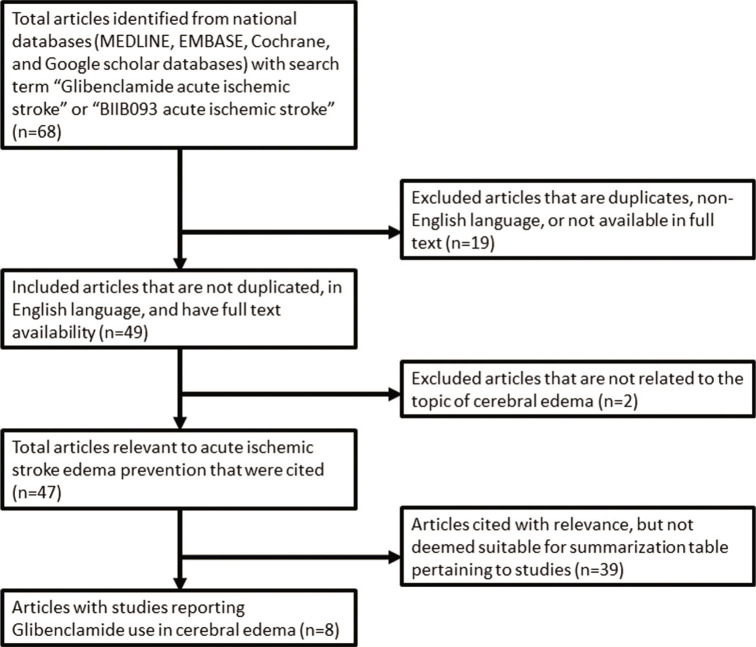
National databases (MEDLINE, EMBASE, Cochrane, and Google scholar databases) were searched to identify studies that reported on the clinical outcomes of glibenclamide administered immediately following acute ischemic stroke.
The pharmacological mechanism of glibenclamide was reviewed in depth as well as the known indications and contraindications to receiving treatment. Eight studies were identified as having meaningful clinical outcome data, finding statistically significant differences in glibenclamide treatment groups ranging from matrix metalloproteinase-9 serum levels, midline shift, modified Rankin Scores, National Institute of Health Stroke Score, and mortality endpoints.
Studies analyzing the GAMES-Pilot and GAMES-PR trials suggest that glibenclamide has a moderate, however, measurable effect on intermediate biomarkers and clinical endpoints. Meaningful conclusions are limited by the small sample size of patients studied.
急性缺血性卒中时的血管源性水肿可归因于瞬时受体电位4通道的开放,该通道在损伤时表达,并受磺脲类受体1(SUR1)蛋白调节。格列本脲,也被称为优降糖、RP - 1127、Cirara和BIIB093,是第二代磺脲类药物,它在钾通道处与SUR1结合,近期临床试验表明其可能显著减轻卒中后的脑水肿。本综述全面分析了格列本脲在急性缺血性卒中时用于减轻严重水肿的临床考量及当前患者的治疗结果。
检索国家数据库(MEDLINE、EMBASE、Cochrane和谷歌学术数据库),以识别报告急性缺血性卒中后立即给予格列本脲临床结果的研究。
深入回顾了格列本脲的药理机制以及已知的治疗适应证和禁忌证。确定了八项具有有意义临床结果数据的研究,发现格列本脲治疗组在基质金属蛋白酶 - 9血清水平、中线移位、改良Rankin评分、美国国立卫生研究院卒中量表评分和死亡率终点等方面存在统计学显著差异。
对GAMES - Pilot和GAMES - PR试验的分析研究表明,格列本脲对中间生物标志物和临床终点有适度但可测量的影响。有意义的结论因所研究患者样本量小而受限。