Leibniz Institute of Plant Genetics and Crop Plant Research (IPK), 06466, Gatersleben, Germany.
Department of Crop Sciences, Center for Integrated Breeding Research (CiBreed), Georg-August-University, Göttingen, Germany.
Theor Appl Genet. 2021 Jul;134(7):2181-2196. doi: 10.1007/s00122-021-03815-0. Epub 2021 Mar 25.
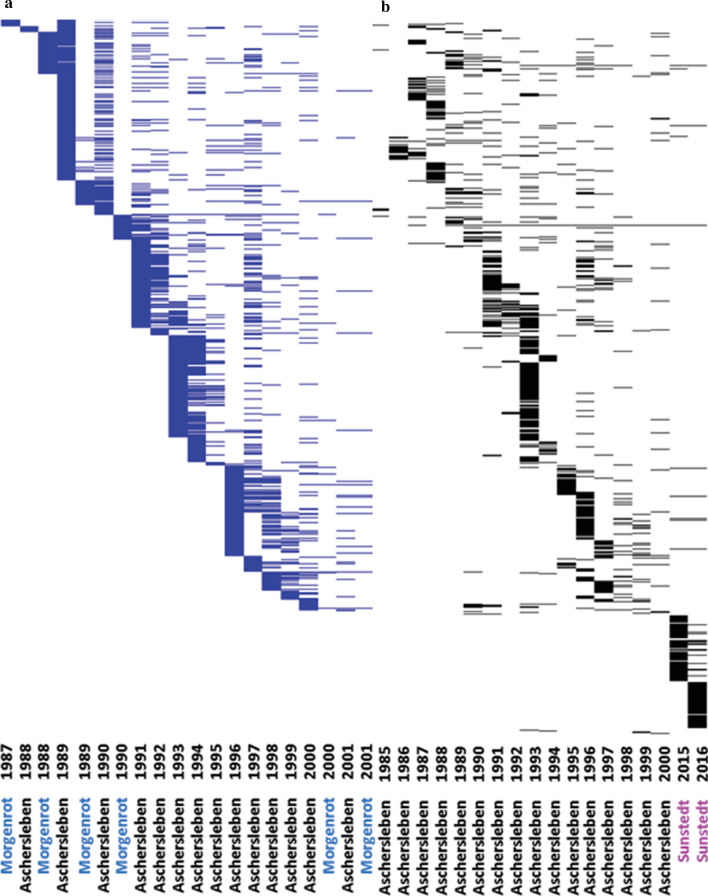
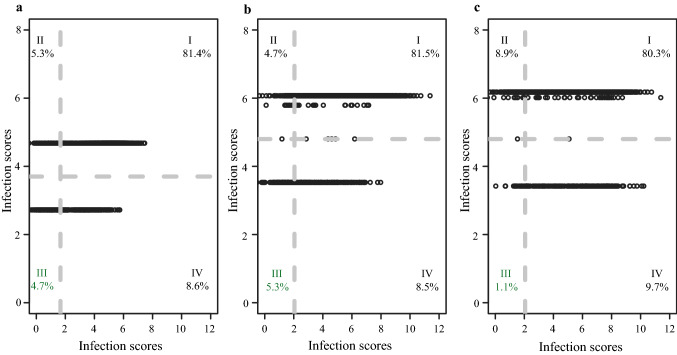
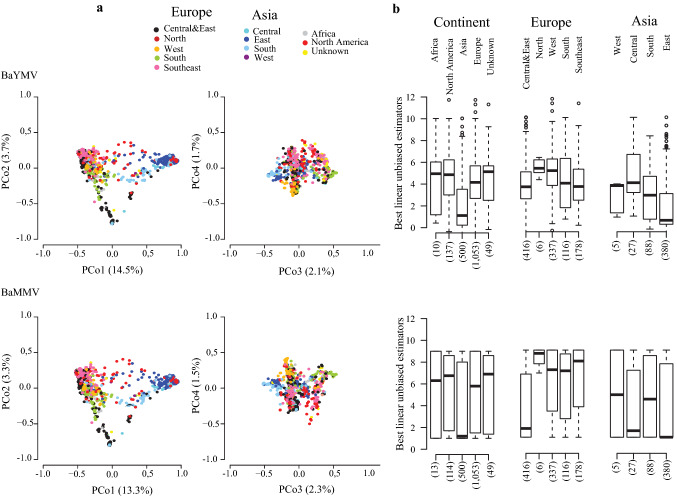
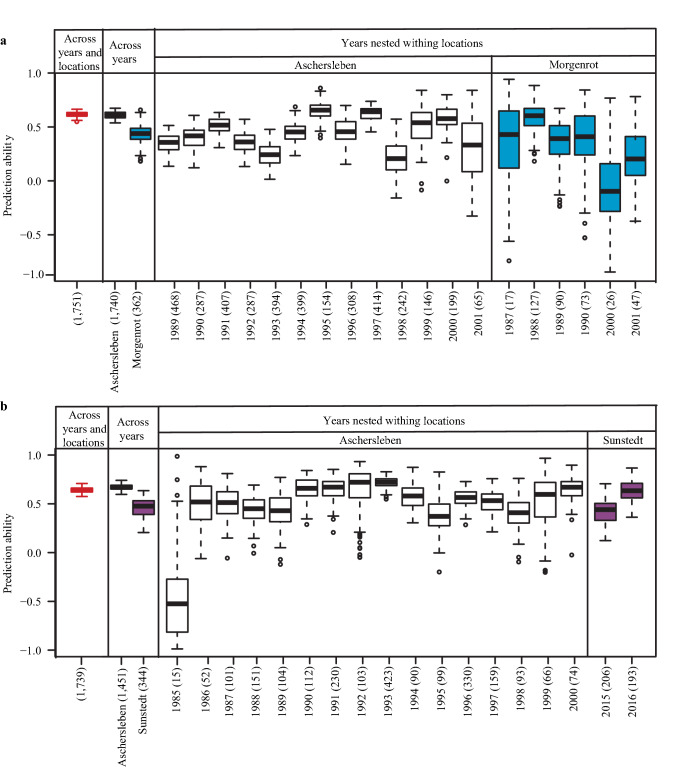
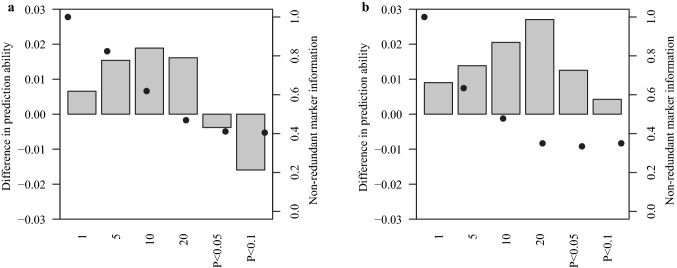
Genomic prediction with special weight of major genes is a valuable tool to populate bio-digital resource centers. Phenotypic information of crop genetic resources is a prerequisite for an informed selection that aims to broaden the genetic base of the elite breeding pools. We investigated the potential of genomic prediction based on historical screening data of plant responses against the Barley yellow mosaic viruses for populating the bio-digital resource center of barley. Our study includes dense marker data for 3838 accessions of winter barley, and historical screening data of 1751 accessions for Barley yellow mosaic virus (BaYMV) and of 1771 accessions for Barley mild mosaic virus (BaMMV). Linear mixed models were fitted by considering combinations for the effects of genotypes, years, and locations. The best linear unbiased estimations displayed a broad spectrum of plant responses against BaYMV and BaMMV. Prediction abilities, computed as correlations between predictions and observed phenotypes of accessions, were low for the marker-assisted selection approach amounting to 0.42. In contrast, prediction abilities of genomic best linear unbiased predictions were high, with values of 0.62 for BaYMV and 0.64 for BaMMV. Prediction abilities of genomic prediction were improved by up to ~ 5% using W-BLUP, in which more weight is given to markers with significant major effects found by association mapping. Our results outline the utility of historical screening data and W-BLUP model to predict the performance of the non-phenotyped individuals in genebank collections. The presented strategy can be considered as part of the different approaches used in genebank genomics to valorize genetic resources for their usage in disease resistance breeding and research.
利用主基因特殊权重进行基因组预测是充实生物数字资源中心的有价值工具。作物遗传资源的表型信息是明智选择的前提,其目的是拓宽精英育种群体的遗传基础。我们研究了基于植物对大麦黄花叶病毒反应的历史筛选数据进行基因组预测,以充实大麦生物数字资源中心的潜力。我们的研究包括 3838 个冬大麦品系的密集标记数据,以及 1751 个品系的大麦黄花叶病毒(BaYMV)和 1771 个品系的大麦温和花叶病毒(BaMMV)的历史筛选数据。通过考虑基因型、年份和地点组合,对线性混合模型进行拟合。最佳线性无偏估计显示了对 BaYMV 和 BaMMV 的广泛植物反应谱。预测能力,以访问个体的预测与观察表型之间的相关性来计算,对于标记辅助选择方法来说很低,为 0.42。相比之下,基因组最佳线性无偏预测的预测能力很高,BaYMV 为 0.62,BaMMV 为 0.64。通过使用 W-BLUP 最多可将基因组预测的预测能力提高 5%,其中对关联作图发现的具有显著主效应的标记赋予更多权重。我们的结果概述了历史筛选数据和 W-BLUP 模型在预测基因库中未表型个体表现方面的用途。所提出的策略可以被视为基因库基因组学中用于疾病抗性育种和研究的不同方法之一,以利用遗传资源。