Antoniewicz Justyna, Jakubczyk Karolina, Kupnicka Patrycja, Bosiacki Mateusz, Chlubek Dariusz, Janda Katarzyna
Department of Human Nutrition and Metabolomics, Pomeranian Medical University in Szczecin, 24 Broniewskiego Street, 71-460, Szczecin, Poland.
Department of Biochemistry and Medical Chemistry, Pomeranian Medical University in Szczecin, 72 Powstańców Wlkp. Street, 70-111, Szczecin, Poland.
Biol Trace Elem Res. 2022 Feb;200(2):910-919. doi: 10.1007/s12011-021-02671-9. Epub 2021 Mar 25.
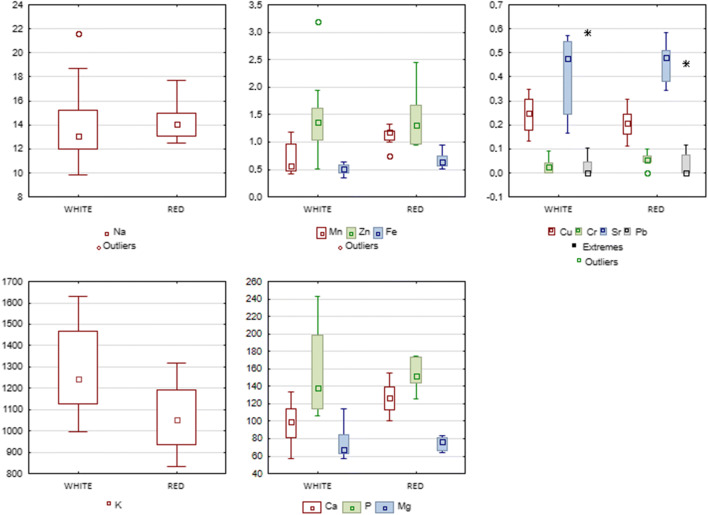
Fruit vinegars are widely used as a spice and food preservative. They are considered as functional food, containing many bioactive compounds with pro-health benefits. Grape vinegars can be also a source of mineral compounds. Their quantity and diversity can be determined by environmental factors and growing conditions, such as temperature, mineral composition of the soil, heavy metal contamination, sunlight availability as well as grape variety and fruit ripeness stage. The aim of the study was to determine the content of minerals in homemade grape vinegars, obtained by spontaneous fermentation. Five different grape (Vitis vinifera L.) varieties were used in the study (Cabernet Cortis, Johanniter, Solaris, Souvignier gris and Prior). Moreover, the effect of sugar addition in the fermentation process on the mineral content was examined. The mineral content was determined using the ICP-OES method. Among the analysed samples, potassium was the most abundant element (936.07-1472.3 mg/L of vinegar). Comparative analysis showed that the content of Ca, Fe and Cr was significantly higher in vinegars prepared from red varieties than in white-coloured ones. In turn, vinegars prepared from white grape varieties contained statistically significantly higher content of potassium. Vinegar colour did not have a significant influence on the content of the remaining elements included in the analysis. Furthermore, statistical analysis did not reveal any significant differences in the content of the analysed minerals in any of the grape varieties used between the samples with and without sugar addition.
果醋被广泛用作香料和食品防腐剂。它们被视为功能性食品,含有许多具有促进健康益处的生物活性化合物。葡萄醋也可以是矿物质化合物的来源。其含量和多样性可由环境因素和生长条件决定,如温度、土壤矿物质组成、重金属污染、阳光可利用性以及葡萄品种和果实成熟阶段。本研究的目的是测定通过自然发酵获得的自制葡萄醋中的矿物质含量。研究中使用了五个不同的葡萄(欧亚种葡萄)品种(赤霞珠、约翰内斯堡、索拉里斯、灰苏维翁和普里奥)。此外,还研究了发酵过程中添加糖对矿物质含量的影响。矿物质含量采用电感耦合等离子体发射光谱法(ICP - OES)测定。在所分析的样品中,钾是含量最丰富的元素(每升醋中含936.07 - 1472.3毫克)。对比分析表明,红葡萄品种制成的醋中钙、铁和铬的含量显著高于白葡萄品种制成的醋。反之,白葡萄品种制成的醋中钾的含量在统计学上显著更高。醋的颜色对分析中包含的其他元素的含量没有显著影响。此外,统计分析未发现添加糖和未添加糖的样品在所使用的任何葡萄品种中分析的矿物质含量有任何显著差异。