Stamp Elizabeth, Schofield Holly, Roberts Victoria Laurina, Burton Wendy, Collinson Michelle, Stevens June, Farrin Amanda, Rutter Harry, Bryant Maria
School of Sport, Exercise and Health Sciences, Loughborough University, Loughborough, LE11 3TU, UK.
Clinical Trials Research Unit, Leeds Institute of Clinical Trials Research, University of Leeds, Leeds, LS2 9JT, UK.
Pilot Feasibility Stud. 2021 Mar 26;7(1):88. doi: 10.1186/s40814-021-00805-3.
Contamination occurs when participants allocated to trial control arms receive elements of the active intervention. Randomisation at cluster level, rather than individual level, may reduce or eliminate contamination, avoiding the dilution of intervention effectiveness that it may cause. However, cluster randomisation can result in selection bias and may not be feasible to deliver. We explored the extent of contamination in a qualitative study nested within a feasibility study of HENRY (Health, Exercise and Nutrition for the Really Young); a UK community-based child obesity prevention programme. We aimed to determine the nature and impact of contamination to inform a larger planned trial and other trials in community based public health settings.
We invited participants to take part in the nested qualitative study who were already involved in the HENRY feasibility study. Semi-structured interviews/focus groups were conducted with children's centre managers (n=7), children's centre staff (n=15), and parents (n=29). Data were transcribed and analysed using an integrative approach. First, deductively organised using a framework guided by the topic guide and then organised using inductive thematic analysis.
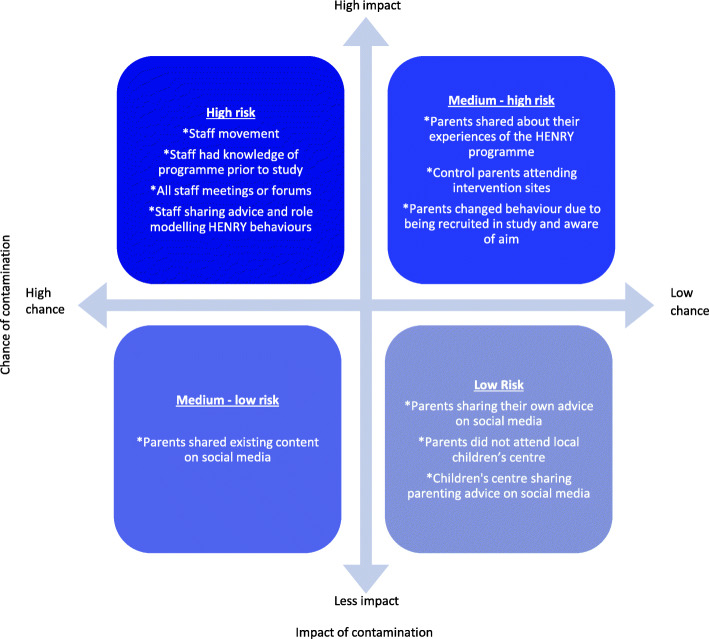
Potential for contamination between treatment arms was recognised by all stakeholder groups. Staff within the intervention centres presented the greatest risk of contamination, predominantly because they were often asked to work in other children centre's (including control group centres). 'Sharing of best practice' by staff was reported to be a common and desirable phenomenon within community based settings. Parental sharing of HENRY messages was reported inconsistently; though some parents indicated a high degree of knowledge transfer within their immediate circles.
The extent of contamination identified has influenced the design of a future effectiveness trial of HENRY which will be clustered at the centre level (with geographically distinct clusters). The common practice of knowledge sharing amongst community teams means that this clustering approach is also likely to be most suitable for other trials based within these settings. We provide recommendations (e.g. cluster randomisation, training intervention facilitators on implications of contamination) to help reduce the impact of contamination in public health intervention trials with or without clustering, whilst enabling transfer of knowledge where appropriate.
ClinicalTrials.gov Identifier NCT03333733 registered 6th November 2017.
当被分配到试验对照组的参与者接受了积极干预的某些要素时,就会发生污染。在群组层面而非个体层面进行随机分组,可能会减少或消除污染,避免其可能导致的干预效果稀释。然而,群组随机化可能会导致选择偏倚,并且实施起来可能不可行。我们在一项嵌套于HENRY(针对幼儿的健康、运动与营养)可行性研究中的定性研究中,探讨了污染的程度;HENRY是一项英国基于社区的儿童肥胖预防项目。我们旨在确定污染的性质和影响,为一项更大规模的计划试验以及其他基于社区的公共卫生环境中的试验提供信息。
我们邀请了已经参与HENRY可行性研究的参与者参加这项嵌套的定性研究。对儿童中心经理(n = 7)、儿童中心工作人员(n = 15)和家长(n = 29)进行了半结构化访谈/焦点小组讨论。数据进行了转录,并采用综合方法进行分析。首先,根据主题指南指导的框架进行演绎组织,然后采用归纳主题分析进行组织。
所有利益相关者群体都认识到治疗组之间存在污染的可能性。干预中心的工作人员造成污染的风险最大,主要是因为他们经常被要求在其他儿童中心(包括对照组中心)工作。据报告,工作人员“分享最佳实践”在基于社区的环境中是一种常见且可取的现象。家长对HENRY信息的分享情况不一;尽管一些家长表示在其直接圈子内有高度的知识传播。
所确定的污染程度影响了HENRY未来有效性试验的设计,该试验将在中心层面进行群组随机化(群组在地理上相互独立)。社区团队中知识共享的普遍做法意味着这种群组随机化方法也可能最适用于基于这些环境的其他试验。我们提供了一些建议(例如,群组随机化、对干预促进者进行关于污染影响的培训),以帮助减少公共卫生干预试验中无论是否进行群组随机化时污染的影响,同时在适当情况下促进知识的传播。
ClinicalTrials.gov标识符NCT03333733,于2017年11月6日注册。