Division of Neuroimaging Research, Barrow Neurological Institute, Phoenix, AZ, 85013, USA.
Muhammad Ali Parkinson Center, Barrow Neurological Institute, Phoenix, AZ, 85013, USA.
Sci Rep. 2021 Mar 26;11(1):6990. doi: 10.1038/s41598-021-86505-7.
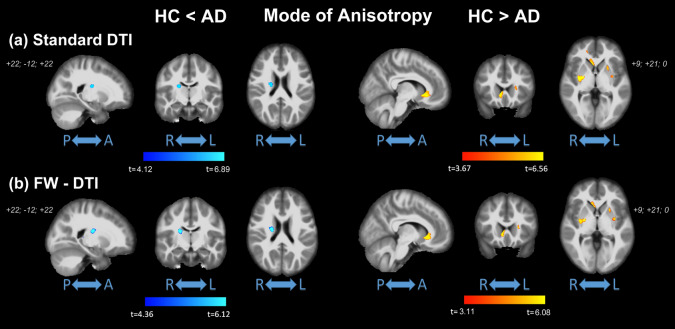
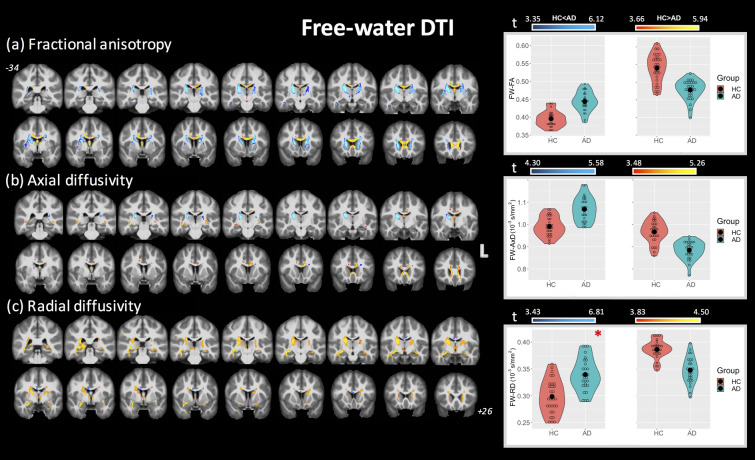
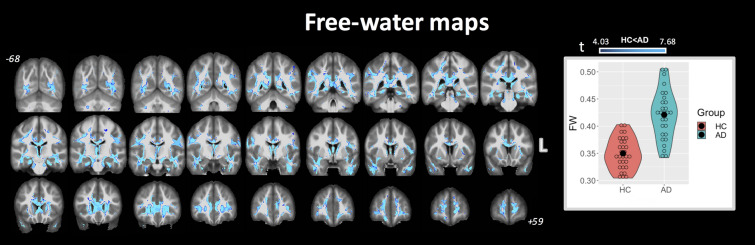
Magnetic resonance imaging (MRI) based diffusion tensor imaging (DTI) can assess white matter (WM) integrity through several metrics, such as fractional anisotropy (FA), axial/radial diffusivities (AxD/RD), and mode of anisotropy (MA). Standard DTI is susceptible to the effects of extracellular free water (FW), which can be removed using an advanced free-water DTI (FW-DTI) model. The purpose of this study was to compare standard and FW-DTI metrics in the context of Alzheimer's disease (AD). Data were obtained from the Open Access Series of Imaging Studies (OASIS-3) database and included both healthy controls (HC) and mild-to-moderate AD. With both standard and FW-DTI, decreased FA was found in AD, mainly in the corpus callosum and fornix, consistent with neurodegenerative mechanisms. Widespread higher AxD and RD were observed with standard DTI; however, the FW index, indicative of AD-associated neurodegeneration, was significantly elevated in these regions in AD, highlighting the potential impact of free water contributions on standard DTI in neurodegenerative pathologies. Using FW-DTI, improved consistency was observed in FA, AxD, and RD, and the complementary FW index was higher in the AD group as expected. With both standard and FW-DTI, higher values of MA coupled with higher values of FA in AD were found in the anterior thalamic radiation and cortico-spinal tract, most likely arising from a loss of crossing fibers. In conclusion, FW-DTI better reflects the underlying pathology of AD and improves the accuracy of DTI metrics related to WM integrity in Alzheimer's disease.
磁共振成像(MRI)基于扩散张量成像(DTI)可以通过多个指标评估白质(WM)的完整性,例如分数各向异性(FA)、轴向/径向扩散系数(AxD/RD)和各向异性模式(MA)。标准 DTI 易受细胞外游离水(FW)的影响,可以使用先进的游离水 DTI(FW-DTI)模型去除。本研究旨在比较 AD 背景下的标准和 FW-DTI 指标。数据来自开放获取成像研究系列(OASIS-3)数据库,包括健康对照组(HC)和轻度至中度 AD 患者。在标准和 FW-DTI 中,AD 患者的 FA 值降低,主要在胼胝体和穹窿,与神经退行性机制一致。标准 DTI 观察到广泛的 AxD 和 RD 升高;然而,FW 指数,表明 AD 相关的神经退行性变,在 AD 患者的这些区域显著升高,突出了游离水对神经退行性病变标准 DTI 的潜在影响。使用 FW-DTI,FA、AxD 和 RD 的一致性得到改善,FW 指数在 AD 组中预期更高。在标准和 FW-DTI 中,AD 患者的前丘脑辐射和皮质脊髓束中发现 FA 升高的同时 MA 值更高,很可能是由于交叉纤维丢失所致。总之,FW-DTI 更好地反映了 AD 的潜在病理学,并提高了与 AD 患者 WM 完整性相关的 DTI 指标的准确性。