Division of Genetics and Genomics, The Manton Center for Orphan Disease Research, Boston Children's Hospital, and Department of Pediatrics, Harvard Medical School, Boston, MA, USA.
Division of Newborn Medicine, Department of Pediatrics, Boston Children's Hospital and Harvard Medical School, Boston, MA, USA.
Genet Med. 2021 Jul;23(7):1372-1375. doi: 10.1038/s41436-021-01146-5. Epub 2021 Mar 26.
Newborn screening (NBS) is performed to identify neonates at risk for actionable, severe, early-onset disorders, many of which are genetic. The BabySeq Project randomized neonates to receive conventional NBS or NBS plus exome sequencing (ES) capable of detecting sequence variants that may also diagnose monogenic disease or indicate genetic disease risk. We therefore evaluated how ES and conventional NBS results differ in this population.
We compared results of NBS (including hearing screens) and ES for 159 infants in the BabySeq Project. Infants were considered "NBS positive" if any abnormal result was found indicating disease risk and "ES positive" if ES identified a monogenic disease risk or a genetic diagnosis.
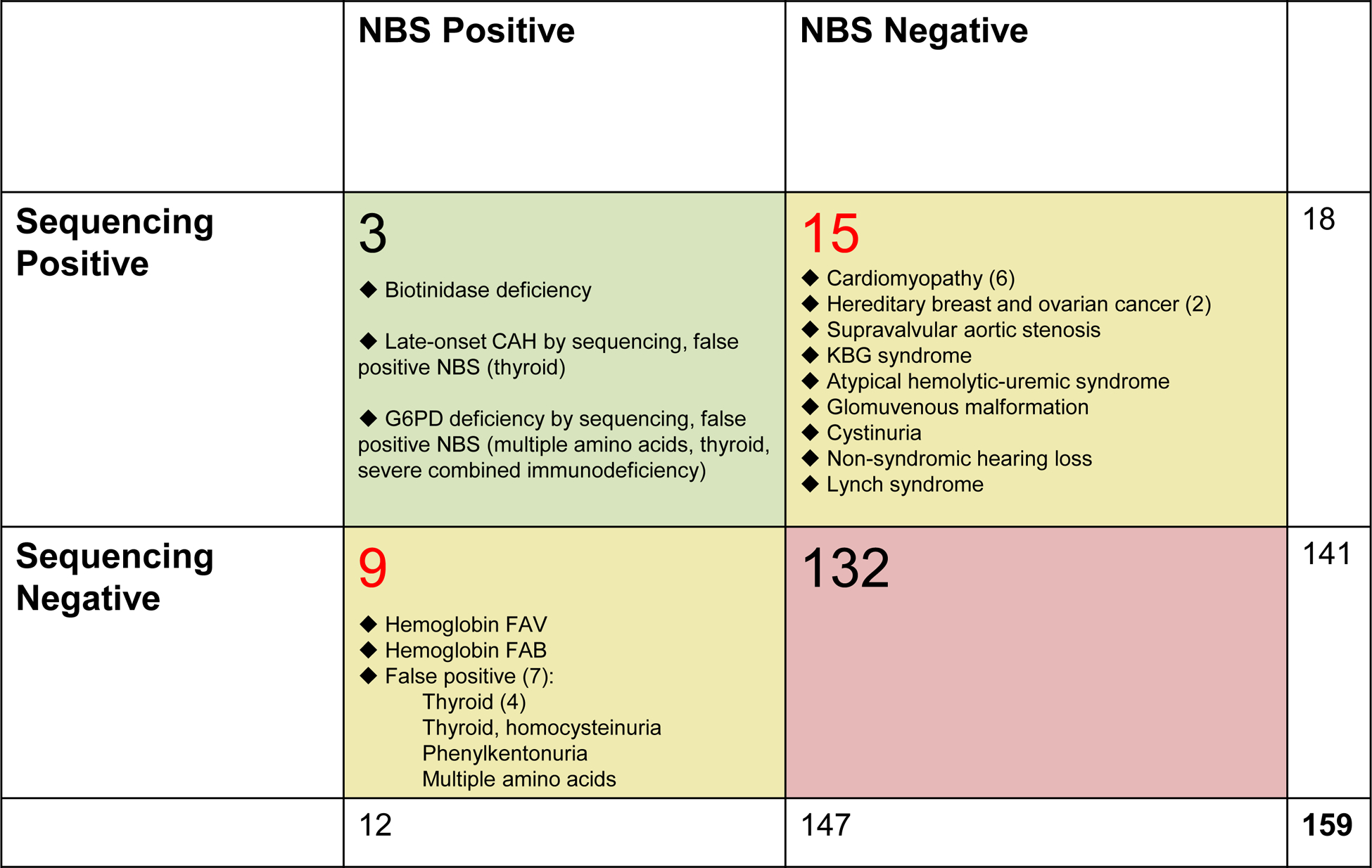
Most infants (132/159, 84%) were NBS and ES negative. Only one infant was positive for the same disorder by both modalities. Nine infants were NBS positive/ES negative, though seven of these were subsequently determined to be false positives. Fifteen infants were ES positive/NBS negative, all of which represented risk of genetic conditions that are not included in NBS programs. No genetic explanation was identified for eight infants referred on the hearing screen.
These differences highlight the complementarity of information that may be gleaned from NBS and ES in the newborn period.
新生儿筛查(NBS)用于识别有风险的新生儿,这些新生儿患有可治疗的严重早发性疾病,其中许多是遗传性的。BabySeq 项目将新生儿随机分为接受常规 NBS 或 NBS 加外显子组测序(ES),后者能够检测可能诊断单基因疾病或指示遗传疾病风险的序列变异。因此,我们评估了 ES 和常规 NBS 在该人群中的结果有何不同。
我们比较了 159 名参与 BabySeq 项目的婴儿的 NBS(包括听力筛查)和 ES 结果。如果任何异常结果表明存在疾病风险,则将婴儿视为“NBS 阳性”,如果 ES 确定存在单基因疾病风险或遗传诊断,则将婴儿视为“ES 阳性”。
大多数婴儿(132/159,84%)NBS 和 ES 均为阴性。只有一名婴儿同时通过两种方式检测出同一疾病。9 名婴儿 NBS 阳性/ES 阴性,但其中 7 名被确定为假阳性。15 名婴儿 ES 阳性/NBS 阴性,均代表不包括在 NBS 计划中的遗传状况的风险。在听力筛查中,有 8 名婴儿被转诊,但没有确定遗传原因。
这些差异突出了新生儿期从 NBS 和 ES 中获取的信息的互补性。