I. Department of Medicine, University Medical Center Hamburg-Eppendorf, Hamburg 20246 Germany.
I. Department of Medicine, University Medical Center Hamburg-Eppendorf, Hamburg 20246 Germany; Bioinformatics Core, University Medical Center Hamburg-Eppendorf, Hamburg 20246 Germany.
J Hepatol. 2021 Aug;75(2):414-423. doi: 10.1016/j.jhep.2021.03.016. Epub 2021 Mar 24.
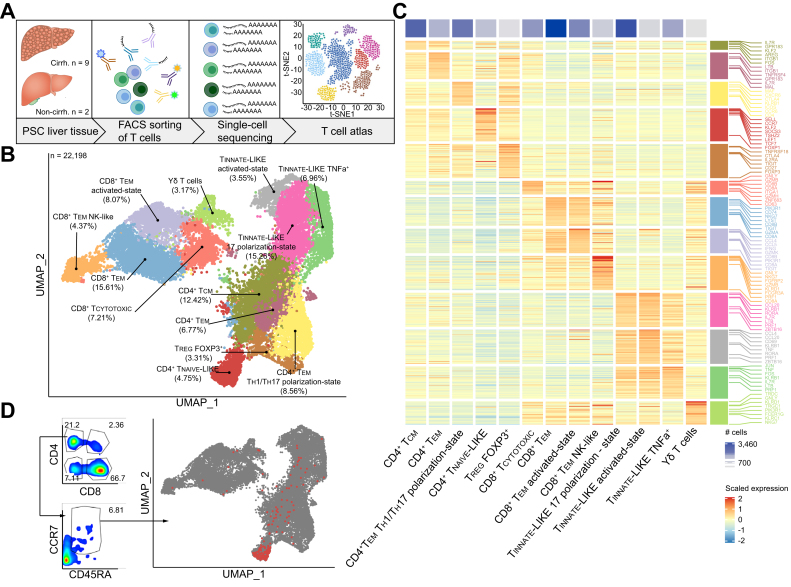
BACKGROUND & AIMS: Little is known about the composition of intrahepatic immune cells and their contribution to the pathogenesis of primary sclerosing cholangitis (PSC). Herein, we aimed to create an atlas of intrahepatic T cells and thereby perform an in-depth characterization of T cells in inflamed human liver.
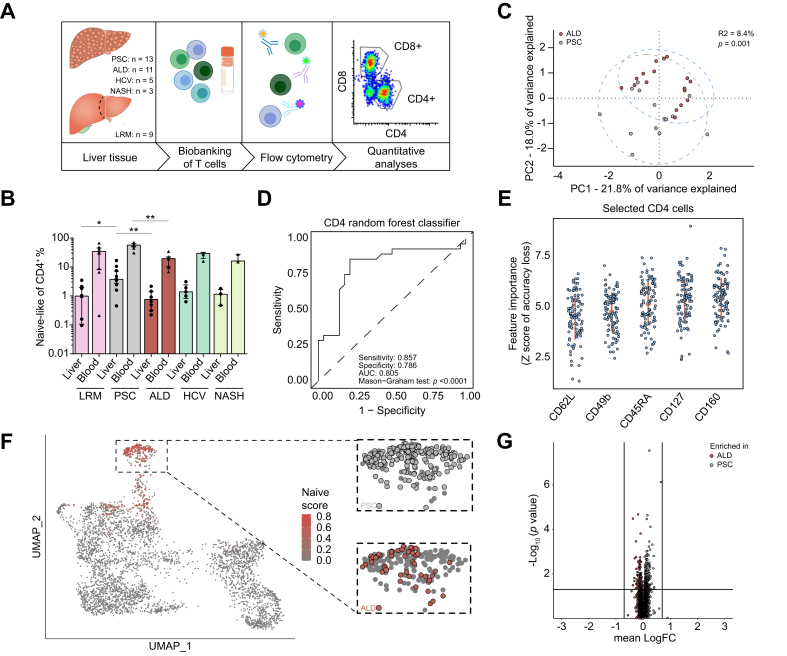
Different single-cell RNA sequencing methods were combined with in silico analyses on intrahepatic and peripheral T cells from patients with PSC (n = 11) and healthy donors (HDs, n = 4). Multi-parameter flow cytometry and functional in vitro experiments were conducted on samples from patients with PSC (n = 24), controls with other liver diseases and HDs.
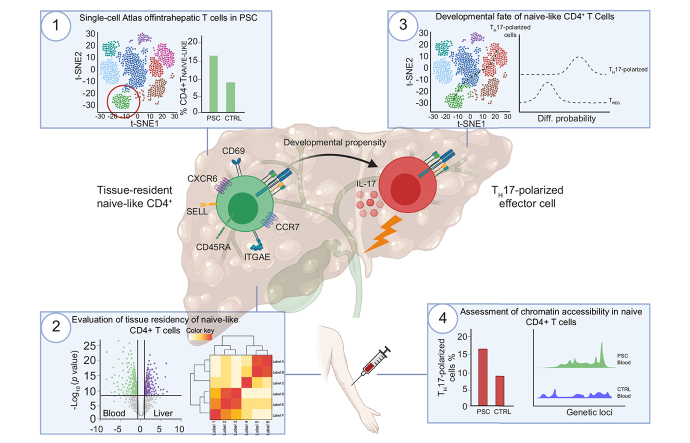
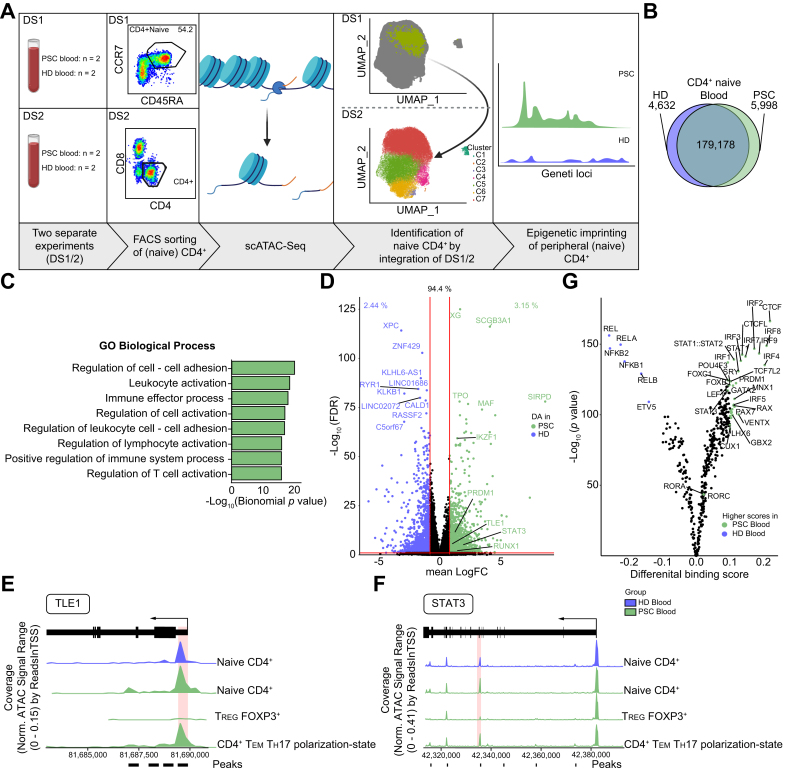
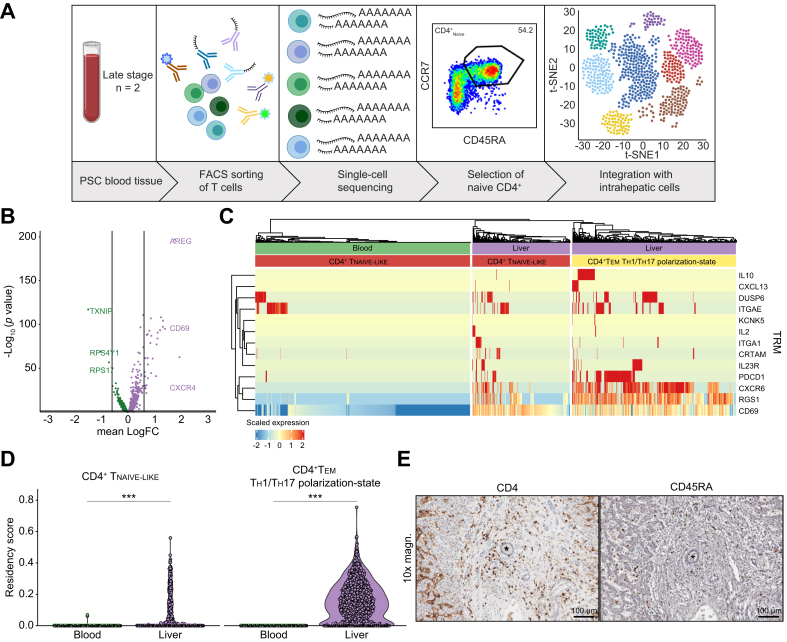
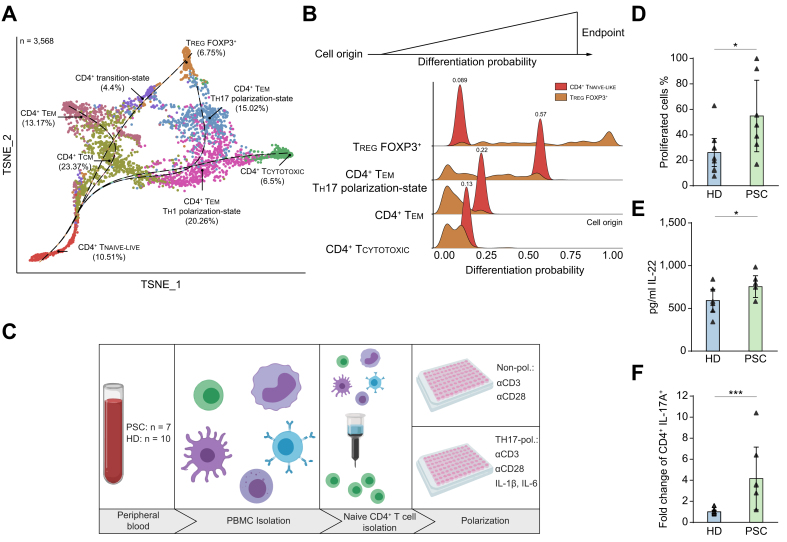
We identified a population of intrahepatic naive-like CD4 T cells, which was present in all liver diseases tested, but particularly expanded in PSC. This population had a transcriptome and T cell receptor repertoire similar to circulating naive T cells but expressed a set of genes associated with tissue residency. Their periductal location supported the concept of tissue-resident naive-like T cells in livers of patients with PSC. Trajectory inference suggested that these cells had the developmental propensity to acquire a T helper 17 (T17) polarization state. Functional and chromatin accessibility experiments revealed that circulating naive T cells in patients with PSC were predisposed to polarize towards T17 cells.
We report the first atlas of intrahepatic T cells in PSC, which led to the identification of a previously unrecognized population of tissue-resident naive-like T cells in the inflamed human liver and to the finding that naive CD4 T cells in PSC harbour the propensity to develop into T17 cells.
The composition of intrahepatic immune cells in primary sclerosing cholangitis (PSC) and their contribution to disease pathogenesis is widely unknown. We analysed intrahepatic T cells and identified a previously uncharacterized population of liver-resident CD4 T cells which are expanded in the livers of patients with PSC compared to healthy liver tissue and other liver diseases. These cells are likely to contribute to the pathogenesis of PSC and could be targeted in novel therapeutic approaches.
对于肝内免疫细胞的组成及其在原发性硬化性胆管炎(PSC)发病机制中的作用知之甚少。在此,我们旨在创建肝内 T 细胞图谱,从而深入分析炎症性人类肝脏中的 T 细胞。
我们结合了不同的单细胞 RNA 测序方法,并对来自 PSC 患者(n=11)和健康供体(HD,n=4)的肝内和外周 T 细胞进行了计算机分析。我们对来自 PSC 患者(n=24)、其他肝病患者和 HD 的样本进行了多参数流式细胞术和功能体外实验。
我们鉴定了一群肝内初始样 CD4 T 细胞,该细胞存在于所有测试的肝脏疾病中,但在 PSC 中特别扩增。该细胞群具有与循环初始 T 细胞相似的转录组和 T 细胞受体库,但表达了一组与组织驻留相关的基因。它们位于胆管周围的位置支持 PSC 患者肝脏中存在组织驻留初始样 T 细胞的概念。轨迹推断表明,这些细胞具有获得 T 辅助 17(T17)极化状态的发育倾向。功能和染色质可及性实验表明,PSC 患者的循环初始 T 细胞倾向于向 T17 细胞极化。
我们报告了 PSC 中肝内 T 细胞的首个图谱,该图谱导致鉴定出了在炎症性人类肝脏中以前未被识别的组织驻留初始样 T 细胞群,并发现 PSC 中的初始 CD4 T 细胞具有发展为 T17 细胞的倾向。
原发性硬化性胆管炎(PSC)肝内免疫细胞的组成及其对疾病发病机制的贡献尚不清楚。我们分析了肝内 T 细胞,鉴定了一群以前未被描述的肝驻留 CD4 T 细胞,与健康肝组织和其他肝病相比,这些细胞在 PSC 患者的肝脏中扩增。这些细胞可能有助于 PSC 的发病机制,并且可以作为新型治疗方法的靶点。