Department of Pathobiology & Diagnostic Investigation, Michigan State University, East Lansing, MI, USA.
Institute for Integrative Toxicology, Michigan State University, East Lansing, MI, USA.
J Thromb Haemost. 2021 Jun;19(6):1390-1408. doi: 10.1111/jth.15312. Epub 2021 May 3.
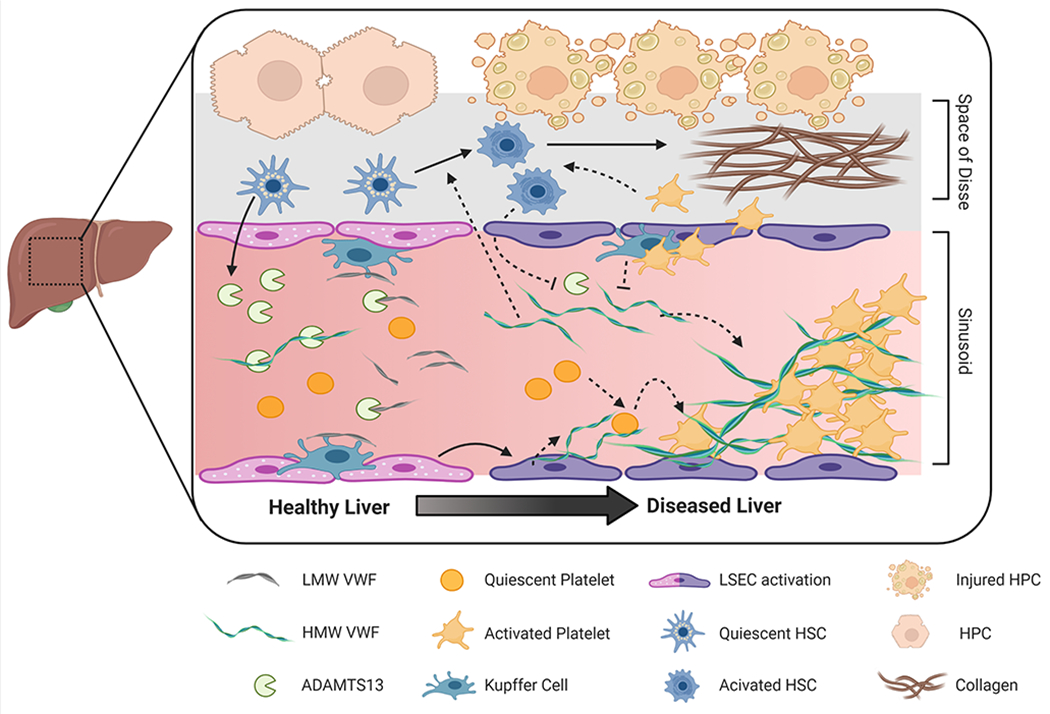
Acute and chronic liver disease are associated with substantial alterations in the hemostatic system. Evidence from both experimental and clinical studies suggests that anticoagulants slow the progression of liver disease. Efficacy of those anticoagulant drugs is, in part, attributed to a reduction of microthrombi formation within the liver. Although anticoagulant drugs show promising results, bleeding risk associated with these drugs is an obvious drawback, particularly in patients with a complex coagulopathy driven by decreased liver function. Identifying therapies that reduce intrahepatic thrombosis with minimal bleeding risk would significantly advance the field. Among the hemostatic alterations observed in patients are substantially increased levels of the platelet-adhesive protein von Willebrand factor (VWF). In contrast, levels of A Disintegrin and Metalloproteinase with Thrombospondin motifs, the enzyme that regulates VWF activity, are significantly reduced in patients with liver disease. Highly elevated VWF levels are proposed to accelerate intrahepatic thrombus formation and thus be a driver of disease progression. Strong clinical evidence suggesting a link between liver disease and changes in VWF is now being matched by emerging mechanistic data showing a detrimental role for VWF in the progression of liver disease. This review focuses on clinical and experimental evidence supporting a connection between VWF function and the progression of acute and chronic liver diseases. Furthermore, with the recent anticipated approval of several novel therapies targeting VWF, we discuss potential strategies and benefits of targeting VWF as an innovative therapy for patients with liver disease.
急、慢性肝病与止血系统的显著改变有关。来自实验和临床研究的证据表明,抗凝剂可减缓肝病的进展。这些抗凝药物的疗效部分归因于减少肝脏内微血栓的形成。尽管抗凝药物显示出有希望的结果,但这些药物相关的出血风险是一个明显的缺点,特别是在由肝功能下降引起的复杂凝血异常的患者中。寻找具有最小出血风险、减少肝内血栓形成的治疗方法将显著推动该领域的发展。在患者中观察到的止血变化中,血小板黏附蛋白 von Willebrand 因子 (VWF) 的水平显著升高。相比之下,肝病患者的 A Disintegrin and Metalloproteinase with Thrombospondin motifs(调节 VWF 活性的酶)水平显著降低。高 VWF 水平被认为可加速肝内血栓形成,从而成为疾病进展的驱动因素。强有力的临床证据表明肝病与 VWF 变化之间存在关联,现在新兴的机制数据也表明 VWF 在肝病进展中具有有害作用。这篇综述重点介绍了支持 VWF 功能与急性和慢性肝病进展之间存在联系的临床和实验证据。此外,随着几种针对 VWF 的新型疗法的近期预期批准,我们讨论了针对 VWF 作为肝病患者创新疗法的潜在策略和获益。