Children's Hospital of Orange County (CHOC), Orange, California.
Children's Hospital of Orange County (CHOC), Orange, California; Morphew Consulting, LLC, Bothell, Washington.
Ann Allergy Asthma Immunol. 2021 Jul;127(1):91-99. doi: 10.1016/j.anai.2021.03.018. Epub 2021 Mar 26.
The coronavirus disease 2019 (COVID-19) pandemic period is experiencing better asthma control, fewer exacerbations, and health care utilization, with limited data on factors that could explain this phenomenon.
To confirm these improved asthma outcomes during COVID-19 and evaluate potential contributing factors.
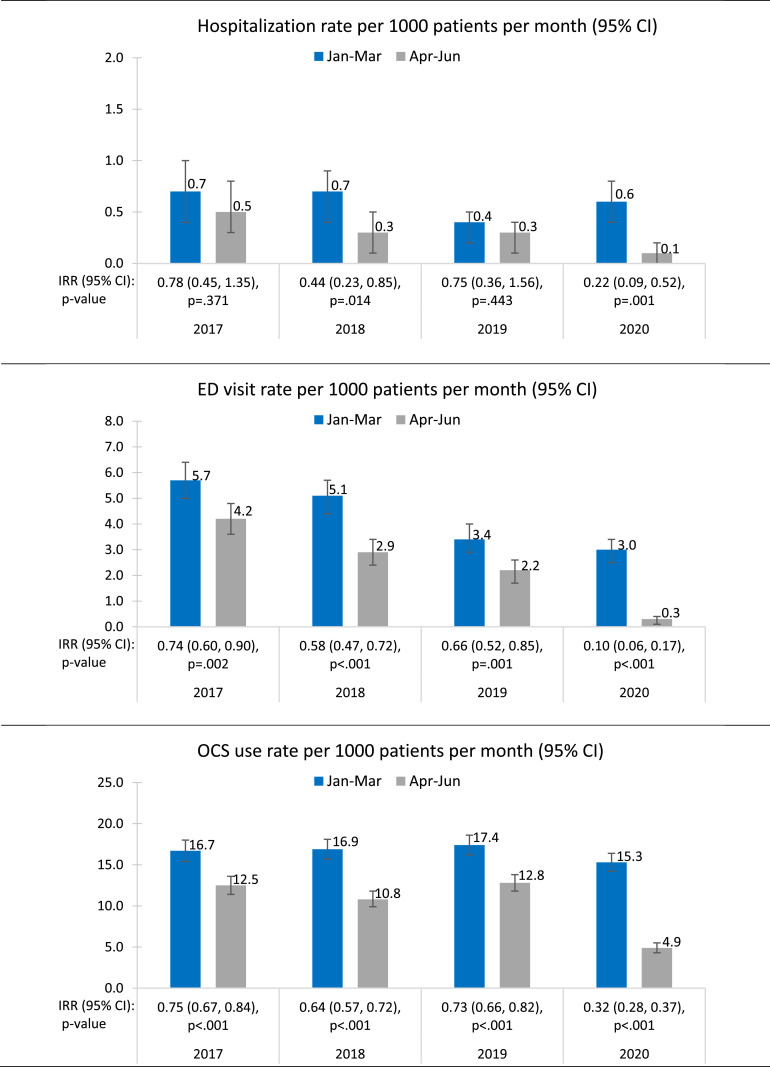
In 18,912 pediatric patients with asthma treated in the Children's Hospital of Orange County network from 2017 to 2020, monthly asthma-related encounters and medication summaries were extracted from electronic health records, particulate matter 2.5 (PM) air pollution from the California Air Resources Board, and influenza-like illness from Illness Surveillance Network for the first 6 months of each year. Changes in outcomes between January to March and April to June (post-COVID-19 shutdown in 2020) were compared with historical data using generalized estimating equations analyses for patient outcomes and generalized linear models for pollution exceedance, influenza-positive, and telehealth visit rates.
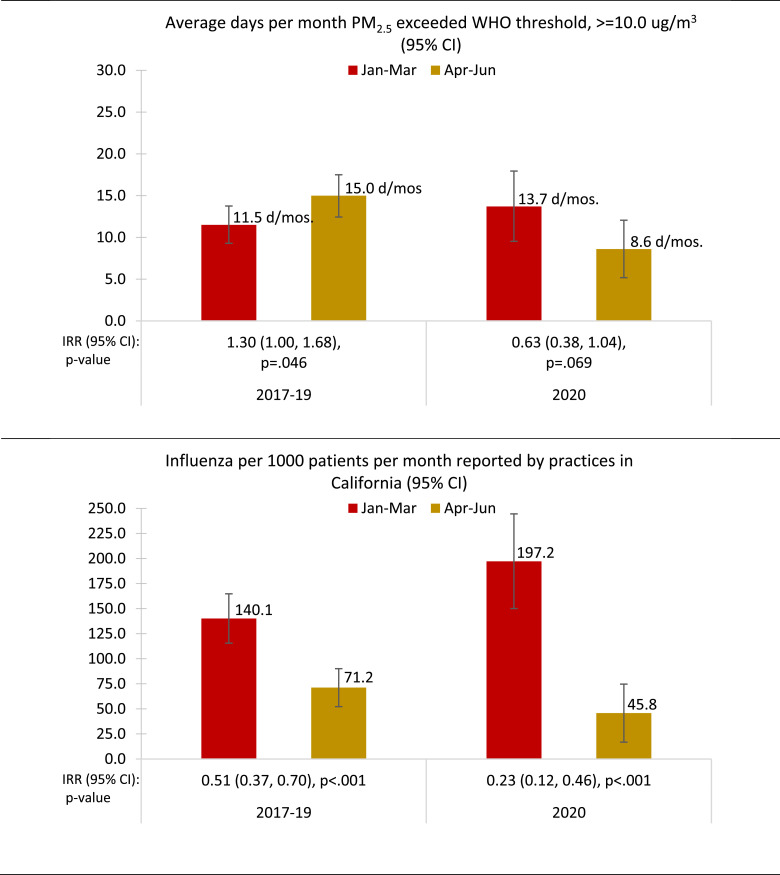
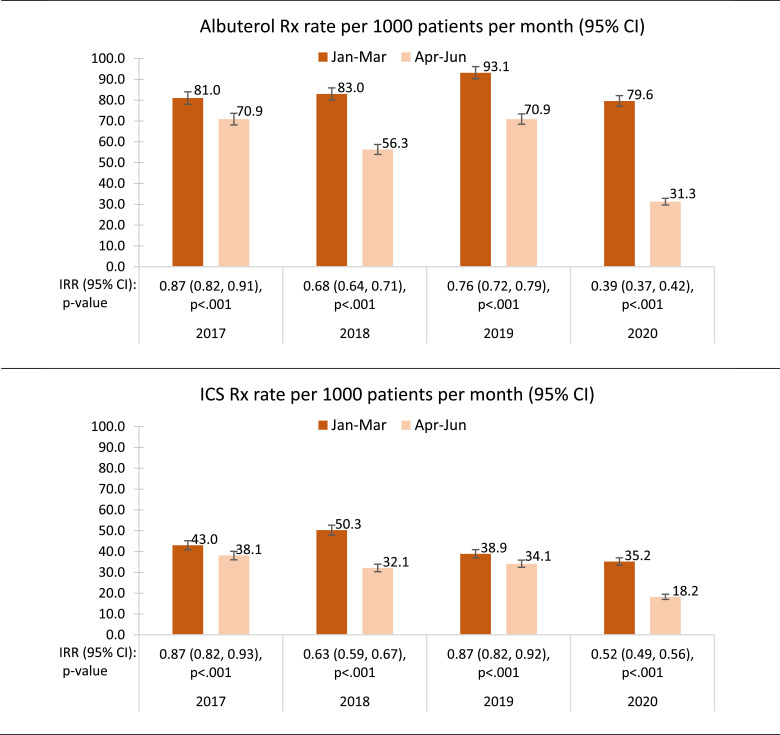
During COVID-19, we found 78%, 90%, 68% reductions in hospitalization, emergency department visits, and exacerbations, respectively, compared with pre-COVID-19 2020, with significantly greater changes than the same time period of 2017 to 2019 and significant reductions in albuterol and inhaled corticosteroid use (P < .05). Emergency department visit reduction was not seen for African Americans. The PM and influenza rates were also significantly reduced during COVID-19 (P < .05). Increased rates in telehealth visits were greater in the publicly insured group when compared with commercially insured.
Our data confirm reduced health care utilization and suggest better asthma control during COVID-19, except for African Americans. This was associated with a significant increase in telehealth visits and reductions in PM and influenza infections, but not better asthma controller adherence.
在 2019 年冠状病毒病(COVID-19)大流行期间,哮喘控制得到改善,恶化情况减少,医疗保健利用率降低,但关于可以解释这一现象的因素的数据有限。
确认 COVID-19 期间哮喘改善的结果,并评估潜在的促成因素。
在 2017 年至 2020 年期间,从电子健康记录中提取了橙县儿童医院网络中 18912 名患有哮喘的儿科患者的每月哮喘相关就诊和药物使用摘要、加利福尼亚州空气资源委员会的细颗粒物 2.5(PM)空气污染以及来自疾病监测网络的流感样疾病。使用广义估计方程分析患者结果和广义线性模型分析污染超标、流感阳性和远程医疗就诊率,比较了 2020 年 COVID-19 关闭前后 1 月至 3 月和 4 月至 6 月的结果与历史数据。
与 COVID-19 之前的 2020 年相比,住院、急诊就诊和恶化分别减少了 78%、90%和 68%,与 2017 年至 2019 年同期相比变化更为显著,并且沙丁胺醇和吸入皮质类固醇的使用量显著减少(P<0.05)。未观察到急诊就诊减少在非裔美国人中。PM 和流感的发生率在 COVID-19 期间也显著降低(P<0.05)。与商业保险相比,公共保险组的远程医疗就诊率增加幅度更大。
我们的数据证实,COVID-19 期间医疗保健利用率降低,提示哮喘控制得到改善,但非裔美国人除外。这与远程医疗就诊率的显著增加以及 PM 和流感感染的减少有关,但与更好的哮喘控制药物依从性无关。