Alizadehsani Roohallah, Roshanzamir Mohamad, Hussain Sadiq, Khosravi Abbas, Koohestani Afsaneh, Zangooei Mohammad Hossein, Abdar Moloud, Beykikhoshk Adham, Shoeibi Afshin, Zare Assef, Panahiazar Maryam, Nahavandi Saeid, Srinivasan Dipti, Atiya Amir F, Acharya U Rajendra
Institute for Intelligent Systems Research and Innovations (IISRI), Deakin University, Geelong, Australia.
Department of Computer Engineering, Faculty of Engineering, Fasa University, 74617-81189 Fasa, Iran.
Ann Oper Res. 2021 Mar 21:1-42. doi: 10.1007/s10479-021-04006-2.
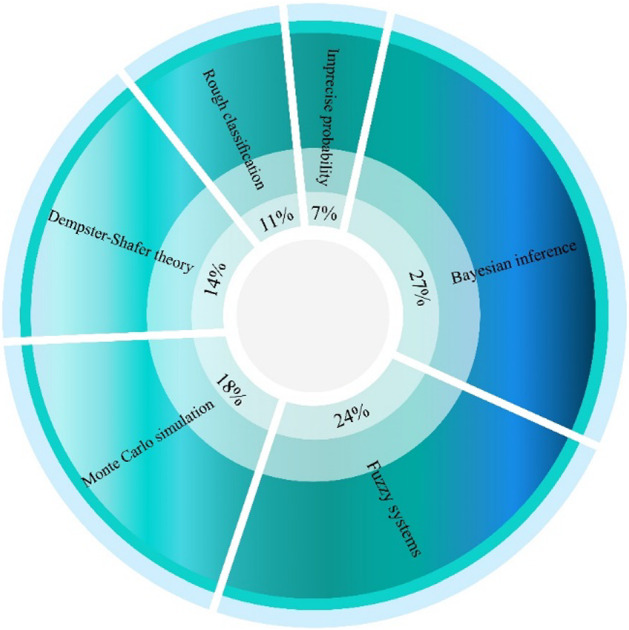
Understanding the data and reaching accurate conclusions are of paramount importance in the present era of big data. Machine learning and probability theory methods have been widely used for this purpose in various fields. One critically important yet less explored aspect is capturing and analyzing uncertainties in the data and model. Proper quantification of uncertainty helps to provide valuable information to obtain accurate diagnosis. This paper reviewed related studies conducted in the last 30 years (from 1991 to 2020) in handling uncertainties in medical data using probability theory and machine learning techniques. Medical data is more prone to uncertainty due to the presence of noise in the data. So, it is very important to have clean medical data without any noise to get accurate diagnosis. The sources of noise in the medical data need to be known to address this issue. Based on the medical data obtained by the physician, diagnosis of disease, and treatment plan are prescribed. Hence, the uncertainty is growing in healthcare and there is limited knowledge to address these problems. Our findings indicate that there are few challenges to be addressed in handling the uncertainty in medical raw data and new models. In this work, we have summarized various methods employed to overcome this problem. Nowadays, various novel deep learning techniques have been proposed to deal with such uncertainties and improve the performance in decision making.
在当今大数据时代,理解数据并得出准确结论至关重要。机器学习和概率论方法已在各个领域广泛用于此目的。一个极其重要但较少被探索的方面是捕捉和分析数据及模型中的不确定性。对不确定性进行恰当量化有助于提供有价值的信息以获得准确诊断。本文回顾了过去30年(从1991年到2020年)使用概率论和机器学习技术处理医学数据不确定性的相关研究。由于数据中存在噪声,医学数据更容易出现不确定性。因此,拥有无任何噪声的干净医学数据对于获得准确诊断非常重要。需要了解医学数据中的噪声来源以解决这个问题。根据医生获取的医学数据,开出疾病诊断和治疗方案。因此,医疗保健中的不确定性正在增加,而解决这些问题的知识有限。我们的研究结果表明,在处理医学原始数据和新模型中的不确定性方面存在一些挑战需要解决。在这项工作中,我们总结了为克服这个问题而采用的各种方法。如今,已经提出了各种新颖的深度学习技术来处理此类不确定性并提高决策性能。