Department of Gastroenterology, All India Institute of Medical Sciences, Patna 801507, Bihar, India.
Department of Radiodiagnosis, All India Institute of Medical Sciences, Patna 801507, Bihar, India.
World J Gastroenterol. 2021 Mar 21;27(11):990-1005. doi: 10.3748/wjg.v27.i11.990.
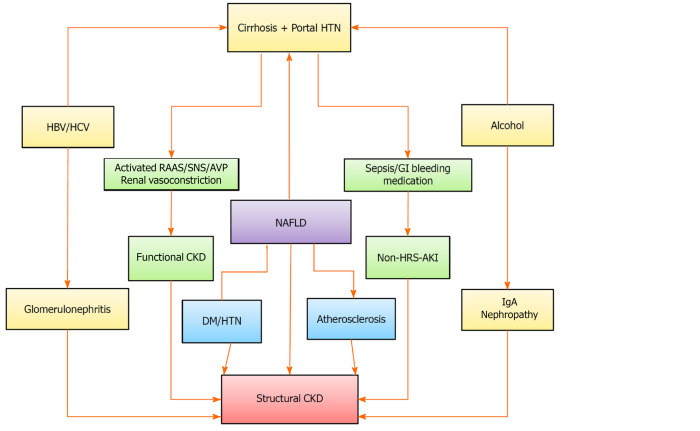
Chronic kidney disease (CKD) in patients with liver cirrhosis has become a new frontier in hepatology. In recent years, a sharp increase in the diagnosis of CKD has been observed among patients with cirrhosis. The rising prevalence of risk factors, such as diabetes, hypertension and nonalcoholic fatty liver disease, appears to have contributed significantly to the high prevalence of CKD. Moreover, the diagnosis of CKD in cirrhosis is now based on a reduction in the estimated glomerular filtration rate of < 60 mL/min over more than 3 mo. This definition has resulted in a better differentiation of CKD from acute kidney injury (AKI), leading to its greater recognition. It has also been noted that a significant proportion of AKI transforms into CKD in patients with decompensated cirrhosis. CKD in cirrhosis can be structural CKD due to kidney injury or functional CKD secondary to circulatory and neurohormonal imbalances. The available literature on combined cirrhosis-CKD is extremely limited, as most attempts to assess renal dysfunction in cirrhosis have so far concentrated on AKI. Due to problems related to glomerular filtration rate estimation in cirrhosis, the absence of reliable biomarkers of CKD and technical difficulties in performing renal biopsy in advanced cirrhosis, CKD in cirrhosis can present many challenges for clinicians. With combined hepatorenal dysfunctions, fluid mobilization becomes problematic, and there may be difficulties with drug tolerance, hemodialysis and decision-making regarding the need for liver simultaneous liver and kidney transplantation. This paper offers a thorough overview of the increasingly known CKD in patients with cirrhosis, with clinical consequences and difficulties occurring in the diagnosis and treatment of such patients.
慢性肾脏病(CKD)在肝硬化患者中已成为肝病学的一个新领域。近年来,肝硬化患者的 CKD 诊断率急剧上升。糖尿病、高血压和非酒精性脂肪肝等危险因素的患病率上升,似乎是 CKD 高发病率的主要原因。此外,目前肝硬化患者 CKD 的诊断基于肾小球滤过率估计值<60mL/min 持续超过 3 个月。这一定义使得 CKD 与急性肾损伤(AKI)的区分更加明显,从而提高了其识别率。此外,还注意到失代偿性肝硬化患者中相当一部分 AKI 会转化为 CKD。肝硬化中的 CKD 可以是结构性 CKD,也可以是循环和神经激素失衡引起的功能性 CKD。关于肝硬化合并 CKD 的文献极为有限,因为迄今为止,大多数评估肝硬化肾功能不全的尝试都集中在 AKI 上。由于肝硬化肾小球滤过率估计存在问题、缺乏 CKD 的可靠生物标志物以及在晚期肝硬化中进行肾活检存在技术困难,肝硬化中的 CKD 给临床医生带来了许多挑战。由于肝肾功能不全合并存在,液体移动变得成问题,药物耐受性、血液透析以及是否需要进行肝-肾联合移植的决策也可能会遇到困难。本文全面概述了肝硬化患者中日益被认识的 CKD,讨论了此类患者诊断和治疗中出现的临床后果和困难。