Piwowarczyk Renata, Schneider Adam C, Góralski Grzegorz, Kwolek Dagmara, Denysenko-Bennett Magdalena, Burda Anna, Ruraż Karolina, Joachimiak Andrzej J, Pedraja Óscar Sánchez
Center for Research and Conservation of Biodiversity, Department of Environmental Biology, Institute of Biology, Jan Kochanowski University, Uniwersytecka 7, PL-25-406 Kielce, Poland Jan Kochanowski University Kielce Poland.
Department of Plant Cytology and Embryology, Institute of Botany, Jagiellonian University, Gronostajowa 9, PL-30-387 Kraków, Poland Jagiellonian University Kraków Poland.
PhytoKeys. 2021 Mar 12;174:165-194. doi: 10.3897/phytokeys.174.62524. eCollection 2021.
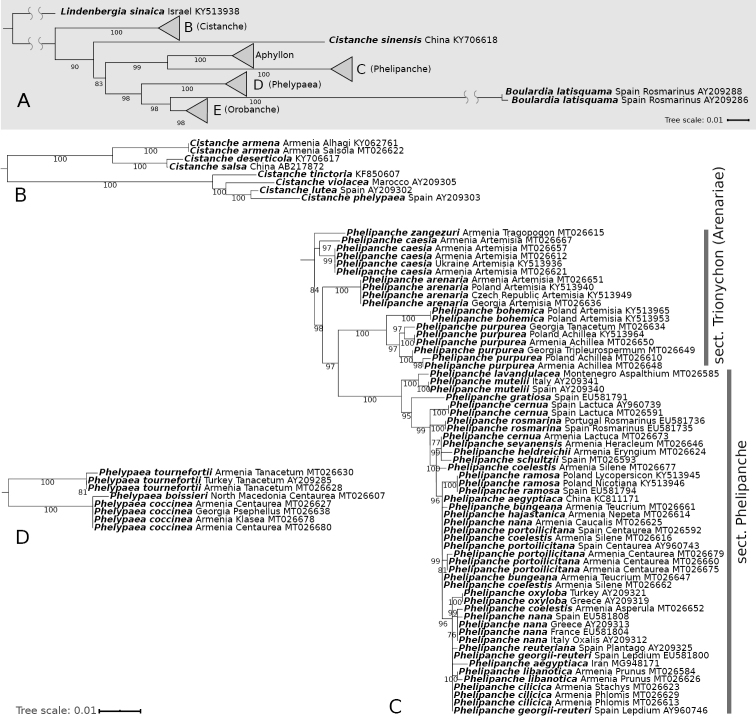
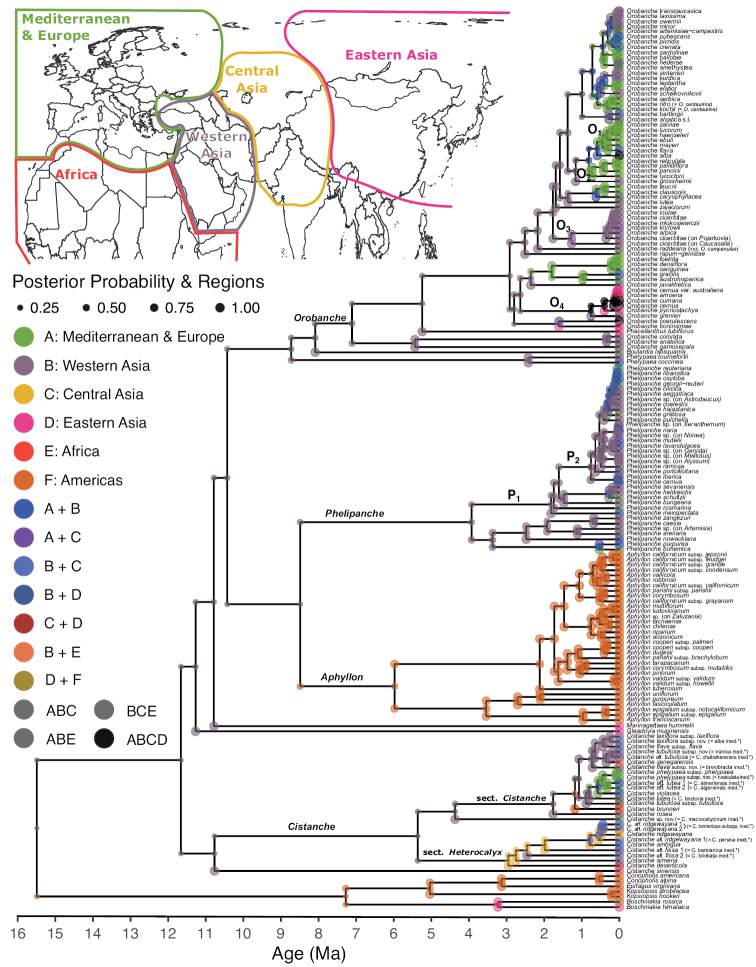
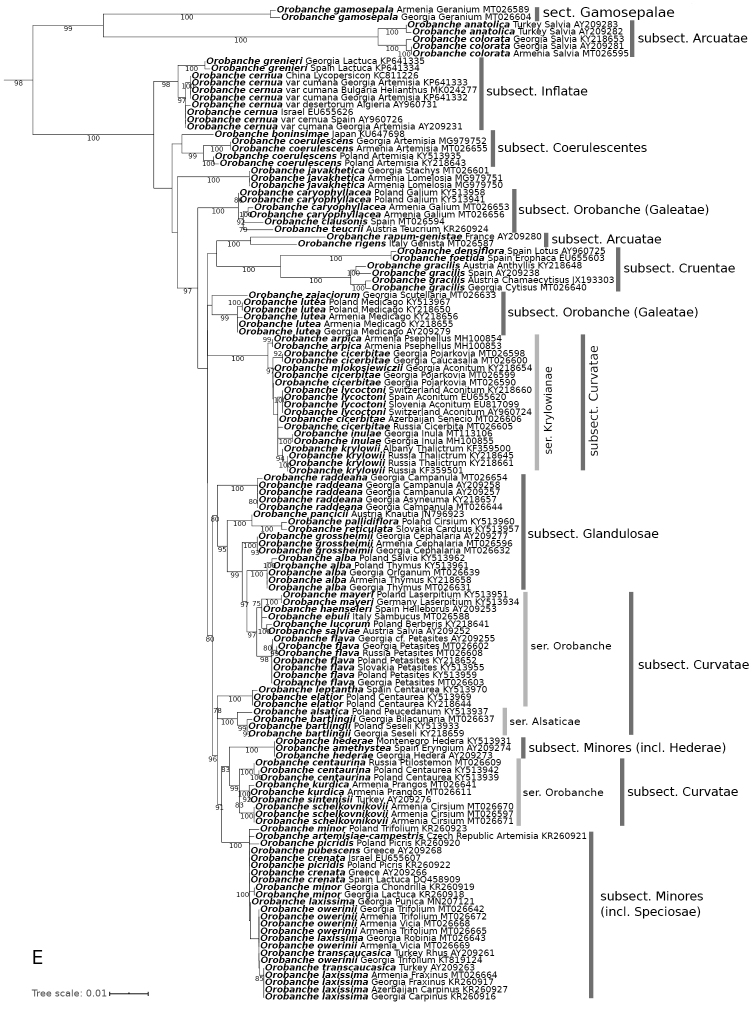
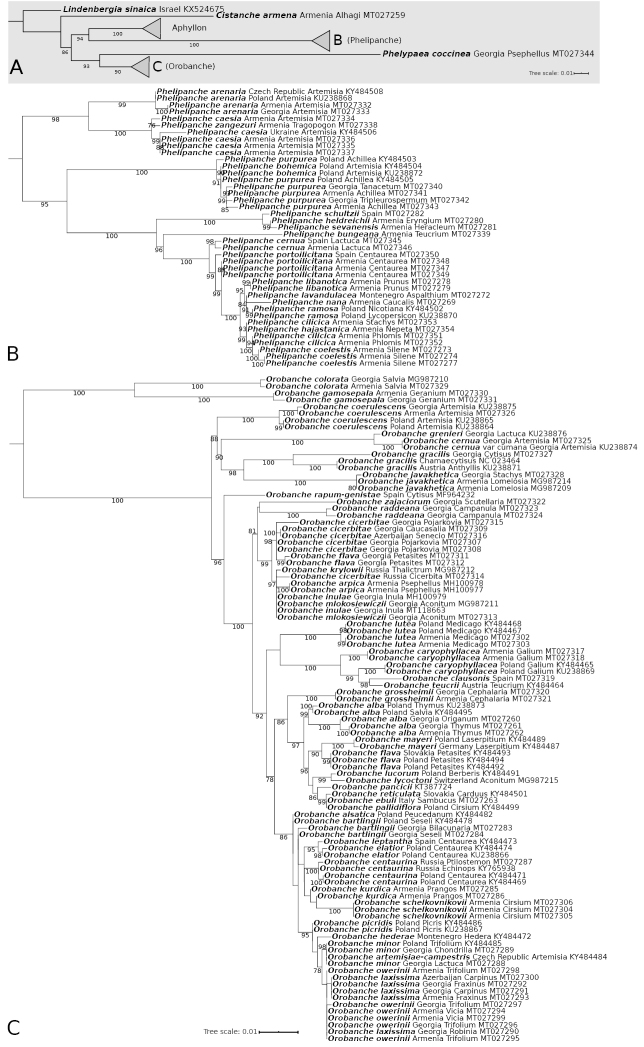
The extensive diversity of the tribe Orobancheae, the most species-rich lineage of holoparasitic Orobanchaceae, is concentrated in the Caucasus and Mediterranean regions of the Old World. This extant diversity has inspired hypotheses that these regions are also centres of origin of its key lineages, however the ability to test hypotheses has been limited by a lack of sampling and phylogenetic information about the species, especially in the Caucasus region. First, we assessed the phylogenetic relationships of several poorly known, problematic, or newly described species and host-races of four genera of Orobancheae occurring in the Caucasus region-, , and -using nuclear ribosomal (ITS) and plastid () sequence data. Then we applied a probablistic dispersal-extinction-cladogenesis model of historical biogeography across a more inclusive clade of holoparasites, to explicitly test hypotheses of Orobancheae diversification and historical biogeography shifts. In sum, we sampled 548 sequences (including 196 newly generated) from 13 genera, 140 species, and 175 taxa across 44 countries. We find that the Western Asia (particularly the Caucasus) and the Mediterranean are the centre of origin for large clades of holoparasitic Orobancheae within the last 6 million years. In the Caucasus, the centres of diversity are composed both of long-branch taxa and shallow, recently diversified clades, while Orobancheae diversity in the Mediterranean appears to represent mainly recent diversification.
列当属是全寄生列当科中物种最为丰富的谱系,该部落广泛的多样性集中在东半球的高加索地区和地中海地区。这种现存的多样性引发了一些假说,即这些地区也是其关键谱系的起源中心,然而,由于缺乏关于这些物种的采样和系统发育信息,尤其是在高加索地区,检验这些假说的能力受到了限制。首先,我们利用核糖体(ITS)和质体()序列数据,评估了高加索地区出现的列当属四个属中几个鲜为人知、有问题或新描述的物种及寄主族之间的系统发育关系。然后,我们对一个更具包容性的全寄生类群应用了历史生物地理学的概率性扩散 - 灭绝 - 分支形成模型,以明确检验列当属多样化和历史生物地理学变化的假说。总之,我们从44个国家的13个属、140个物种和175个分类单元中采样了548个序列(包括196个新生成的序列)。我们发现,在过去600万年里,西亚(尤其是高加索地区)和地中海地区是全寄生列当属大型分支的起源中心。在高加索地区,多样性中心既包括长分支分类单元,也包括较浅的、最近多样化的分支,而地中海地区的列当属多样性似乎主要代表了近期的多样化。