Chair of Cognitive and Clinical Neuroscience, Faculty of Psychology, Technische Universität Dresden, Dresden, Germany.
Max Planck Institute for Human Cognitive and Brain Sciences, Leipzig, Germany.
Front Neural Circuits. 2021 Mar 12;15:644743. doi: 10.3389/fncir.2021.644743. eCollection 2021.
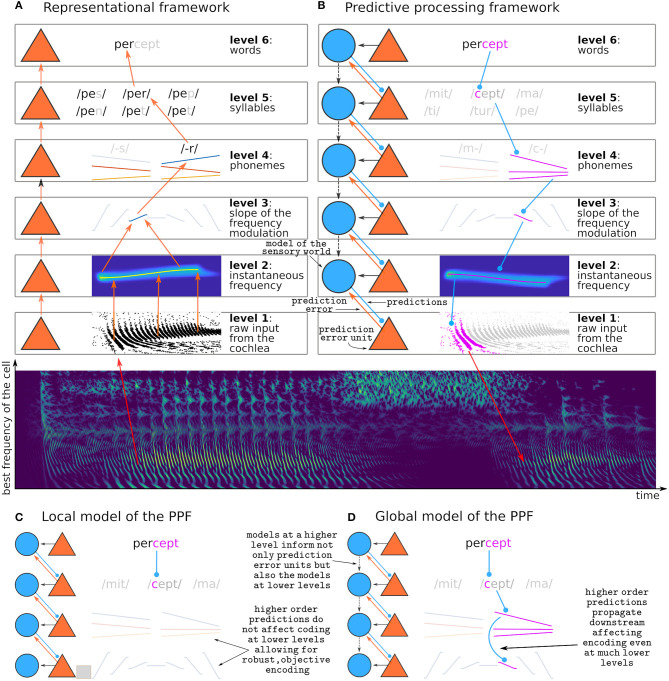
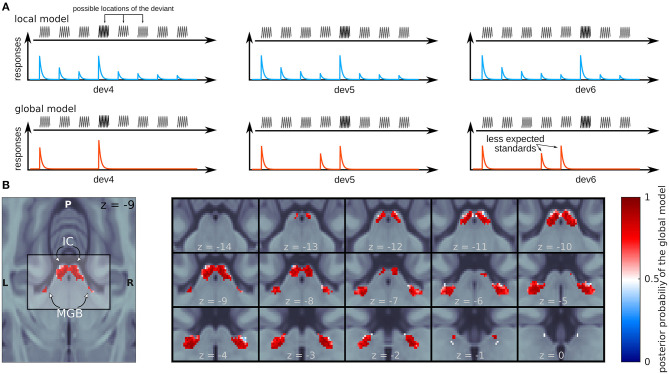
Predictive processing, a leading theoretical framework for sensory processing, suggests that the brain constantly generates predictions on the sensory world and that perception emerges from the comparison between these predictions and the actual sensory input. This requires two distinct neural elements: generative units, which encode the model of the sensory world; and prediction error units, which compare these predictions against the sensory input. Although predictive processing is generally portrayed as a theory of cerebral cortex function, animal and human studies over the last decade have robustly shown the ubiquitous presence of prediction error responses in several nuclei of the auditory, somatosensory, and visual subcortical pathways. In the auditory modality, prediction error is typically elicited using so-called oddball paradigms, where sequences of repeated pure tones with the same pitch are at unpredictable intervals substituted by a tone of deviant frequency. Repeated sounds become predictable promptly and elicit decreasing prediction error; deviant tones break these predictions and elicit large prediction errors. The simplicity of the rules inducing predictability make oddball paradigms agnostic about the origin of the predictions. Here, we introduce two possible models of the organizational topology of the predictive processing auditory network: (1) the global view, that assumes that predictions on the sensory input are generated at high-order levels of the cerebral cortex and transmitted in a cascade of generative models to the subcortical sensory pathways; and (2) the local view, that assumes that independent local models, computed using local information, are used to perform predictions at each processing stage. In the global view information encoding is optimized globally but biases sensory representations along the entire brain according to the subjective views of the observer. The local view results in a diminished coding efficiency, but guarantees in return a robust encoding of the features of sensory input at each processing stage. Although most experimental results to-date are ambiguous in this respect, recent evidence favors the global model.
预测加工是一种用于感知处理的主要理论框架,它表明大脑不断对感官世界生成预测,而感知则源自这些预测与实际感官输入之间的比较。这需要两个截然不同的神经元素:生成单元,用于编码感官世界的模型;以及预测误差单元,用于将这些预测与感官输入进行比较。尽管预测加工通常被描绘为大脑皮层功能的理论,但过去十年的动物和人类研究有力地表明,在听觉、躯体感觉和视觉皮质下通路的几个核中,普遍存在预测误差反应。在听觉模态中,预测误差通常使用所谓的“oddball 范式”来诱发,在这种范式中,具有相同音高的重复纯音序列以不可预测的间隔被具有偏差频率的音替代。重复的声音很快变得可预测,并引起预测误差减少;偏差音打破这些预测,并引起大的预测误差。诱导可预测性的规则的简单性使得 oddball 范式对预测的来源不敏感。在这里,我们介绍了预测加工听觉网络的组织拓扑结构的两个可能模型:(1)全局视图,假设对感官输入的预测是在大脑皮层的高级水平生成的,并通过生成模型的级联传递到皮质下感觉通路;(2)局部视图,假设使用局部信息计算的独立局部模型用于在每个处理阶段进行预测。在全局视图中,信息编码是全局优化的,但根据观察者的主观观点沿整个大脑偏置感官表示。局部视图导致编码效率降低,但反过来保证了在每个处理阶段对感官输入的特征进行稳健编码。尽管迄今为止大多数实验结果在这方面都存在歧义,但最近的证据支持全局模型。