Wen Yongjian, Cai Wenhao, Yang Jingyu, Fu Xianghui, Putha Lohitha, Xia Qing, Windsor John A, Phillips Anthony R, Tyndall Joel D A, Du Dan, Liu Tingting, Huang Wei
Department of Integrated Traditional Chinese and Western Medicine, Sichuan Provincial Pancreatitis Centre and West China-Liverpool Biomedical Research Centre, West China Hospital of Sichuan University, Chengdu, China.
Surgical and Translational Research Centre, Faculty of Medical and Health Sciences, University of Auckland, Auckland, New Zealand.
Front Pharmacol. 2021 Mar 11;12:638950. doi: 10.3389/fphar.2021.638950. eCollection 2021.
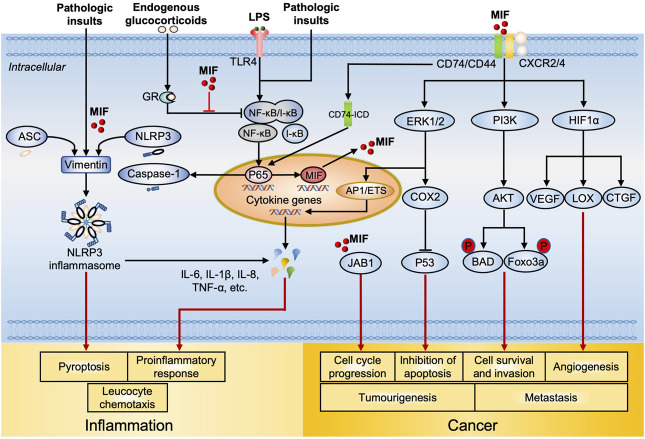
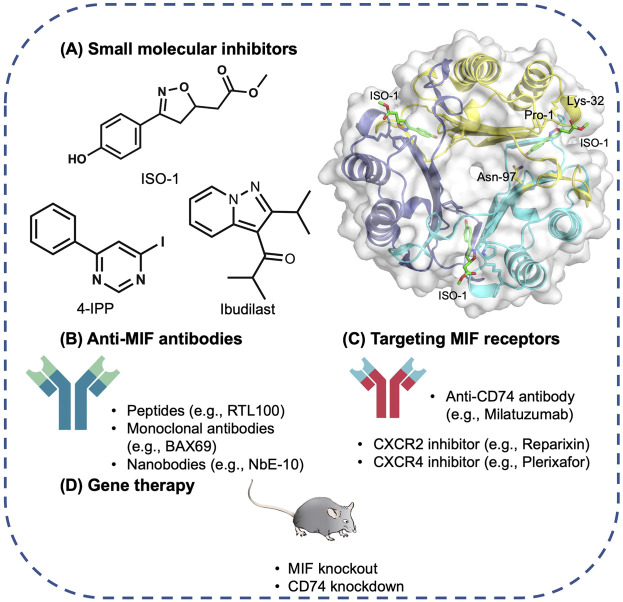
Macrophage migration inhibitory factor (MIF) is a pleiotropic cytokine implicated in the pathogenesis of inflammation and cancer. It is produced by various cells and circulating MIF has been identified as a biomarker for a range of diseases. Extracellular MIF mainly binds to the cluster of differentiation 74 (CD74)/CD44 to activate downstream signaling pathways. These in turn activate immune responses, enhance inflammation and can promote cancer cell proliferation and invasion. Extracellular MIF also binds to the C-X-C chemokine receptors cooperating with or without CD74 to activate chemokine response. Intracellular MIF is involved in Toll-like receptor and inflammasome-mediated inflammatory response. Pharmacological inhibition of MIF has been shown to hold great promise in treating inflammatory diseases and cancer, including small molecule MIF inhibitors targeting the tautomerase active site of MIF and antibodies that neutralize MIF. In the current review, we discuss the role of MIF signaling pathways in inflammation and cancer and summarize the recent advances of the role of MIF in experimental and clinical exocrine pancreatic diseases. We expect to provide insights into clinical translation of MIF antagonism as a strategy for treating acute pancreatitis and pancreatic cancer.
巨噬细胞移动抑制因子(MIF)是一种多效细胞因子,与炎症和癌症的发病机制有关。它由多种细胞产生,循环中的MIF已被确定为一系列疾病的生物标志物。细胞外MIF主要与分化簇74(CD74)/CD44结合以激活下游信号通路。这些信号通路进而激活免疫反应、增强炎症,并可促进癌细胞增殖和侵袭。细胞外MIF还与C-X-C趋化因子受体结合,在有或没有CD74的情况下协同激活趋化因子反应。细胞内MIF参与Toll样受体和炎性小体介导的炎症反应。已证明对MIF的药理学抑制在治疗炎症性疾病和癌症方面具有巨大潜力,包括靶向MIF互变异构酶活性位点的小分子MIF抑制剂和中和MIF的抗体。在本综述中,我们讨论了MIF信号通路在炎症和癌症中的作用,并总结了MIF在实验性和临床外分泌胰腺疾病中作用的最新进展。我们期望为将MIF拮抗作用作为治疗急性胰腺炎和胰腺癌的策略的临床转化提供见解。