Lim Kenji Rowel Q, Yokota Toshifumi
Department of Medical Genetics, Faculty of Medicine and Dentistry, University of Alberta, Edmonton, AB, Canada.
The Friends of Garrett Cumming Research and Muscular Dystrophy Canada, HM Toupin Neurological Science Research Chair, Edmonton, AB, Canada.
Front Pharmacol. 2021 Mar 12;12:642858. doi: 10.3389/fphar.2021.642858. eCollection 2021.
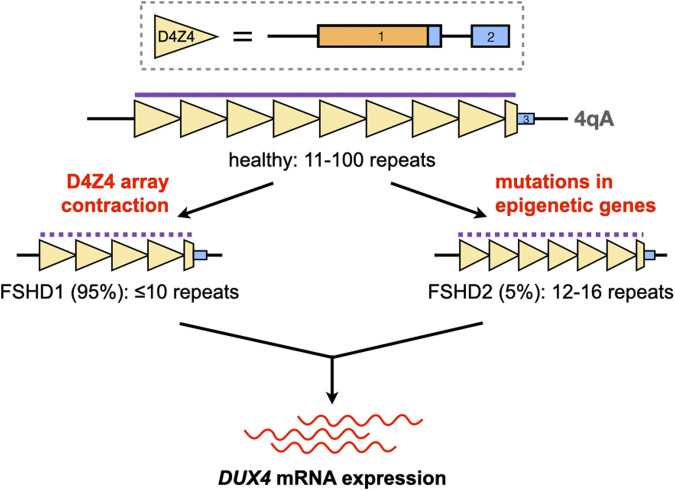
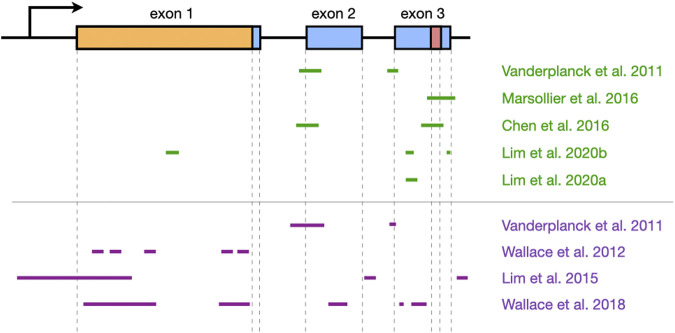
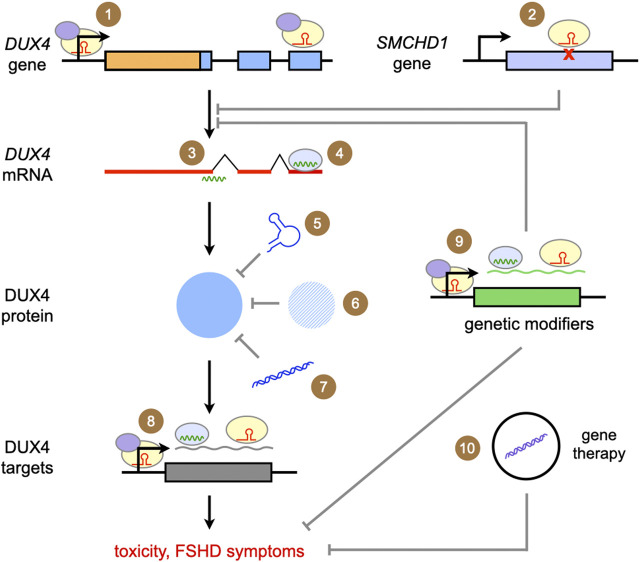
Facioscapulohumeral muscular dystrophy (FSHD) is an autosomal dominant disorder characterized by progressive, asymmetric muscle weakness at the face, shoulders, and upper limbs, which spreads to the lower body with age. It is the third most common inherited muscular disorder worldwide. Around 20% of patients are wheelchair-bound, and some present with extramuscular manifestations. FSHD is caused by aberrant expression of the () gene in muscle. codes for a transcription factor which, in skeletal muscle, dysregulates numerous signaling activities that culminate in cytotoxicity. Potential treatments for FSHD therefore aim to reduce the expression of or the activity of its toxic protein product. In this article, we review how genetic approaches such as those based on oligonucleotide and genome editing technologies have been developed to achieve these goals. We also outline the challenges these therapies are facing on the road to translation, and discuss possible solutions and future directions.
面肩肱型肌营养不良症(FSHD)是一种常染色体显性疾病,其特征为面部、肩部和上肢进行性、不对称性肌肉无力,随着年龄增长会蔓延至身体下部。它是全球第三大常见的遗传性肌肉疾病。约20%的患者需要依靠轮椅行动,部分患者还伴有肌肉外表现。FSHD由肌肉中()基因的异常表达引起。该基因编码一种转录因子,在骨骼肌中,它会失调众多信号活动,最终导致细胞毒性。因此,FSHD的潜在治疗方法旨在降低该基因的表达或其有毒蛋白质产物的活性。在本文中,我们回顾了如何开发基于寡核苷酸和基因组编辑技术等基因方法来实现这些目标。我们还概述了这些疗法在转化过程中面临的挑战,并讨论了可能的解决方案和未来方向。