Zhao Tong, Le Shenglong, Freitag Nils, Schumann Moritz, Wang Xiuqiang, Cheng Sulin
Exercise, Health and Technology Centre, Department of Physical Education, Shanghai Jiao Tong University, Shanghai, China.
Faculty of Sport and Health Science, University of Jyväskylä, Jyväskylä, Finland.
Front Physiol. 2021 Mar 11;12:652023. doi: 10.3389/fphys.2021.652023. eCollection 2021.
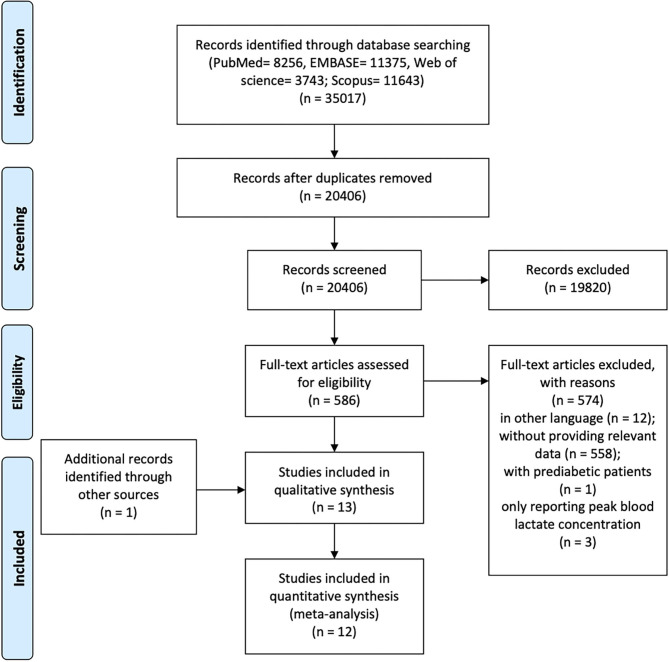
To assess the effect of chronic exercise training on blood lactate metabolism at rest (i.e., basal lactate concentrations) and during exercise (i.e., blood lactate concentration at a fixed load, load at a fixed blood lactate concentration, and load at the individual blood lactate threshold) among patients with type 2 diabetes mellitus (T2DM). PubMed (MedLine), Embase, Web of Science, and Scopus were searched. Randomized controlled trials, non-randomized controlled trials, and case-control studies using chronic exercise training (i.e., 4 weeks) and that assessed blood lactate concentrations at rest and during exercise in T2DM patients were included. Thirteen studies were eligible for the systematic review, while 12 studies with 312 participants were included into the meta-analysis. In the pre-to-post intervention meta-analysis, chronic exercise training had no significant effect on changes in basal blood lactate concentrations (standardized mean difference (SMD) = -0.20; 95% CI, -0.55 to 0.16; = 0.28), and the results were similar when comparing the effect of intervention and control groups. Furthermore, blood lactate concentration at a fixed load significantly decreased (SMD = -0.73; 95% CI, -1.17 to -0.29; = 0.001), while load at a fixed blood lactate concentration increased (SMD = 0.40; 95% CI, 0.07 to 0.72; = 0.02) after chronic exercise training. No change was observed in load at the individual blood lactate threshold (SMD = 0.28; 95% CI, -0.14 to 0.71; = 0.20). Chronic exercise training does not statistically affect basal blood lactate concentrations; however, it may decrease the blood lactate concentrations during exercise, indicating improvements of physical performance capacity which is beneficial for T2DM patients' health in general. Why chronic exercise training did not affect basal blood lactate concentrations needs further investigation.
评估慢性运动训练对2型糖尿病(T2DM)患者静息时(即基础乳酸浓度)和运动期间(即固定负荷下的血乳酸浓度、固定血乳酸浓度下的负荷以及个体血乳酸阈值时的负荷)血乳酸代谢的影响。检索了PubMed(MedLine)、Embase、Web of Science和Scopus。纳入了使用慢性运动训练(即4周)且评估T2DM患者静息和运动期间血乳酸浓度的随机对照试验、非随机对照试验和病例对照研究。13项研究符合系统评价的标准,而12项研究(共312名参与者)被纳入荟萃分析。在干预前后的荟萃分析中,慢性运动训练对基础血乳酸浓度的变化无显著影响(标准化均值差(SMD)=-0.20;95%置信区间,-0.55至0.16;P=0.28),比较干预组和对照组的效果时结果相似。此外,慢性运动训练后,固定负荷下的血乳酸浓度显著降低(SMD=-0.73;95%置信区间,-1.17至-0.29;P=0.001),而固定血乳酸浓度下的负荷增加(SMD=0.40;95%置信区间,0.07至0.72;P=0.02)。个体血乳酸阈值时的负荷未观察到变化(SMD=0.28;95%置信区间,-0.14至0.71;P=0.20)。慢性运动训练对基础血乳酸浓度无统计学影响;然而,它可能会降低运动期间的血乳酸浓度,表明身体运动能力有所改善,这总体上有利于T2DM患者的健康。慢性运动训练为何不影响基础血乳酸浓度需要进一步研究。