Oh Sun-Young, Dieterich Marianne, Lee Bit Na, Boegle Rainer, Kang Jin-Ju, Lee Na-Ri, Gerb Johannes, Hwang Seung-Bae, Kirsch Valerie
Department of Neurology, School of Medicine, Jeonbuk National University, Jeonju, South Korea.
Research Institute of Clinical Medicine, Jeonbuk National University Hospital-Biomedical Research Institute, Jeonbuk National University, Jeonju, South Korea.
Front Neurol. 2021 Mar 11;12:594481. doi: 10.3389/fneur.2021.594481. eCollection 2021.
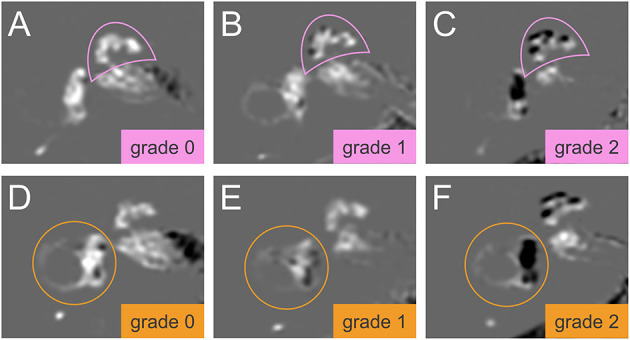
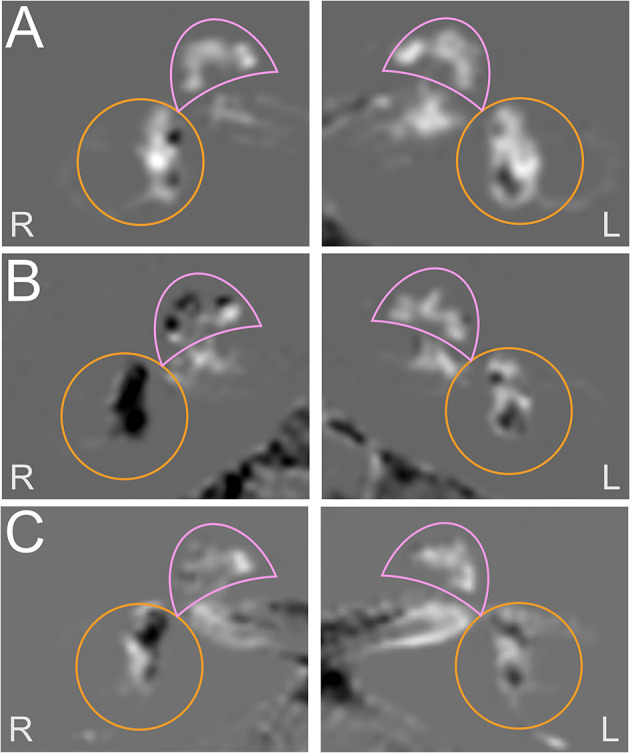
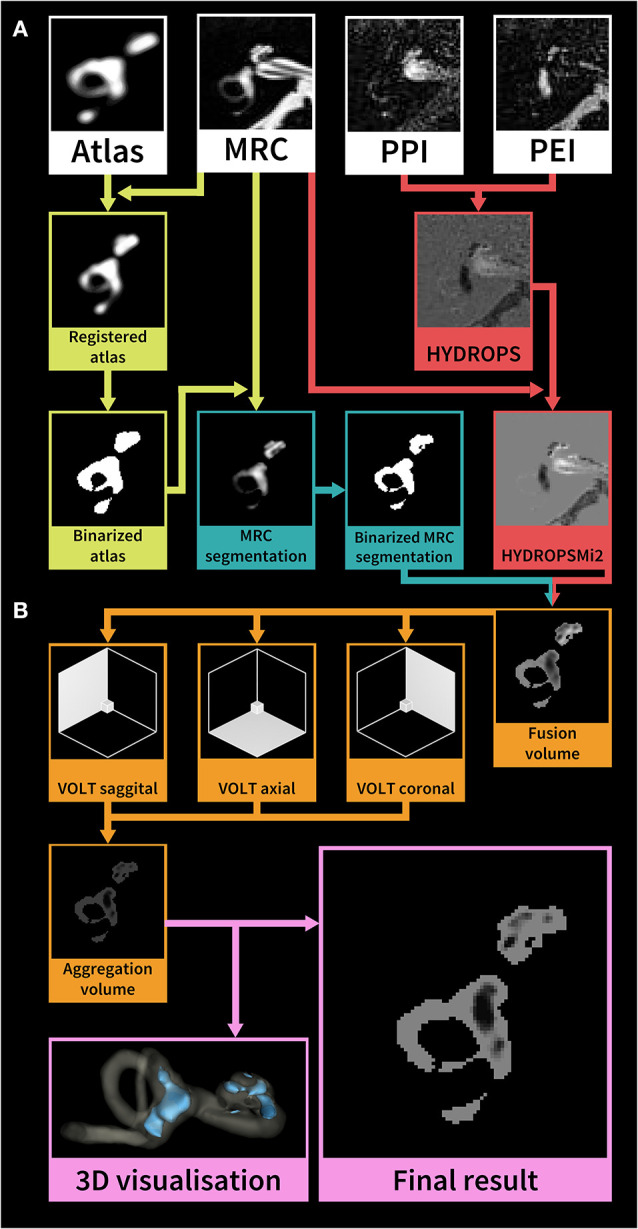
Intravenous contrast agent enhanced, high-resolution magnetic resonance imaging of the inner ear (iMRI) confirmed that patients with Menière's disease (MD) and vestibular migraine (VM) could present with endolymphatic hydrops (EH). The present study aimed to investigate EH characteristics and their interrelation to neurotologic testing in patients with VM, MD, or VM with concurrent MD (VM-MD). Sixty-two patients (45 females, aged 23-81 years) with definite or probable VM ( = 25, 19 definite), MD ( = 29, 17 definite), or showing characteristics of both diseases ( = 8) were included in this study. Diagnostic workup included neurotologic assessments including video-oculography (VOG) during caloric stimulation and head-impulse test (HIT), ocular and cervical vestibular evoked myogenic potentials (o/cVEMP), pure tone audiometry (PTA), as well as iMRI. EH's degree was assessed visually and via volumetric quantification using a probabilistic atlas-based segmentation of the bony labyrinth and volumetric local thresholding (VOLT). Although a relevant number of VM patients reported varying auditory symptoms (13 of 25, 52.0%), EH in VM was only observed twice. In contrast, EH in VM-MD was prevalent (2/8, 25%) and in MD frequent [23/29, 79.3%; χ(2) = 29.1, < 0.001, φ = 0.7]. Location and laterality of EH and neurophysiological testing classifications were highly associated (Fisher exact test, < 0.005). In MD, visual semi-quantitative grading and volumetric quantification correlated highly to each other ( = 0.8, < 0.005, two-sided) and to side differences in VOG during caloric irrigation (vestibular EH ipsilateral: = 0.6, < 0.05, two-sided). In VM, correlations were less pronounced. VM-MD assumed an intermediate position between VM and MD. Cochlear and vestibular hydrops can occur in MD and VM patients with auditory symptoms; this suggests inner ear damage irrespective of the diagnosis of MD or VM. The EH grades often correlated with auditory symptoms such as hearing impairment and tinnitus. Further research is required to uncover whether migraine is one causative factor of EH or whether EH in VM patients with auditory symptoms suggests an additional pathology due to MD.
静脉注射造影剂增强的内耳高分辨率磁共振成像(iMRI)证实,梅尼埃病(MD)和前庭性偏头痛(VM)患者可出现内淋巴积水(EH)。本研究旨在调查VM、MD或合并MD的VM(VM-MD)患者的EH特征及其与神经耳科学检查的相互关系。本研究纳入了62例(45例女性,年龄23 - 81岁)确诊或可能患有VM(n = 25,19例确诊)、MD(n = 29,17例确诊)或具有两种疾病特征(n = 8)的患者。诊断检查包括神经耳科学评估,包括冷热试验期间的视频眼震图(VOG)和头部脉冲试验(HIT)、眼和颈前庭诱发肌源性电位(o/cVEMP)、纯音听力测定(PTA)以及iMRI。通过基于概率图谱的骨迷路分割和容积局部阈值法(VOLT)进行视觉评估和容积定量来评估EH的程度。尽管相当数量的VM患者报告有不同的听觉症状(25例中的13例,52.0%),但VM中仅观察到2例EH。相比之下,VM-MD中EH很常见(2/8,25%),MD中则很频繁[23/29,79.3%;χ(2)=29.1,P < 0.001,φ = 0.7]。EH的位置和侧别与神经生理学检查分类高度相关(Fisher确切概率检验,P < 0.005)。在MD中,视觉半定量分级和容积定量彼此高度相关(r = 0.8,P < 0.005,双侧),并且与冷热灌注期间VOG的侧别差异相关(前庭EH同侧:r = 0.6,P < 0.05,双侧)。在VM中,相关性不太明显。VM-MD处于VM和MD之间的中间位置。耳蜗和前庭积水可发生在有听觉症状的MD和VM患者中;这表明无论MD或VM的诊断如何,内耳均有损伤。EH分级通常与听力减退和耳鸣等听觉症状相关。需要进一步研究以揭示偏头痛是否是EH的一个致病因素,或者有听觉症状的VM患者中的EH是否提示由于MD导致的额外病变。