Department of Clinical Immunology, Rigshospitalet, Copenhagen University Hospital, Copenhagen, Denmark.
Department of Hematology, Rigshospitalet, Copenhagen University Hospital, Copenhagen, Denmark.
Front Immunol. 2021 Mar 10;12:625165. doi: 10.3389/fimmu.2021.625165. eCollection 2021.
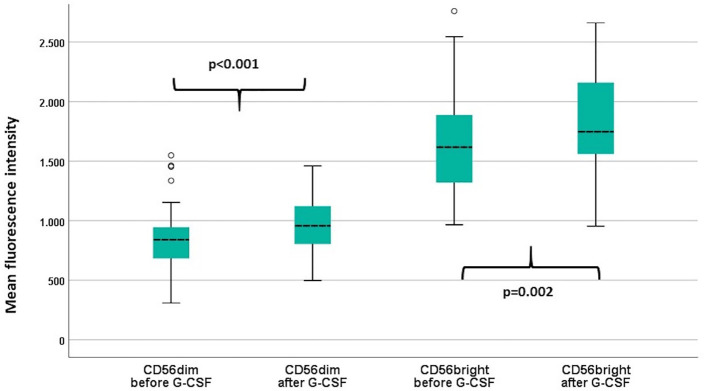
Allogeneic hematopoietic stem cell transplantation (HSCT) is a potential cure for patients with hematological malignancies but substantial risks of recurrence of the malignant disease remain. TCR γδ and NK cells are perceived as potent innate effector cells in HSCT and have been associated with post-transplant protection from relapse in clinical studies. Immunocompetent cells from the donor are crucial for patient outcomes and peripheral blood stem cells (PBSC) are being increasingly applied as graft source. G-CSF is the preferential mobilizing agent in healthy donors for PBSC grafts, yet effects of G-CSF on TCR γδ and NK cells are scarcely uncovered and could influence the graft composition and potency of these cells. Therefore, we analyzed T and NK cell subsets and activation markers in peripheral blood samples of 49 donors before and after G-CSF mobilization and-for a subset of donors-also in the corresponding graft samples using multicolor flowcytometry with staining for CD3, CD4, CD8, TCRαβ, TCRγδ, Vδ1, Vδ2, HLA-DR, CD45RA, CD197, CD45RO, HLA-DR, CD16, CD56, and CD314. We found that TCR γδ cells were mobilized and harvested with an efficiency corresponding that of TCR αβ cells. For TCR γδ as well as for TCR αβ cells, G-CSF preferentially mobilized naïve and terminally differentiated effector (TEMRA) cells over memory cells. In the TCR γδ cell compartment, G-CSF preferentially mobilized cells of the nonVδ2 types and increased the fraction of HLA-DR positive TCR γδ cells. For NK cells, mobilization by G-CSF was increased compared to that of T cells, yet NK cells appeared to be less efficiently harvested than T cells. In the NK cell compartment, G-CSF-stimulation preserved the proportion of CD56dim NK effector cells which have been associated with relapse protection. The expression of the activating receptor NKG2D implied in anti-leukemic responses, was significantly increased in both CD56dim and CD56bright NK cells after G-CSF stimulation. These results indicate differentiated mobilization and altering properties of G-CSF which could improve the effects of donor TCR γδ and NK cells in the processes of graft-versus-leukemia for relapse prevention after HSCT.
异基因造血干细胞移植(HSCT)是治疗血液系统恶性肿瘤患者的一种潜在方法,但恶性疾病复发的风险仍然很大。TCRγδ 和 NK 细胞被认为是 HSCT 中的强大先天效应细胞,并与临床研究中移植后复发的保护有关。供者的免疫活性细胞对患者的预后至关重要,外周血干细胞(PBSC)作为移植物来源越来越多地被应用。G-CSF 是健康供者用于 PBSC 移植物的首选动员剂,但 G-CSF 对 TCRγδ 和 NK 细胞的影响尚未被充分揭示,可能会影响这些细胞的移植物组成和效力。因此,我们使用多色流式细胞术分析了 49 名供者在 G-CSF 动员前后以及一部分供者在相应移植物样本中的外周血样本中的 T 和 NK 细胞亚群和激活标志物,这些标志物使用 CD3、CD4、CD8、TCRαβ、TCRγδ、Vδ1、Vδ2、HLA-DR、CD45RA、CD197、CD45RO、HLA-DR、CD16、CD56 和 CD314 进行染色。我们发现 TCRγδ 细胞的动员和收获效率与 TCRαβ 细胞相当。对于 TCRγδ 和 TCRαβ 细胞,G-CSF 优先动员幼稚和终末分化效应(TEMRA)细胞,而不是记忆细胞。在 TCRγδ 细胞区室中,G-CSF 优先动员非 Vδ2 类型的细胞,并增加 HLA-DR 阳性 TCRγδ 细胞的比例。与 T 细胞相比,G-CSF 对 NK 细胞的动员增加,但 NK 细胞的收获效率似乎低于 T 细胞。在 NK 细胞区室中,G-CSF 刺激保留了与复发保护相关的 CD56dim NK 效应细胞的比例。在 G-CSF 刺激后,与白血病反应有关的激活受体 NKG2D 的表达在 CD56dim 和 CD56bright NK 细胞中均显著增加。这些结果表明 G-CSF 的分化动员和改变特性可能会改善供者 TCRγδ 和 NK 细胞在 HSCT 后移植物抗白血病过程中的作用,从而预防复发。