Department of Pharmacology and Therapeutics, Faculty of Life and Health Sciences, Institute of Systems, Molecular and Integrative Biology, University of Liverpool, Liverpool, United Kingdom.
Front Immunol. 2021 Mar 10;12:651687. doi: 10.3389/fimmu.2021.651687. eCollection 2021.
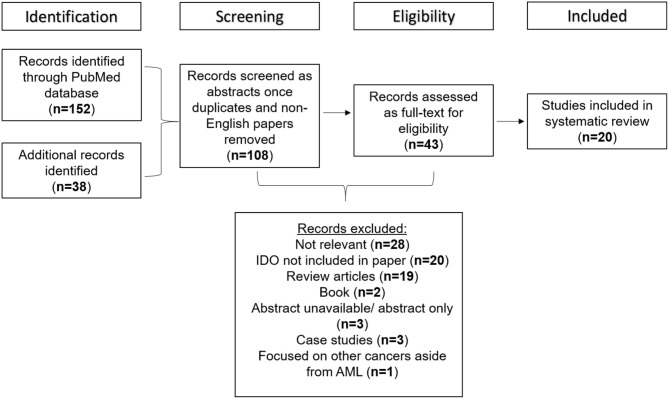
The immunomodulatory enzyme, indoleamine 2,3-dioxygenase (IDO) facilitates tryptophan catabolism at the rate-limiting step of the kynurenine (Kyn) pathway. IDO expression and elevations in Kyn metabolites are associated with immunosuppressive tumor microenvironment including T cell proliferative arrest and generation of regulatory T cells (Tregs) which can favor tumor progression. However, the extent of the role of IDO in acute myeloid leukemia (AML) is currently ill-defined. This study reviews the role of IDO-driven Treg function in AML and evaluates the current body of evidence implicating IDO in AML pathogenesis. Studies related to IDO in AML were identified through a systematic review of PubMed and Scopus. Data extracted described sample analysis, IDO expression, IDO in prognosis, techniques used in Treg phenotypic studies, and the effect of IDO inhibitors. Twenty studies were included in the systematic review. Expression of IDO was identified in a range of cells in AML, both inducible and constitutive. Seven studies indicated an association between elevated expression and poor clinical prognosis. Six studies suggested a positive correlation between IDO expression and Treg induction, with FoxP3 being the prominent Treg phenotypic marker. Of eight studies investigating IDO inhibition, some reported reductions in Treg frequency and enhanced effector T cell proliferation. This review highlights that IDO expression in AML is associated with poor prognosis and measurement of IDO and its Kyn metabolites may offer utility as prospective prognostic markers. Pharmacological inhibition of IDO using novel drugs may hold promise for the treatment of AML.
免疫调节酶吲哚胺 2,3-双加氧酶(IDO)在犬尿氨酸(Kyn)途径的限速步骤促进色氨酸分解代谢。IDO 的表达和 Kyn 代谢物的升高与免疫抑制性肿瘤微环境相关,包括 T 细胞增殖停滞和调节性 T 细胞(Treg)的产生,这有利于肿瘤进展。然而,IDO 在急性髓系白血病(AML)中的作用程度目前尚不清楚。本研究综述了 IDO 驱动的 Treg 功能在 AML 中的作用,并评估了目前涉及 IDO 在 AML 发病机制中的证据。 通过对 PubMed 和 Scopus 的系统评价,确定了与 AML 中 IDO 相关的研究。提取的数据描述了样本分析、IDO 表达、IDO 在预后中的作用、Treg 表型研究中使用的技术以及 IDO 抑制剂的作用。 系统评价共纳入 20 项研究。IDO 在 AML 中的多种细胞中表达,包括诱导型和组成型。有 7 项研究表明,表达升高与临床预后不良有关。有 6 项研究表明 IDO 表达与 Treg 诱导之间存在正相关,FoxP3 是突出的 Treg 表型标志物。在 8 项研究 IDO 抑制的研究中,一些研究报告 Treg 频率降低和效应 T 细胞增殖增强。 本综述强调 AML 中 IDO 的表达与预后不良相关,IDO 及其 Kyn 代谢物的测量可能作为有前途的预后标志物。使用新型药物抑制 IDO 可能为 AML 的治疗提供希望。