Skin Research Center, Shahid Beheshti University of Medical Sciences, Tehran, Iran.
Sultan Qaboos Univ Med J. 2021 Feb;21(1):e22-e33. doi: 10.18295/squmj.2021.21.01.004. Epub 2021 Mar 15.
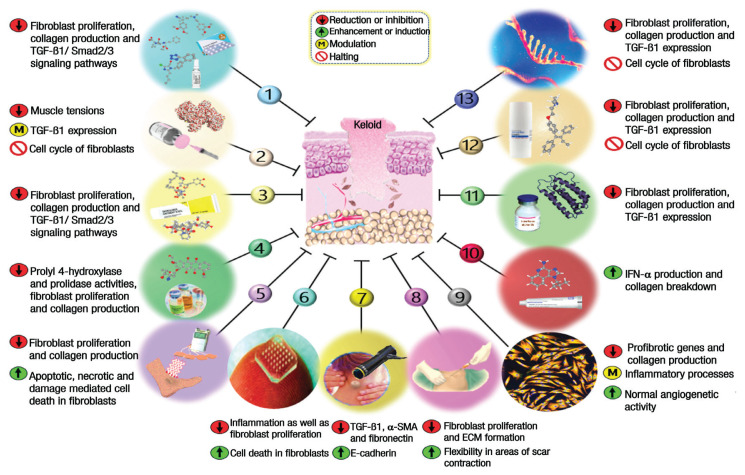
Keloids are abnormal fibroproliferative scars with aggressive dermal growth expanding beyond the borders of the original injury. Different therapeutic modalities, such as corticosteroids, surgical excision, topical silicone gel sheeting, laser therapy, cryotherapy, photodynamic therapy and radiotherapy, have been used to treat keloids; however, none of these modalities has proven completely effective. Recently, researchers have devised several promising anti-keloid therapies including anti-hypertensive pharmaceuticals, calcineurin inhibitors, electrical stimulation, mesenchymal stem cell therapy, microneedle physical contact and ribonucleic acid-based therapies. The present review summarises emerging and novel treatments for keloids. PubMed (National Library of Medicine, Bethesda, Maryland, USA), EMBASE (Elsevier, Amsterdam, Netherlands) and Web of Science (Clarivate Analytics, Philadelphia, Pennsylvania, USA) were searched for relevant literature published between January 1987 to June 2020. A total of 118 articles were included in this review. A deeper understanding of the molecular mechanisms underlying keloid scarring pathogenesis would open further avenues for developing innovative treatments.
瘢痕疙瘩是一种异常的纤维组织增生性瘢痕,其真皮生长具有侵袭性,超出了原始损伤的边界。皮质类固醇、手术切除、外用硅酮凝胶片、激光治疗、冷冻疗法、光动力疗法和放射疗法等多种治疗方法已被用于治疗瘢痕疙瘩,但没有一种方法被证明完全有效。最近,研究人员设计了几种有前途的抗瘢痕疙瘩治疗方法,包括抗高血压药物、钙调神经磷酸酶抑制剂、电刺激、间充质干细胞治疗、微针物理接触和基于核糖核酸的治疗方法。本综述总结了瘢痕疙瘩的新兴和新型治疗方法。检索了 1987 年 1 月至 2020 年 6 月期间发表的相关文献,包括 PubMed(美国马里兰州贝塞斯达国立医学图书馆)、EMBASE(荷兰阿姆斯特丹爱思唯尔)和 Web of Science(美国宾夕法尼亚州费城科睿唯安)。本综述共纳入 118 篇文章。深入了解瘢痕疙瘩发病机制的分子机制将为开发创新治疗方法开辟更多途径。