Yang Yongjun, Liu Chao, Yan Xiaoting, Li Jiawei, Yang Xiaofeng
First Clinical Medical College, Shanxi Medical University, Taiyuan, China.
Department of Urology, First Hospital of Shanxi Medical University, Taiyuan, China.
Front Oncol. 2021 Mar 10;11:638065. doi: 10.3389/fonc.2021.638065. eCollection 2021.
To evaluate the safety and efficacy of overnight continuous saline bladder irrigation (CSBI) for patients who have received thulium laser resection of bladder tumor (TmLRBT) combined with immediate intravesical chemotherapy previously.
From October 2014 to June 2018, 235 patients with newly diagnosed non-muscle invasive bladder cancer (NMIBC) were included in this retrospective study. All patients received intravesical instillation of pirarubicin immediately after TmLRBT. The patients were divided into two groups according to the duration of postoperative bladder irrigation with normal saline. After immediate intravesical chemotherapy, patients in group 1 received overnight CSBI, while patients in group 2 did not receive overnight CSBI. Data on the time of initial tumor recurrence, recurrence-free survival (RFS) and progression-free survival (PFS) rates, and perioperative complications were collected and analyzed.
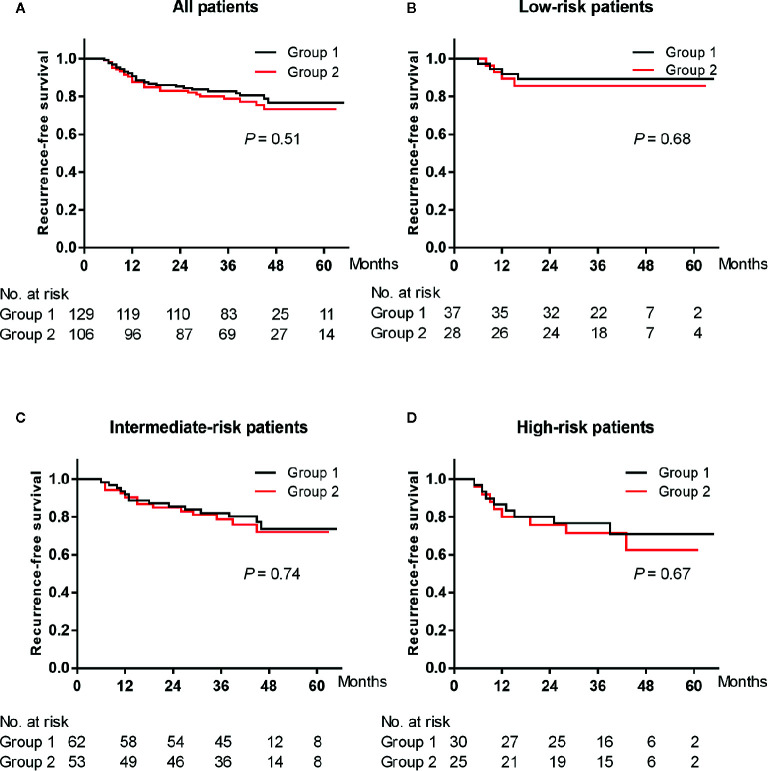
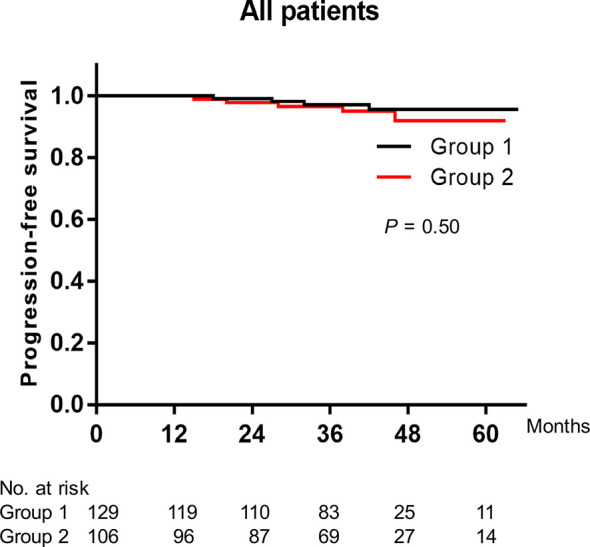
Of 235 included patients (129 in group 1 and 106 in group 2), the median follow-up periods were 42 and 38 months, respectively. There were no significant differences in patients' baseline characteristics between the two groups. The RFS rates of patients in group 1 were 90.7, 82.7, and 76.8% at the end of the first, third, and fifth years, while the corresponding RFS rates of patients in group 2 were 87.7, 78.9, and 73.3%, respectively. Four patients in group 1 and five patients in group 2 experienced tumor progression. No significant differences between the two groups were observed in the time of initial tumor recurrence, RFS, and PFS rates. Only Grade I complications occurred in the two groups, and no significant difference was reached between the two groups.
For patients with NMIBC who have previously received TmLRBT combined with immediate intravesical chemotherapy, overnight CSBI may not improve oncological outcomes and reduce perioperative complications.
评估过夜持续膀胱冲洗(CSBI)对既往接受过铥激光膀胱肿瘤切除术(TmLRBT)并立即进行膀胱内化疗患者的安全性和有效性。
2014年10月至2018年6月,235例新诊断的非肌层浸润性膀胱癌(NMIBC)患者纳入本回顾性研究。所有患者在TmLRBT后立即膀胱内灌注吡柔比星。根据术后用生理盐水冲洗膀胱的持续时间将患者分为两组。立即膀胱内化疗后,第1组患者接受过夜CSBI,而第2组患者未接受过夜CSBI。收集并分析初始肿瘤复发时间、无复发生存率(RFS)和无进展生存率(PFS)以及围手术期并发症的数据。
235例纳入患者中(第1组129例,第2组106例),中位随访期分别为42个月和38个月。两组患者的基线特征无显著差异。第1组患者在第1、3和5年末的RFS率分别为90.7%、82.7%和76.8%,而第2组患者相应的RFS率分别为87.7%、78.9%和73.3%。第1组4例患者和第2组5例患者发生肿瘤进展。两组在初始肿瘤复发时间、RFS和PFS率方面未观察到显著差异。两组仅发生I级并发症,两组之间无显著差异。
对于既往接受过TmLRBT并立即进行膀胱内化疗的NMIBC患者,过夜CSBI可能无法改善肿瘤学结局并减少围手术期并发症。