Yang Li, Li Aitian, Liu Fengsen, Zhao Qitai, Ji Shaofei, Zhu Wen, Yu Weina, Zhang Ru, Liu Yaqing, Li Wencai, Zhang Yi
Biotherapy Center, The First Affiliated Hospital of Zhengzhou University, Zhengzhou, China.
Emergency Intervention Department, Orthopaedic Hospital of Zhengzhou City, Zhengzhou, China.
Front Cell Dev Biol. 2021 Mar 11;9:596484. doi: 10.3389/fcell.2021.596484. eCollection 2021.
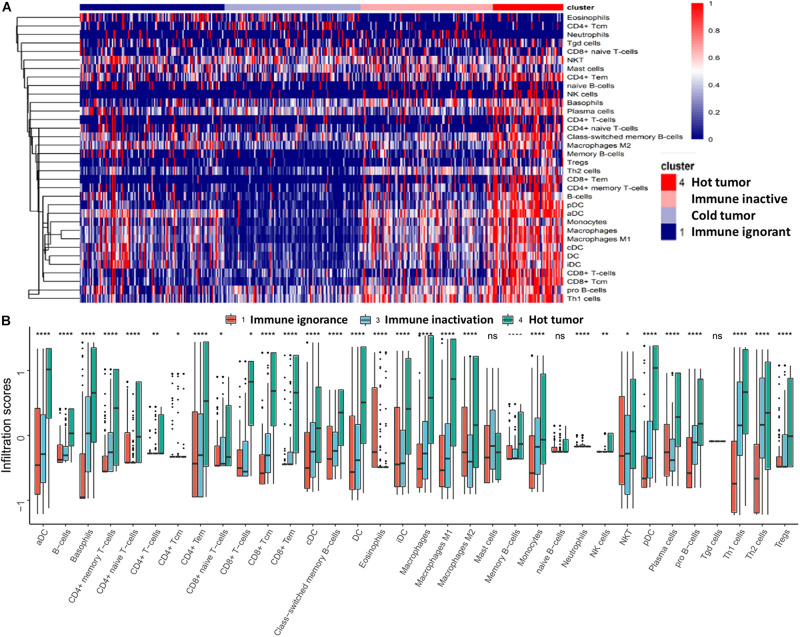
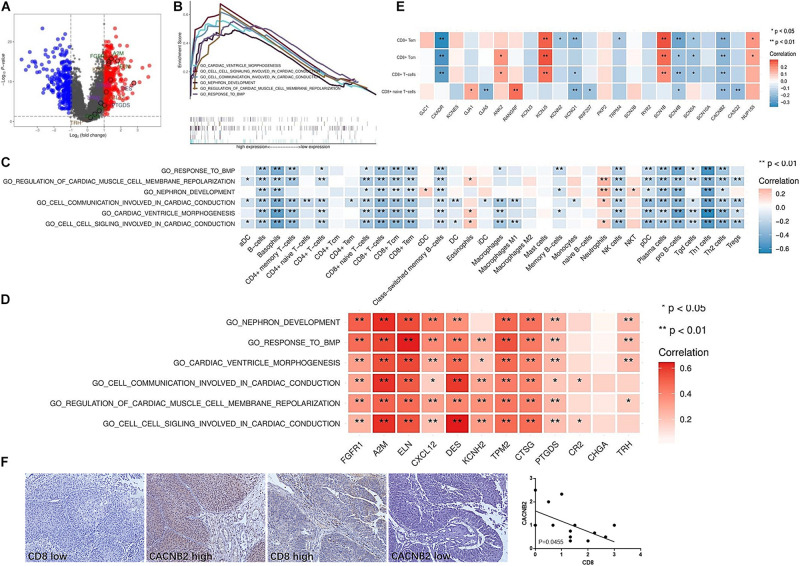
Urothelial bladder cancer (UBC) is the most common malignant tumor of the urinary system. Most patients do not benefit from treatment with immune checkpoint inhibitors, which are closely associated with immune profiling in the context of UBC. Therefore, we aimed to characterize the immune profile of UBC to identify different immune subtypes that may influence therapy choice. We identified four subtypes of UBC based on immune profiling including immune ignorant, cold tumor, immune inactive, and hot tumor. After excluding the cold tumor subtype because of its unique pathology distinct from the other types, a high correlation between patient survival and immune characteristics was observed. Most immune cell types had highly infiltrated the hot tumor subtype compared to other subtypes. Interestingly, although immune cells infiltrated the tumor microenvironment, they exhibited an exhaustion phenotype. CCL4 may be the key molecule functioning in immune cell infiltration in the hot tumor subtype. Moreover, neutrophils may function as an important suppressor in the tumor microenvironment of the immune ignorant and immune inactive subtypes. Furthermore, different tumor-intrinsic signaling pathways were involved in immune cell infiltration and exclusion in these four different subtypes. Immune profiling could serve as a prognostic biomarker for UBC, and has potential to guide treatment decisions in UBC. Targeting tumor-intrinsic signaling pathways may be a promising strategy to treat UBC.
尿路上皮膀胱癌(UBC)是泌尿系统最常见的恶性肿瘤。大多数患者无法从免疫检查点抑制剂治疗中获益,而免疫检查点抑制剂在UBC背景下与免疫特征密切相关。因此,我们旨在描述UBC的免疫特征,以识别可能影响治疗选择的不同免疫亚型。我们基于免疫特征确定了UBC的四种亚型,包括免疫无知型、冷肿瘤型、免疫无活性型和热肿瘤型。由于冷肿瘤亚型具有与其他类型不同的独特病理学特征,将其排除后,观察到患者生存率与免疫特征之间存在高度相关性。与其他亚型相比,大多数免疫细胞类型在热肿瘤亚型中高度浸润。有趣的是,尽管免疫细胞浸润了肿瘤微环境,但它们表现出耗竭表型。CCL4可能是在热肿瘤亚型中免疫细胞浸润起作用的关键分子。此外,中性粒细胞可能在免疫无知型和免疫无活性亚型的肿瘤微环境中作为重要的抑制因子发挥作用。此外,这四种不同亚型中不同的肿瘤内在信号通路参与了免疫细胞的浸润和排除。免疫特征可作为UBC的预后生物标志物,并有可能指导UBC的治疗决策。靶向肿瘤内在信号通路可能是治疗UBC的一种有前景的策略。