Tsuchiya Hiroyuki, Shiota Goshi
Division of Medical Genetics and Regenerative Medicine, Department of Genomic Medicine and Regenerative Therapy, Faculty of Medicine, Tottori University, 86 Nishi-cho, Yonago, Tottori, 683-8503, Japan.
Regen Ther. 2021 Mar 11;17:20-33. doi: 10.1016/j.reth.2021.02.006. eCollection 2021 Jun.
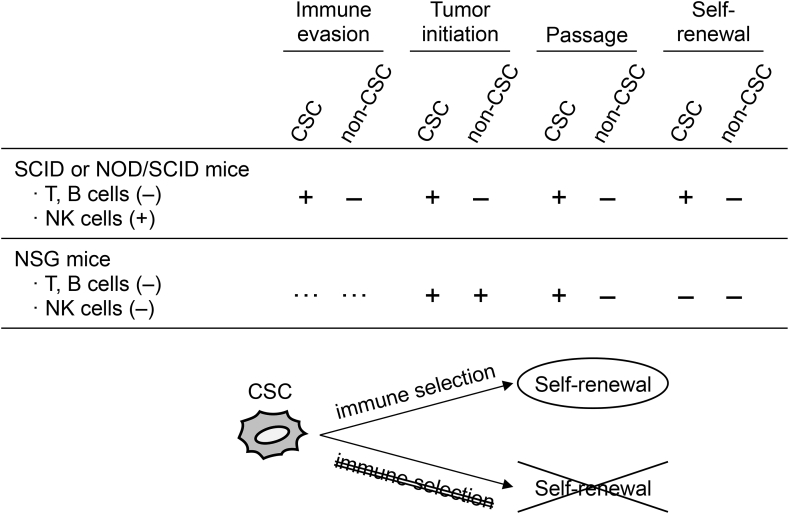
Tumor immunity represents a new avenue for cancer therapy. Immune checkpoint inhibitors have successfully improved outcomes in several tumor types. In addition, currently, immune cell-based therapy is also attracting significant attention. However, the clinical efficacy of these treatments requires further improvement. The mechanisms through which cancer cells escape the immune response must be identified and clarified. Cancer stem cells (CSCs) play a central role in multiple aspects of malignant tumors. CSCs can initiate tumors in partially immunocompromised mice, whereas non-CSCs fail to form tumors, suggesting that tumor initiation is a definitive function of CSCs. However, the fact that non-CSCs also initiate tumors in more highly immunocompromised mice suggests that the immune evasion property may be a more fundamental feature of CSCs rather than a tumor-initiating property. In this review, we summarize studies that have elucidated how CSCs evade tumor immunity and create an immunosuppressive milieu with a focus on CSC-specific characteristics and functions. These profound mechanisms provide important clues for the development of novel tumor immunotherapies.
肿瘤免疫是癌症治疗的新途径。免疫检查点抑制剂已成功改善了多种肿瘤类型的治疗结果。此外,目前基于免疫细胞的疗法也备受关注。然而,这些治疗方法的临床疗效仍需进一步提高。必须识别并阐明癌细胞逃避免疫反应的机制。癌症干细胞(CSCs)在恶性肿瘤的多个方面起着核心作用。癌症干细胞可在部分免疫受损的小鼠中引发肿瘤,而非癌症干细胞则无法形成肿瘤,这表明肿瘤起始是癌症干细胞的决定性功能。然而,非癌症干细胞在免疫受损程度更高的小鼠中也能引发肿瘤这一事实表明,免疫逃逸特性可能是癌症干细胞更基本的特征,而非肿瘤起始特性。在本综述中,我们总结了已阐明癌症干细胞如何逃避肿瘤免疫并营造免疫抑制环境的研究,重点关注癌症干细胞的特异性特征和功能。这些深刻的机制为新型肿瘤免疫疗法的开发提供了重要线索。