Elton Linzy, Haider Najmul, Kock Richard, Thomason Margaret J, Tembo John, Arruda Liã Bárbara, Ntoumi Francine, Zumla Alimuddin, McHugh Timothy D
Centre for Clinical Microbiology, Division of Infection & Immunity, University College London, London, UK.
Royal Veterinary College, London, UK.
One Health Outlook. 2021;3(1):5. doi: 10.1186/s42522-021-00037-8. Epub 2021 Mar 22.
The emergence of high consequence pathogens such as Ebola and SARS-CoV-2, along with the continued burden of neglected diseases such as rabies, has highlighted the need for preparedness for emerging and endemic infectious diseases of zoonotic origin in sub-Saharan Africa (SSA) using a One Health approach. To identify trends in SSA preparedness, the World Health Organization (WHO) Joint External Evaluation (JEE) reports were analysed. JEEs are voluntary, collaborative processes to assess country's capacities to prevent, detect and rapidly respond to public health risks. This report aimed to analyse the JEE zoonotic disease preparedness data as a whole and identify strengths and weaknesses.
JEE zoonotic disease preparedness scores for 44 SSA countries who had completed JEEs were analysed. An overall zoonotic disease preparedness score was calculated as an average of the sum of all the SSA country zoonotic disease preparedness scores and compared to the overall mean JEE score. Zoonotic disease preparedness indicators were analysed and data were collated into regions to identify key areas of strength.
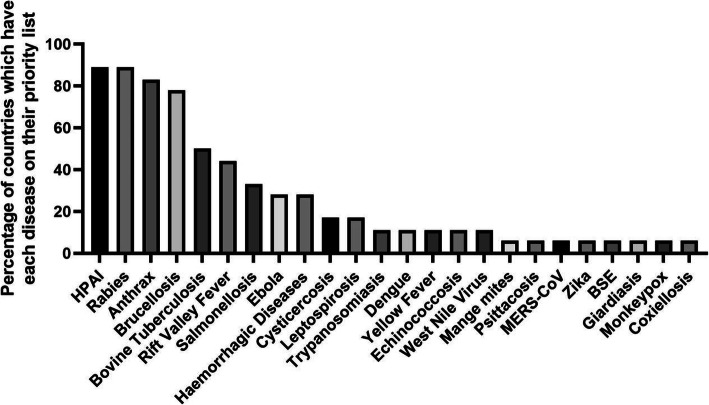
The mean 'Zoonotic disease' preparedness score (2.35, range 1.00-4.00) was 7% higher compared to the mean overall JEE preparedness score (2.19, range 1.55-3.30), putting 'Zoonotic Diseases' 5th out of 19 JEE sub-areas for preparedness. The average scores for each 'Zoonotic Disease' category were 2.45 for 'Surveillance Systems', 2.76 for 'Veterinary Workforce' and 1.84 for 'Response Mechanisms'. The Southern African region scored highest across the 'Zoonotic disease' categories (2.87).A multisectoral priority zoonotic pathogens list is in place for 43% of SSA countries and 70% reported undertaking national surveillance on 1-5 zoonotic diseases. 70% of SSA countries reported having public health training courses in place for veterinarians and 30% had veterinarians in all districts (reported as sufficient staffing). A multisectoral action plan for zoonotic outbreaks was in place for 14% countries and 32% reported having an established inter-agency response team for zoonotic outbreaks. The zoonotic diseases that appeared most in reported country priority lists were rabies and Highly Pathogenic Avian Influenza (HPAI) (both 89%), anthrax (83%), and brucellosis (78%).
With 'Zoonotic Diseases' ranking 5th in the JEE sub-areas and a mean SSA score 7% greater than the overall mean JEE score, zoonotic disease preparedness appears to have the attention of most SSA countries. However, the considerable range suggests that some countries have more measures in place than others, which may perhaps reflect the geography and types of pathogens that commonly occur. The category 'Response Mechanisms' had the lowest mean score across SSA, suggesting that implementing a multisectoral action plan and response team could provide the greatest gains.
埃博拉和严重急性呼吸综合征冠状病毒2(SARS-CoV-2)等高后果病原体的出现,以及狂犬病等被忽视疾病的持续负担,凸显了撒哈拉以南非洲(SSA)采用“同一健康”方法防范人畜共患起源的新发和地方性传染病的必要性。为确定SSA防范工作的趋势,对世界卫生组织(WHO)联合外部评估(JEE)报告进行了分析。JEE是评估各国预防、检测和快速应对公共卫生风险能力的自愿性协作过程。本报告旨在全面分析JEE人畜共患病防范数据,并确定优势和劣势。
分析了44个已完成JEE的SSA国家的JEE人畜共患病防范得分。计算总体人畜共患病防范得分,即所有SSA国家人畜共患病防范得分总和的平均值,并与总体JEE平均得分进行比较。对人畜共患病防范指标进行了分析,并将数据整理到各个区域以确定关键优势领域。
“人畜共患病”防范平均得分(2.35,范围1.00 - 4.00)比总体JEE防范平均得分(2.19,范围1.55 - 3.30)高7%,使“人畜共患病”在19个JEE子领域的防范排名中位列第5。每个“人畜共患病”类别的平均得分分别为:“监测系统”2.45、“兽医劳动力”2.76、“应对机制”1.84。南部非洲地区在“人畜共患病”类别中的得分最高(2.87)。43%的SSA国家制定了多部门重点人畜共患病原体清单,70%的国家报告对1 - 5种人畜共患病进行了国家监测。70%的SSA国家报告为兽医提供了公共卫生培训课程,30%的国家所有地区都有兽医(报告称人员配备充足)。14%的国家制定了人畜共患病疫情多部门行动计划,32%的国家报告已建立人畜共患病疫情跨部门应对小组。报告的国家重点清单中出现最多的人畜共患病是狂犬病和高致病性禽流感(HPAI)(均为89%)、炭疽(83%)和布鲁氏菌病(78%)。
“人畜共患病”在JEE子领域中排名第5,SSA平均得分比JEE总体平均得分高7%,人畜共患病防范似乎受到了大多数SSA国家的关注。然而,得分范围差异较大表明,一些国家采取的措施比其他国家更多,这可能反映了常见病原体的地理分布和类型。“应对机制”类别在SSA的平均得分最低,这表明实施多部门行动计划和应对小组可能会带来最大收益。