Lu Ze, Vincent Joshua I, MacDermid Joy C
School of Rehabilitation Science, McMaster University, Hamilton, Ontario, Canada.
Roth McFarlane Hand and Upper Limb Centre, St. Joseph's Hospital, London, Ontario, Canada.
Arch Rehabil Res Clin Transl. 2021 Jan 13;3(1):100103. doi: 10.1016/j.arrct.2021.100103. eCollection 2021 Mar.
To use Rasch analysis to examine the measurement properties of the 23-item version of the Work Instability Scale (WIS-23) in a sample of worker compensation claimants with upper extremity disorders.
Secondary data analysis on the data retrieved from a cross-sectional study.
Tertiary care hospital.
Patients (N=392) attending a specialty clinic for workers with upper limb injuries at a tertiary hospital were prospectively enrolled.
Not applicable.
WIS-23.
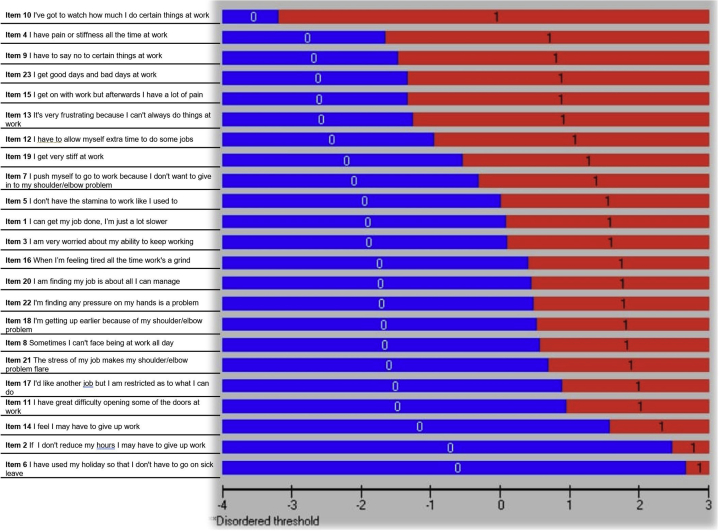
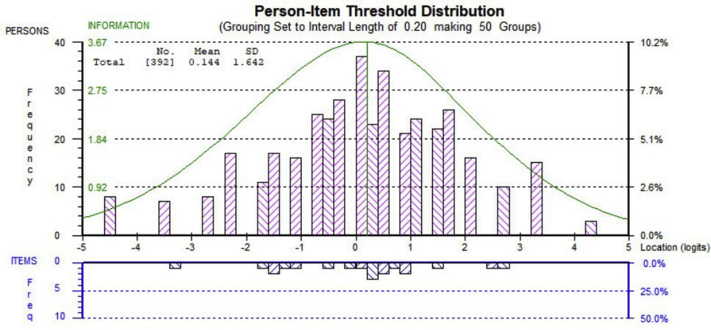
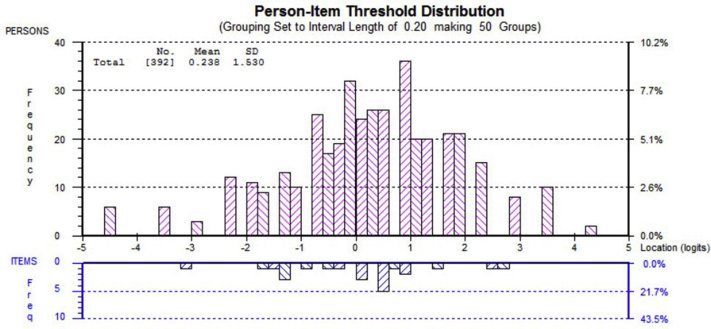
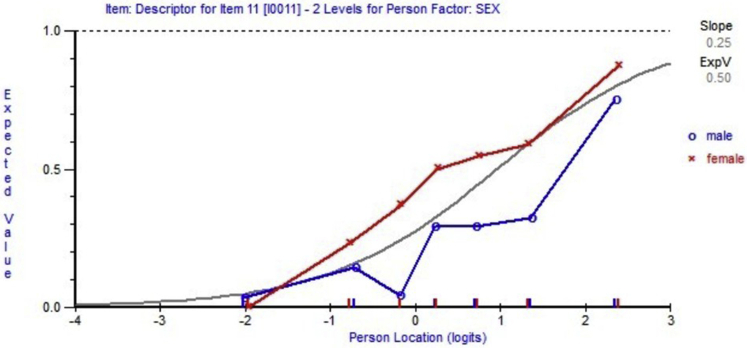
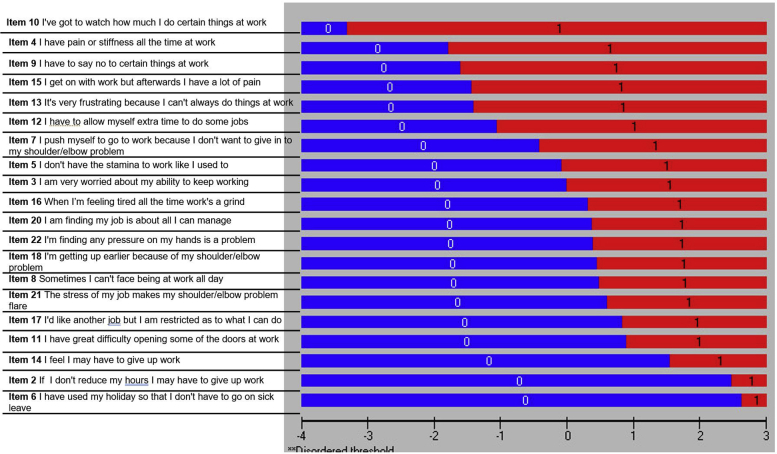
The study sample contained 392 participants between the ages of 19 and 73 years (mean, 47.0±10.5y). There were 148 (37.8%) women, 182 (46.4%) men, and 62 (15.8%) participants for whom sex identification was unavailable. The initial WIS data analysis showed significant misfit from the Rasch model (item-trait interaction: χ=293.52; <.0001). Item removal and splitting were performed to improve the model fit, resulting in a 20-item scale that met all assumptions (χ=160.42; =.008), including unidimensionality, local independence of items, and the absence of differential item function based on age, sex of respondents, employment type, and affected upper extremity area across all tested factors.
With the application of Rasch analysis, we refined the WIS-23 to produce a 20-item WIS for work-related upper extremity disorders (WIS-WREUD). The 20-item WIS-WREUD demonstrated excellent item and person fit, unidimensionality, acceptable person separation index, and local independency. The WIS-20 may provide better measurement properties, although longitudinal psychometric evaluations are needed.
运用拉施分析检验工作不稳定量表23项版本(WIS - 23)在患有上肢疾病的工伤索赔者样本中的测量属性。
对横断面研究中检索到的数据进行二次数据分析。
三级护理医院。
前瞻性纳入在一家三级医院上肢损伤工人专科门诊就诊的患者(N = 392)。
不适用。
WIS - 23。
研究样本包含392名年龄在19岁至73岁之间的参与者(平均年龄47.0±10.5岁)。其中有148名(37.8%)女性,182名(46.4%)男性,62名(15.8%)参与者性别信息缺失。WIS的初始数据分析显示与拉施模型存在显著失配(项目 - 特质交互作用:χ = 293.52;P <.0001)。进行了项目删除和拆分以改善模型拟合,得到一个满足所有假设的20项量表(χ = 160.42;P = 0.008),包括单维度性、项目局部独立性,以及在所有测试因素(年龄、受访者性别、就业类型和受影响的上肢区域)上不存在项目功能差异。
通过应用拉施分析,我们对WIS - 23进行了优化,生成了一个用于与工作相关上肢疾病的20项WIS(WIS - WREUD)。20项的WIS - WREUD显示出良好的项目和人员拟合、单维度性、可接受的人员分离指数以及局部独立性。尽管需要进行纵向心理测量评估,但WIS - 20可能具有更好的测量属性。