Zhan Zhucheng, Jing Zheng, He Bing, Hosseini Noshad, Westerhoff Maria, Choi Eun-Young, Garmire Lana X
School of Science and Engineering, Chinese University of Hong Kong, Shenzhen Campus, Shenzhen 518172, P.R. China.
Department of Applied Statistics, University of Michigan, Ann Arbor, MI 48104, USA.
NAR Genom Bioinform. 2021 Mar 22;3(1):lqab015. doi: 10.1093/nargab/lqab015. eCollection 2021 Mar.
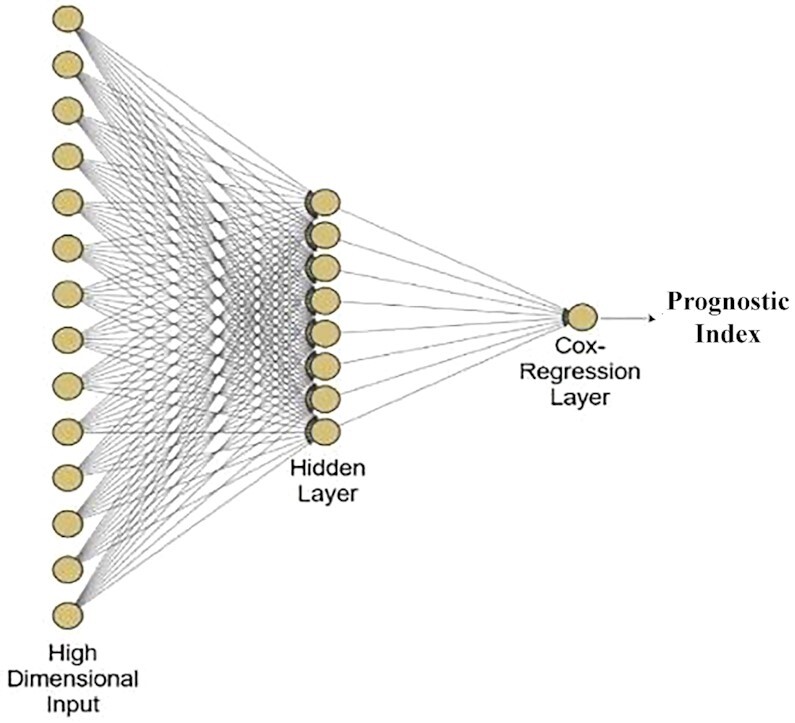
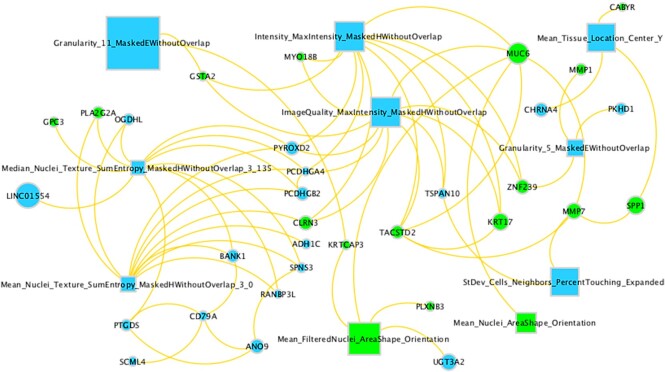
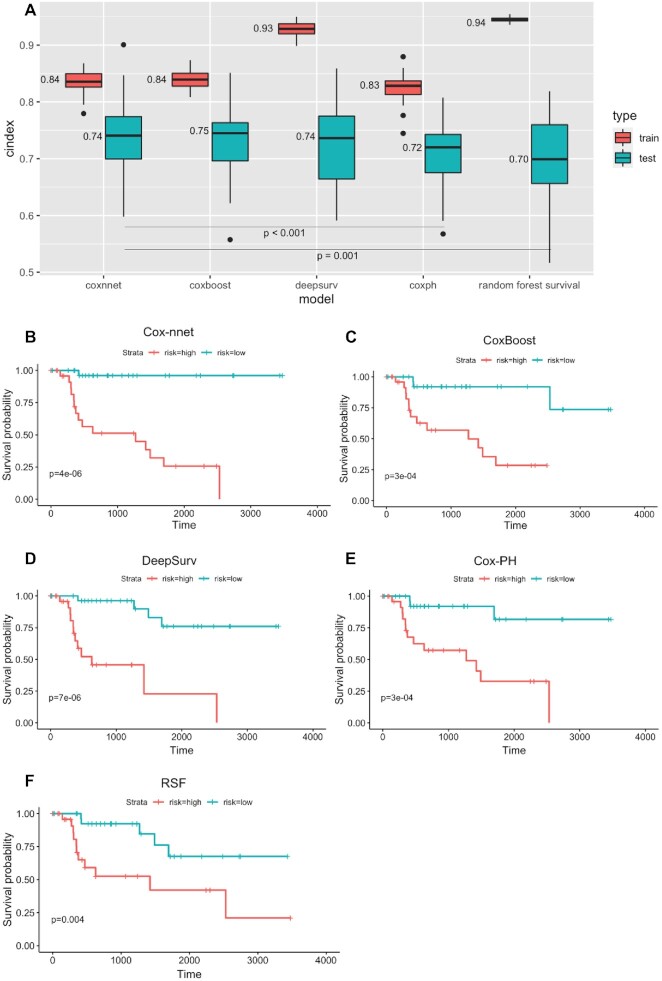
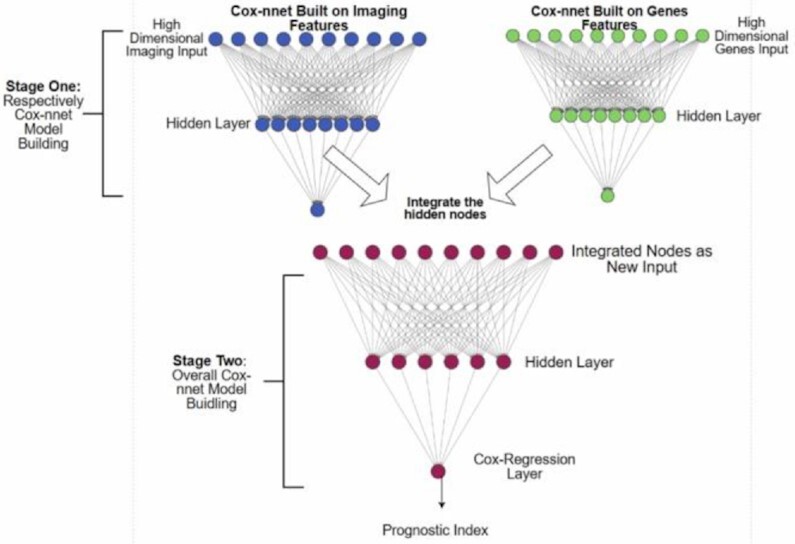
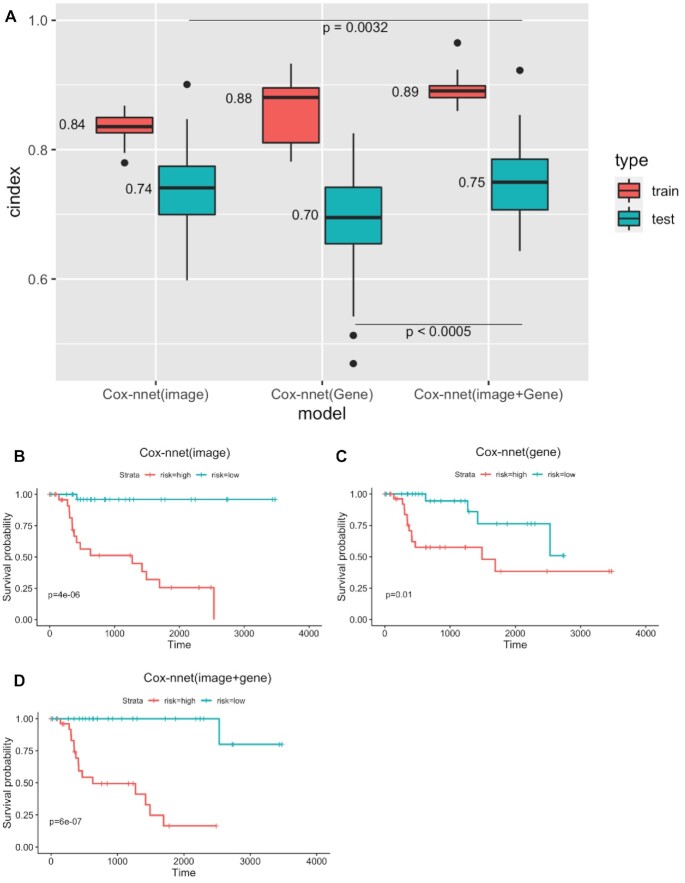
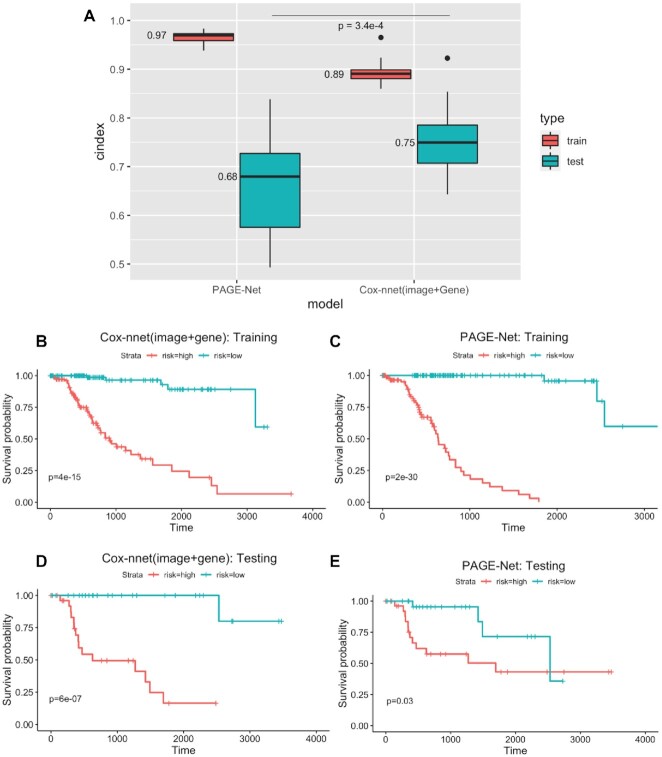
Pathological images are easily accessible data with the potential of prognostic biomarkers. Moreover, integration of heterogeneous data types from multi-modality, such as pathological image and gene expression data, is invaluable to help predicting cancer patient survival. However, the analytical challenges are significant. Here, we take the hepatocellular carcinoma (HCC) pathological image features extracted by CellProfiler, and apply them as the input for Cox-nnet, a neural network-based prognosis prediction model. We compare this model with the conventional Cox proportional hazards (Cox-PH) model, CoxBoost, Random Survival Forests and DeepSurv, using -index and log-rank -values. The results show that Cox-nnet is significantly more accurate than Cox-PH and Random Survival Forests models and comparable with CoxBoost and DeepSurv models, on pathological image features. Further, to integrate pathological image and gene expression data of the same patients, we innovatively construct a two-stage Cox-nnet model, and compare it with another complex neural-network model called PAGE-Net. The two-stage Cox-nnet complex model combining histopathology image and transcriptomic RNA-seq data achieves much better prognosis prediction, with a median -index of 0.75 and log-rank -value of 6e-7 in the testing datasets, compared to PAGE-Net (median -index of 0.68 and log-rank -value of 0.03). Imaging features present additional predictive information to gene expression features, as the combined model is more accurate than the model with gene expression alone (median -index 0.70). Pathological image features are correlated with gene expression, as genes correlated to top imaging features present known associations with HCC patient survival and morphogenesis of liver tissue. This work proposes two-stage Cox-nnet, a new class of biologically relevant and interpretable models, to integrate multiple types of heterogenous data for survival prediction.
病理图像是易于获取的数据,具有作为预后生物标志物的潜力。此外,整合来自多模态的异质数据类型,如病理图像和基因表达数据,对于帮助预测癌症患者的生存情况非常有价值。然而,分析挑战巨大。在此,我们采用由CellProfiler提取的肝细胞癌(HCC)病理图像特征,并将其作为基于神经网络的预后预测模型Cox-nnet的输入。我们使用C指数和对数秩P值,将该模型与传统的Cox比例风险(Cox-PH)模型、CoxBoost、随机生存森林和DeepSurv进行比较。结果表明,在病理图像特征方面,Cox-nnet比Cox-PH和随机生存森林模型显著更准确,与CoxBoost和DeepSurv模型相当。此外,为了整合同一患者的病理图像和基因表达数据,我们创新性地构建了一个两阶段Cox-nnet模型,并将其与另一个名为PAGE-Net的复杂神经网络模型进行比较。与PAGE-Net(中位数C指数为0.68,对数秩P值为0.03)相比,结合组织病理学图像和转录组RNA-seq数据的两阶段Cox-nnet复杂模型实现了更好的预后预测,在测试数据集中中位数C指数为0.75,对数秩P值为6e-7。成像特征为基因表达特征提供了额外的预测信息,因为联合模型比仅使用基因表达的模型更准确(中位数C指数0.70)。病理图像特征与基因表达相关,因为与顶级成像特征相关的基因呈现出与HCC患者生存和肝组织形态发生的已知关联。这项工作提出了两阶段Cox-nnet,这是一类新的具有生物学相关性和可解释性的模型,用于整合多种类型的异质数据进行生存预测。