Department of Psychiatry and Psychotherapy, University Medical Center of the Johannes Gutenberg University Mainz, Mainz, Germany.
Leibniz Institute for Resilience Research (LIR), Mainz, Germany.
Global Health. 2021 Mar 29;17(1):34. doi: 10.1186/s12992-021-00670-y.
Mental burden due to the SARS-CoV-2 pandemic has been widely reported for the general public and specific risk groups like healthcare workers and different patient populations. We aimed to assess its impact on mental health during the early phase by comparing pandemic with prepandemic data and to identify potential risk and protective factors.
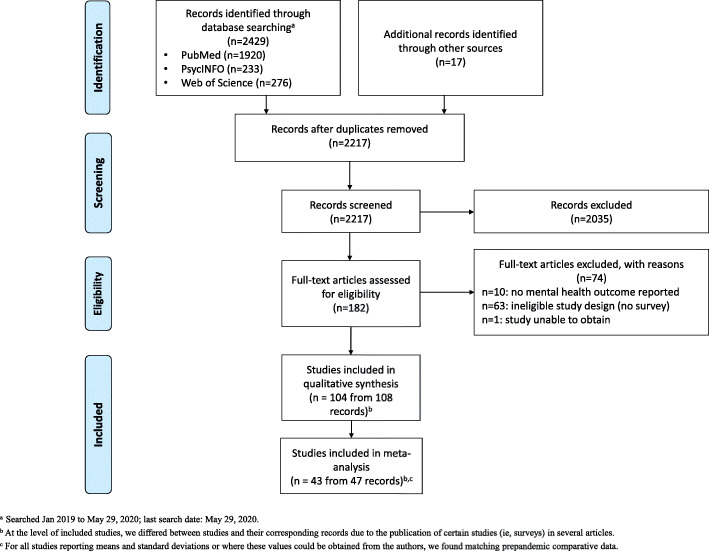
For this systematic review and meta-analyses, we systematically searched PubMed, PsycINFO, and Web of Science from January 1, 2019 to May 29, 2020, and screened reference lists of included studies. In addition, we searched PubMed and PsycINFO for prepandemic comparative data. Survey studies assessing mental burden by the SARS-CoV-2 pandemic in the general population, healthcare workers, or any patients (eg, COVID-19 patients), with a broad range of eligible mental health outcomes, and matching studies evaluating prepandemic comparative data in the same population (if available) were included. We used multilevel meta-analyses for main, subgroup, and sensitivity analyses, focusing on (perceived) stress, symptoms of anxiety and depression, and sleep-related symptoms as primary outcomes.
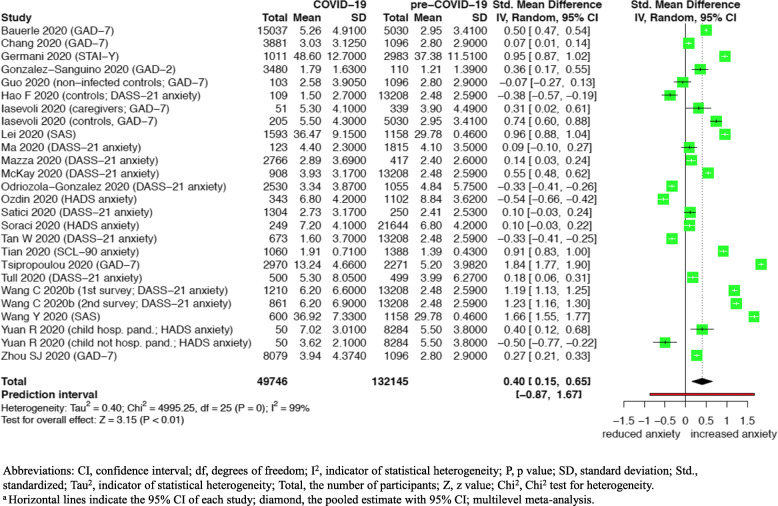
Of 2429 records retrieved, 104 were included in the review (n = 208,261 participants), 43 in the meta-analysis (n = 71,613 participants). While symptoms of anxiety (standardized mean difference [SMD] 0.40; 95% CI 0.15-0.65) and depression (SMD 0.67; 95% CI 0.07-1.27) were increased in the general population during the early phase of the pandemic compared with prepandemic conditions, mental burden was not increased in patients as well as healthcare workers, irrespective of COVID-19 patient contact. Specific outcome measures (eg, Patient Health Questionnaire) and older comparative data (published ≥5 years ago) were associated with increased mental burden. Across the three population groups, existing mental disorders, female sex, and concerns about getting infected were repeatedly reported as risk factors, while older age, a good economic situation, and education were protective.
This meta-analysis paints a more differentiated picture of the mental health consequences in pandemic situations than previous reviews. High-quality, representative surveys, high granular longitudinal studies, and more research on protective factors are required to better understand the psychological impacts of the SARS-CoV-2 pandemic and to help design effective preventive measures and interventions that are tailored to the needs of specific population groups.
SARS-CoV-2 大流行给公众以及医护人员等特定风险群体和不同患者群体带来了广泛的精神负担。我们旨在通过比较大流行期间和大流行前的数据来评估其对早期心理健康的影响,并确定潜在的风险和保护因素。
在这项系统评价和荟萃分析中,我们系统地检索了 PubMed、PsycINFO 和 Web of Science,检索时间从 2019 年 1 月 1 日至 2020 年 5 月 29 日,并筛选了纳入研究的参考文献列表。此外,我们还在 PubMed 和 PsycINFO 中检索了大流行前的对照数据。纳入了评估一般人群、医护人员或任何患者(如 COVID-19 患者)中 SARS-CoV-2 大流行造成的精神负担的调查研究,这些研究使用了广泛的合格心理健康结果,并评估了相同人群中(如有的话)大流行前的对照数据。我们使用多水平荟萃分析进行主要、亚组和敏感性分析,重点关注(感知)压力、焦虑和抑郁症状以及与睡眠相关的症状作为主要结局。
在检索到的 2429 条记录中,有 104 条被纳入综述(n=208261 名参与者),43 条被纳入荟萃分析(n=71613 名参与者)。与大流行前相比,一般人群在大流行早期阶段的焦虑症状(标准化均数差 [SMD] 0.40;95%CI 0.15-0.65)和抑郁症状(SMD 0.67;95%CI 0.07-1.27)增加,但患者和医护人员的精神负担并未增加,无论是否接触 COVID-19 患者。特定的结果测量(如患者健康问卷)和较旧的对照数据(发表时间≥5 年)与精神负担增加有关。在这三个人群组中,现有的精神障碍、女性性别和对感染的担忧被反复报告为风险因素,而年龄较大、经济状况良好和教育程度较高则是保护因素。
与之前的综述相比,这项荟萃分析更全面地描绘了大流行情况下的心理健康后果。需要高质量、有代表性的调查、高粒度的纵向研究以及更多关于保护因素的研究,以更好地了解 SARS-CoV-2 大流行的心理影响,并帮助设计针对特定人群需求的有效预防措施和干预措施。