Infectious Disease Discovery, Roche Pharmaceutical Research and Early Development, Roche Innovation Center Shanghai, Shanghai, China
Infectious Disease Discovery, Roche Pharmaceutical Research and Early Development, Roche Innovation Center Shanghai, Shanghai, China.
Antimicrob Agents Chemother. 2021 May 18;65(6). doi: 10.1128/AAC.02576-20.
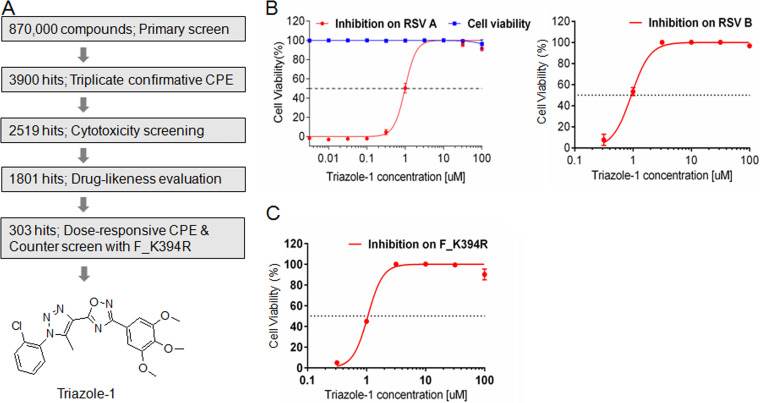
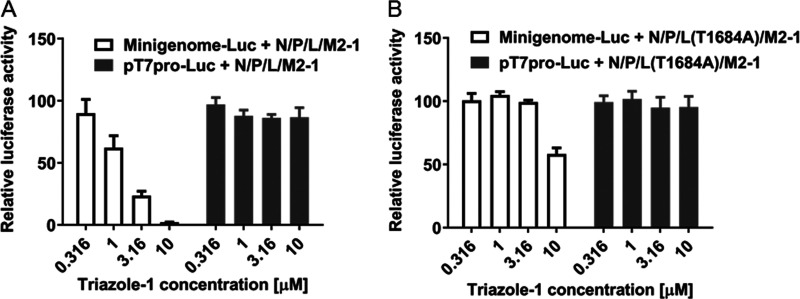
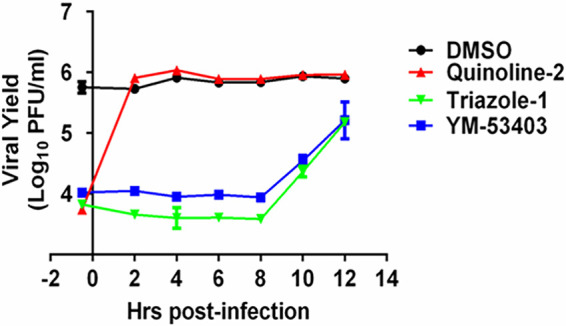
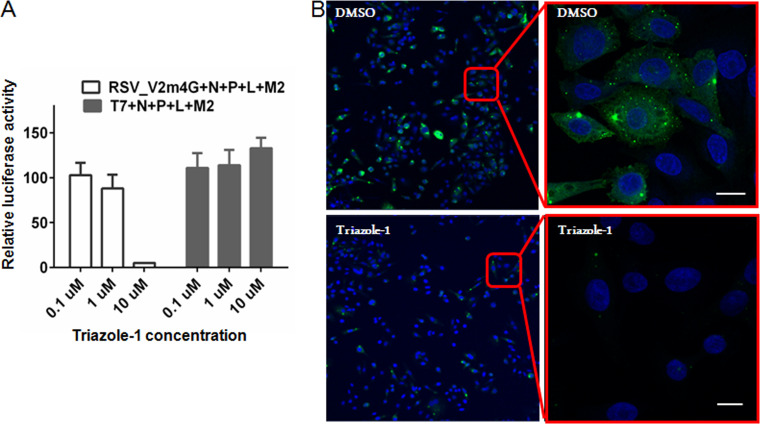
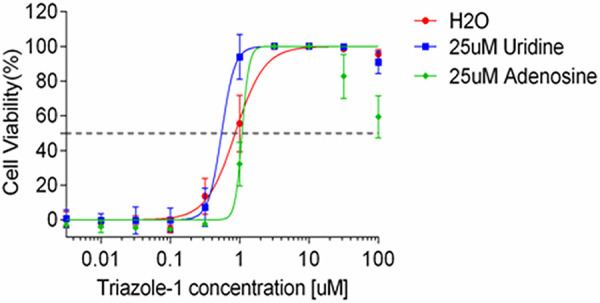
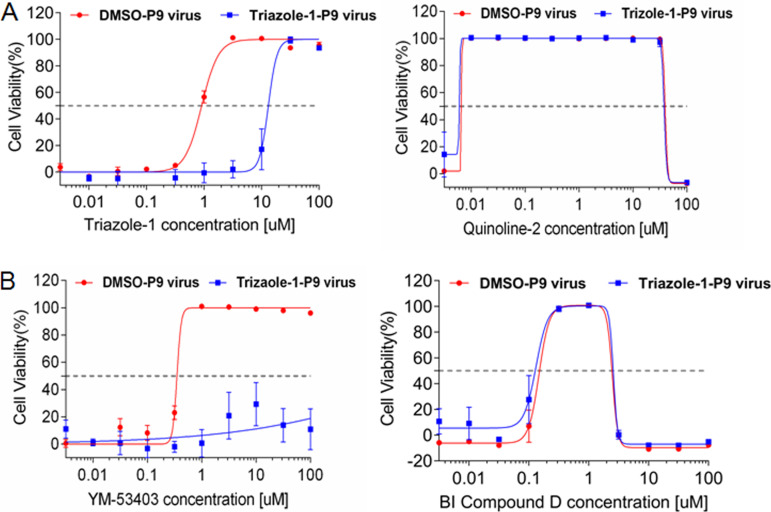
A high-throughput screen of a Roche internal chemical library based on inhibition of the respiratory syncytial virus (RSV)-induced cytopathic effect (CPE) on HEp-2 cells was performed to identify RSV inhibitors. Over 2,000 hits were identified and confirmed to be efficacious against RSV infection Here, we report the discovery of a triazole-oxadiazole derivative, designated triazole-1, as an RSV replication inhibitor, and we characterize its mechanism of action. Triazole-1 inhibited the replication of both RSV A and B subtypes with 50% inhibitory concentration (IC) values of approximately 1 μM, but it was not effective against other viruses, including influenza virus A, human enterovirus 71 (EV71), and vaccinia virus. Triazole-1 was shown to inhibit RSV replication when added at up to 8 h after viral entry, suggesting that it inhibits RSV after viral entry. In a minigenome reporter assay in which RSV transcription regulatory sequences flanking a luciferase gene were cotransfected with RSV N/P/L/M2-1 genes into HEp-2 cells, triazole-1 demonstrated specific and dose-dependent RSV transcription inhibitory effects. Consistent with these findings, deep sequencing of the genomes of triazole-1-resistant mutants revealed a single point mutation (A to G) at nucleotide 13546 of the RSV genome, leading to a T-to-A change at amino acid position 1684 of the L protein, which is the RSV RNA polymerase for both viral transcription and replication. The effect of triazole-1 on minigenome transcription, which was mediated by the L protein containing the T1684A mutation, was significantly reduced, suggesting that the T1684A mutation alone conferred viral resistance to triazole-1.
高通量筛选罗氏内部化学文库,基于抑制呼吸道合胞病毒(RSV)诱导的 HEp-2 细胞病变效应(CPE),以鉴定 RSV 抑制剂。鉴定出超过 2000 个化合物,证实对 RSV 感染有效。在这里,我们报告发现一种三唑-噁二唑衍生物,命名为三唑-1,作为 RSV 复制抑制剂,并对其作用机制进行了表征。三唑-1 抑制 RSV A 和 B 两种亚型的复制,半数抑制浓度(IC₅₀)值约为 1 μM,但对其他病毒如流感病毒 A、人肠道病毒 71(EV71)和牛痘病毒无效。三唑-1 在病毒进入后长达 8 小时添加时可抑制 RSV 复制,表明它在病毒进入后抑制 RSV。在 minigenome 报告基因实验中,将 RSV 转录调控序列侧翼的荧光素酶基因与 RSV N/P/L/M2-1 基因共转染到 HEp-2 细胞中,三唑-1 表现出特异性和剂量依赖性的 RSV 转录抑制作用。与这些发现一致,对三唑-1 抗性突变体的基因组进行深度测序表明,RSV 基因组 13546 位核苷酸发生单点突变(A 至 G),导致 L 蛋白 1684 位氨基酸由 T 突变为 A,这是 RSV 聚合酶,用于病毒转录和复制。三唑-1 对 minigenome 转录的影响,由含有 T1684A 突变的 L 蛋白介导,显著降低,表明 T1684A 突变单独赋予病毒对三唑-1 的抗性。