Department of Hepatobiliary Surgery, The Second Affiliated Hospital of Anhui Medical University.
Department of Hepatobiliary Surgery, The First Affiliated Hospital of Anhui Medical University, Hefei, Anhui, PR China.
Anticancer Drugs. 2021 Sep 1;32(8):822-828. doi: 10.1097/CAD.0000000000001074.
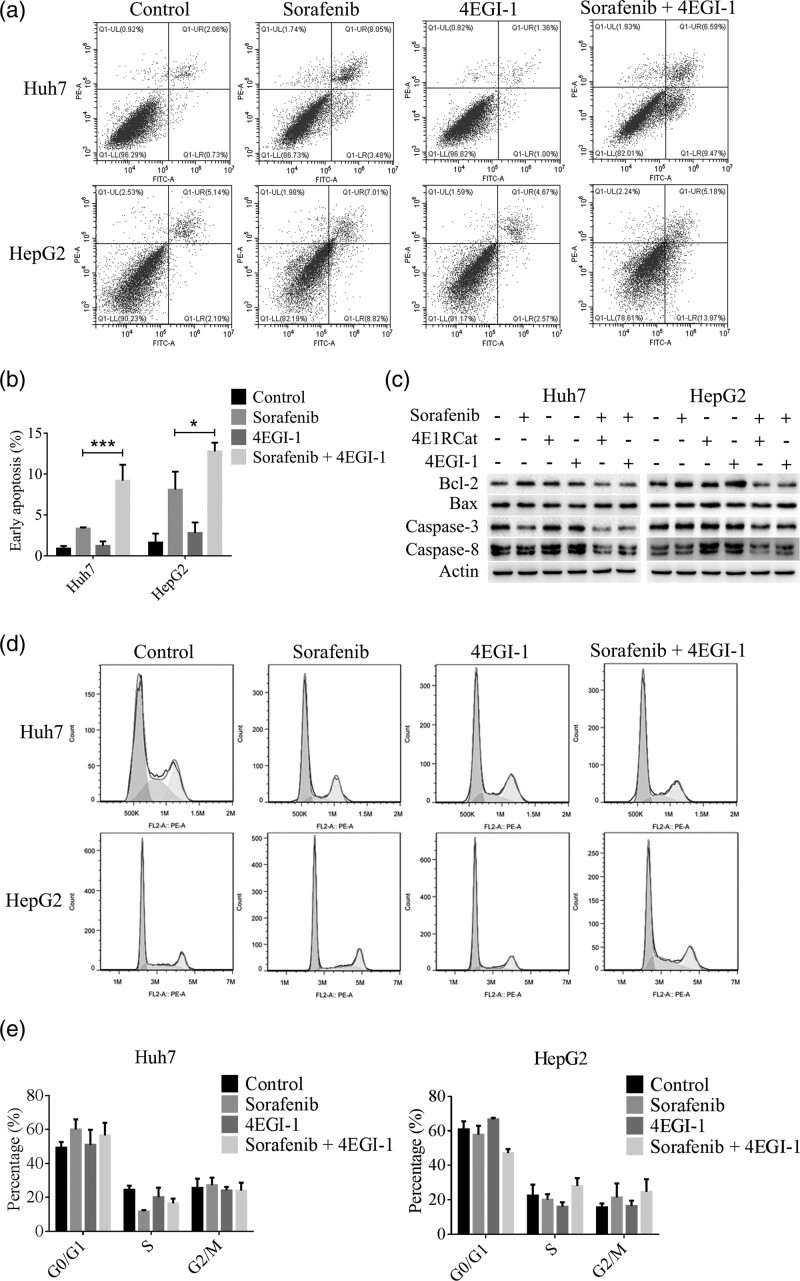
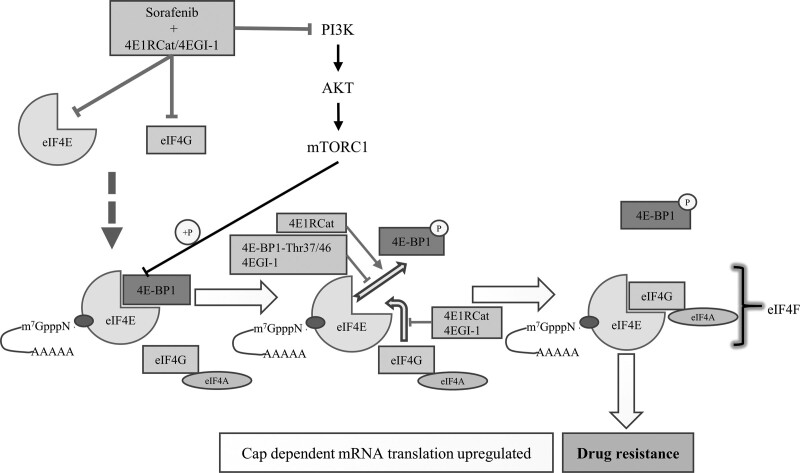
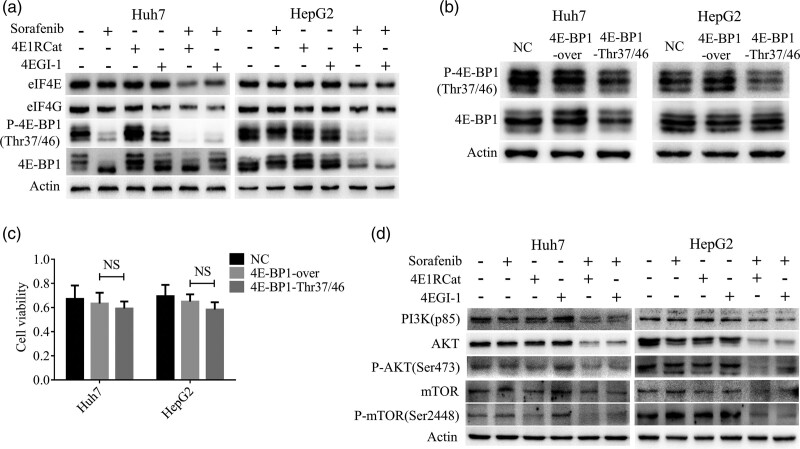
The clinical efficacy of sorafenib in hepatocellular carcinoma (HCC) is disappointing due to its low response rate and high rates of adverse effects. The eukaryotic translation initiation factor 4F (eIF4F) complex, mainly consisting of eIF4E-eukaryotic translation initiation factor 4G (eIF4G) interaction, is involved in the induction of drug resistance. Herein, we aimed to demonstrate that eIF4E-eIF4G complex inhibition enhanced the effect of sorafenib. The antiproliferation effect of combined treatment was evaluated by MTT assay and colony formation assay. Flow cytometry was used to detect the early cell apoptosis and cell cycle. The specific mechanism was demonstrated using western blot and lentivirus transfection. The combination of sorafenib with eIF4E-eIF4G inhibitors 4E1RCat (structural) or 4EGI-1 (competitive) synergistically inhibited the cell viability and colony formation ability of HCC cells. Moreover, the combined treatment induced more early apoptosis than sorafenib alone through downregulating the Bcl-2 expression. Besides, the coadministration of sorafenib and 4E1RCat or 4EGI-1 synergistically inhibited the expressions of eIF4E, eIF4G and phospho-4E-BP1 in HCC cells while blocking the phosphorylation of 4E-BP1 with lentiviral transfection failed to increase the sensitivity of HCC cells to sorafenib treatment. PI3K-AKT-mTOR signaling was also inhibited by the combined treatment. In a word, eIF4E-eIF4G complex inhibition synergistically enhances the effect of sorafenib in HCC treatment.
索拉非尼治疗肝细胞癌(HCC)的临床疗效并不理想,因为其反应率低,不良反应发生率高。真核翻译起始因子 4F(eIF4F)复合物主要由 eIF4E-真核翻译起始因子 4G(eIF4G)相互作用组成,参与诱导耐药。在此,我们旨在证明 eIF4E-eIF4G 复合物抑制可增强索拉非尼的疗效。通过 MTT 检测和集落形成实验评估联合治疗的抗增殖作用。采用流式细胞术检测早期细胞凋亡和细胞周期。通过 Western blot 和慢病毒转染验证特定机制。索拉非尼与 eIF4E-eIF4G 抑制剂 4E1RCat(结构)或 4EGI-1(竞争性)联合应用可协同抑制 HCC 细胞的活力和集落形成能力。此外,联合治疗通过下调 Bcl-2 表达诱导比索拉非尼单独治疗更多的早期细胞凋亡。此外,索拉非尼与 4E1RCat 或 4EGI-1 联合应用协同抑制 HCC 细胞中 eIF4E、eIF4G 和磷酸化 4E-BP1 的表达,而通过慢病毒转染阻断 4E-BP1 的磷酸化未能增加 HCC 细胞对索拉非尼治疗的敏感性。PI3K-AKT-mTOR 信号通路也被联合治疗抑制。总之,eIF4E-eIF4G 复合物抑制协同增强索拉非尼在 HCC 治疗中的疗效。