Department of Orthopedic Surgery, HanDan Central Hospital, HanDan, China.
Department of Trauma Emergency Center, The Third Hospital of Hebei Medical University, Orthopaedics Research Institution of Hebei Province, Key Laboratory of Biomechanics of Hebei Province, Shijiazhuang, China.
Orthop Surg. 2021 May;13(3):900-907. doi: 10.1111/os.12937. Epub 2021 Mar 30.
To investigate the epidemiological characteristics of major intra-articular fractures.
This retrospective study enrolled patients with major intra-articular fractures who were treated in the Third Hospital of Hebei Medical University from January 2015 to December 2019. A total of 11,084 patients (7,338 [66.20%] males and 3,746 [33.80%] females) meeting the inclusion and exclusion criteria were included. The distribution characteristics of intra-articular fractures involving shoulder, elbow, wrist, hip, knee, ankle, and subtalar joints were identified.The potential associations between fractures and various other factors, such as age, gender, sites, were explored.
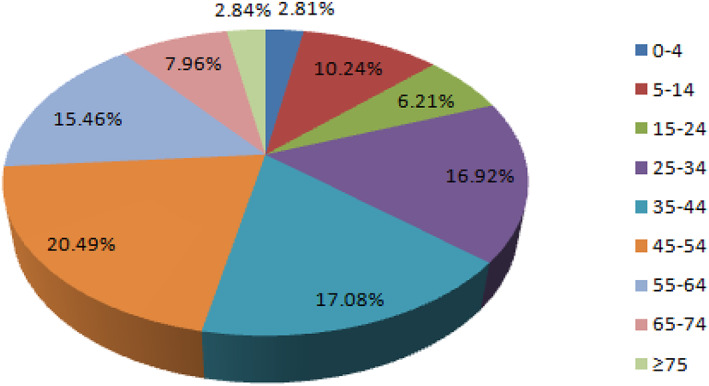
There were 74 cases (0.67%) of shoulder fractures, 1,941 cases (17.51%) of elbow fractures, 1,155 cases (10.42%) of wrist fractures, 520 cases (4.69%) of hip fractures, 3,118 cases (28.13%) of knee fractures, 2,156 cases (19.45%) of ankle fractures, and 2,120 cases (19.13%) of subtalar fractures. The overall male-to-female ratio was 1.96:1. The highest proportion age group of major intra-articular fractures included the ages 45-54 years. For males, the highest proportion age group was 45-54 years, for females, it was 55-64 years. The knee joint fracture was the most common type, accounting for 28.13%. For male and female patients, knee fractures accounted for 26.19% and 31.93%, respectively, with a male to female ratio of 1.13:1. The proportion of shoulder fractures was the smallest among this investigation, accounting for 0.67%. For male and female patients, shoulder fractures accounted for 0.44% and 1.12%, respectively, with a male to female ratio of 0.76:1. The age group with the highest proportion of shoulder joint fractures was ≥65 year olds (41.89%), with a male to female ratio of 0.76:1. The age group with the highest risk of elbow, wrist, hip, knee, ankle, and subtalar joint fracture was 5-14 year olds (33.59%) with a male to female ratio of 3.29:1, 5-14 year olds (23.98%) with a male to female ratio of 6.91:1, 45-54 year olds (26.92%) with a male to female ratio of 5.67:1, 45-54 year olds (24.60%) with a male to female ratio of 1.68:1, 25-34 year olds (20.36%) with a male to female ratio of 2.30:1, 45-54 year olds (27.41%) with a male to female ratio of 9.02:1, respectively. The most common site of intra-articular fractures in different age groups was corresponding as follows: 0-4 year olds (elbow), 5-14 year olds (elbow), 15-24 year olds (ankle), 25-34 year olds (subtalar joint), 35-44 year olds (subtalar joint), 45-54 year olds (knee), 55-64 year olds (knee), 65-74 year olds (knee), and ≥75 year olds (knee).
The current study revealed the age- and gender-specific epidemiological characteristics of major intra-articular fractures, providing a basis for clinical evaluation and practices.
研究主要关节内骨折的流行病学特征。
本回顾性研究纳入了 2015 年 1 月至 2019 年 12 月在河北医科大学第三医院治疗的主要关节内骨折患者。共纳入 11084 例患者(7338 例男性[66.20%]和 3746 例女性[33.80%]),符合纳入和排除标准。确定了涉及肩部、肘部、腕部、髋部、膝部、踝关节和跗骨关节的关节内骨折的分布特征。探讨了骨折与年龄、性别、部位等其他各种因素之间的潜在关联。
有 74 例(0.67%)肩部骨折,1941 例(17.51%)肘部骨折,1155 例(10.42%)腕部骨折,520 例(4.69%)髋部骨折,3118 例(28.13%)膝部骨折,2156 例(19.45%)踝关节骨折,2120 例(19.13%)跗骨关节骨折。总体男女比例为 1.96:1。主要关节内骨折的最高比例年龄组包括 45-54 岁年龄组。对于男性,最高比例年龄组为 45-54 岁,对于女性,为 55-64 岁。膝关节骨折是最常见的类型,占 28.13%。对于男性和女性患者,膝关节骨折分别占 26.19%和 31.93%,男女比例为 1.13:1。在本次调查中,肩部骨折的比例最小,占 0.67%。对于男性和女性患者,肩部骨折分别占 0.44%和 1.12%,男女比例为 0.76:1。肩部关节骨折比例最高的年龄组为≥65 岁(41.89%),男女比例为 0.76:1。肘部、腕部、髋部、膝部、踝关节和跗骨关节骨折风险最高的年龄组为 5-14 岁(33.59%),男女比例为 3.29:1,5-14 岁(23.98%),男女比例为 6.91:1,45-54 岁(26.92%),男女比例为 5.67:1,45-54 岁(24.60%),男女比例为 1.68:1,25-34 岁(20.36%),男女比例为 2.30:1,45-54 岁(27.41%),男女比例为 9.02:1。不同年龄组的关节内骨折最常见的部位如下:0-4 岁(肘部),5-14 岁(肘部),15-24 岁(踝关节),25-34 岁(跗骨关节),35-44 岁(跗骨关节),45-54 岁(膝关节),55-64 岁(膝关节),65-74 岁(膝关节),≥75 岁(膝关节)。
本研究揭示了主要关节内骨折的年龄和性别特异性流行病学特征,为临床评估和实践提供了依据。