Department of Medical Oncology, Dana-Farber Cancer Institute, Boston, MA, USA.
The Eli and Edythe L. Broad Institute, Cambridge, MA, USA.
Nat Commun. 2021 Mar 30;12(1):1979. doi: 10.1038/s41467-021-22139-7.
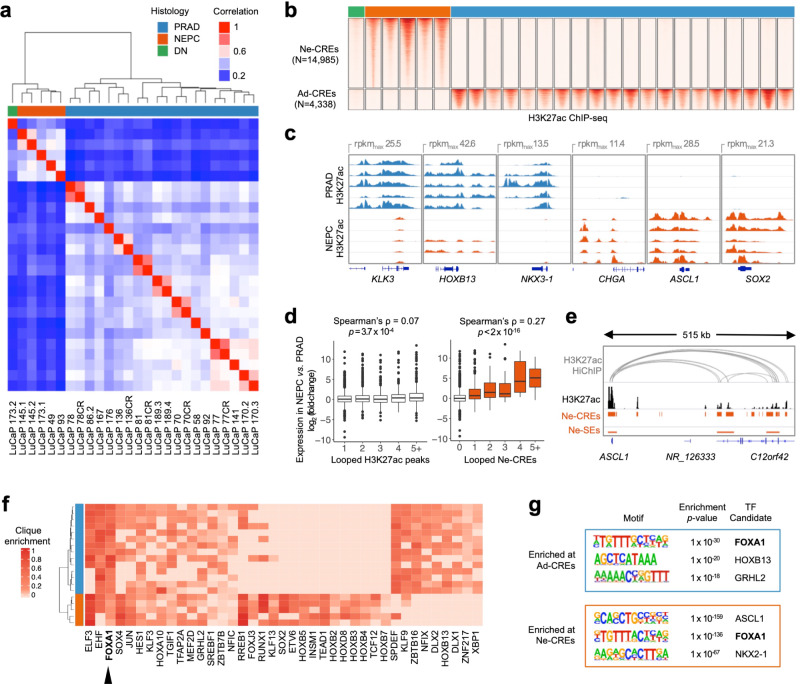
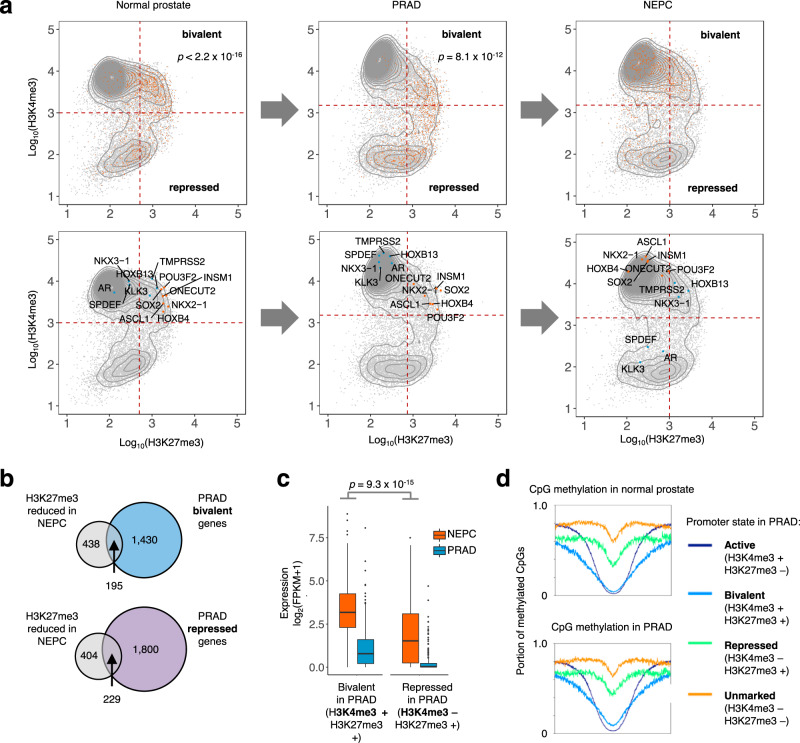
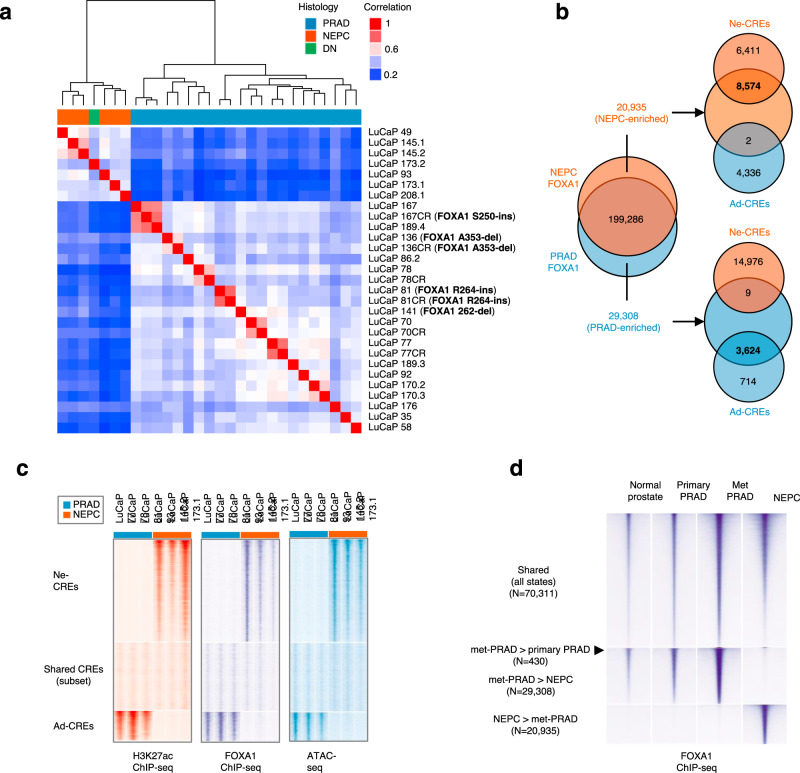
Lineage plasticity, the ability of a cell to alter its identity, is an increasingly common mechanism of adaptive resistance to targeted therapy in cancer. An archetypal example is the development of neuroendocrine prostate cancer (NEPC) after treatment of prostate adenocarcinoma (PRAD) with inhibitors of androgen signaling. NEPC is an aggressive variant of prostate cancer that aberrantly expresses genes characteristic of neuroendocrine (NE) tissues and no longer depends on androgens. Here, we investigate the epigenomic basis of this resistance mechanism by profiling histone modifications in NEPC and PRAD patient-derived xenografts (PDXs) using chromatin immunoprecipitation and sequencing (ChIP-seq). We identify a vast network of cis-regulatory elements (N~15,000) that are recurrently activated in NEPC. The FOXA1 transcription factor (TF), which pioneers androgen receptor (AR) chromatin binding in the prostate epithelium, is reprogrammed to NE-specific regulatory elements in NEPC. Despite loss of dependence upon AR, NEPC maintains FOXA1 expression and requires FOXA1 for proliferation and expression of NE lineage-defining genes. Ectopic expression of the NE lineage TFs ASCL1 and NKX2-1 in PRAD cells reprograms FOXA1 to bind to NE regulatory elements and induces enhancer activity as evidenced by histone modifications at these sites. Our data establish the importance of FOXA1 in NEPC and provide a principled approach to identifying cancer dependencies through epigenomic profiling.
谱系可塑性,即细胞改变自身身份的能力,是癌症对靶向治疗产生适应性耐药的一种越来越常见的机制。一个典型的例子是,前列腺腺癌(PRAD)经雄激素信号抑制剂治疗后,发展为神经内分泌前列腺癌(NEPC)。NEPC 是一种侵袭性前列腺癌变体,异常表达神经内分泌(NE)组织特征的基因,不再依赖雄激素。在这里,我们通过使用染色质免疫沉淀和测序(ChIP-seq)在 NEPC 和 PRAD 患者来源异种移植(PDX)中对组蛋白修饰进行分析,研究了这种耐药机制的表观基因组基础。我们确定了一个庞大的顺式调控元件网络(N~15,000),它们在 NEPC 中经常被激活。FOXA1 转录因子(TF)在前列腺上皮细胞中先驱雄激素受体(AR)染色质结合,在 NEPC 中被重新编程为 NE 特异性调控元件。尽管不再依赖 AR,但 NEPC 仍保持 FOXA1 的表达,并需要 FOXA1 来增殖和表达 NE 谱系定义基因。PRAD 细胞中 NE 谱系 TF ASCL1 和 NKX2-1 的异位表达将 FOXA1 重新编程为与 NE 调控元件结合,并诱导增强子活性,这可以通过这些位点的组蛋白修饰来证明。我们的数据确立了 FOXA1 在 NEPC 中的重要性,并提供了一种通过表观基因组分析鉴定癌症依赖性的原则方法。