Department of Integrative Marine Ecology, Stazione Zoologica Anton Dohrn, Villa Comunale, 80121, Naples, Italy.
Department of Public Health and Infectious Diseases, Section of Parasitology, Sapienza University of Rome, 00185, Rome, Italy.
Sci Rep. 2021 Mar 30;11(1):7135. doi: 10.1038/s41598-021-86248-5.
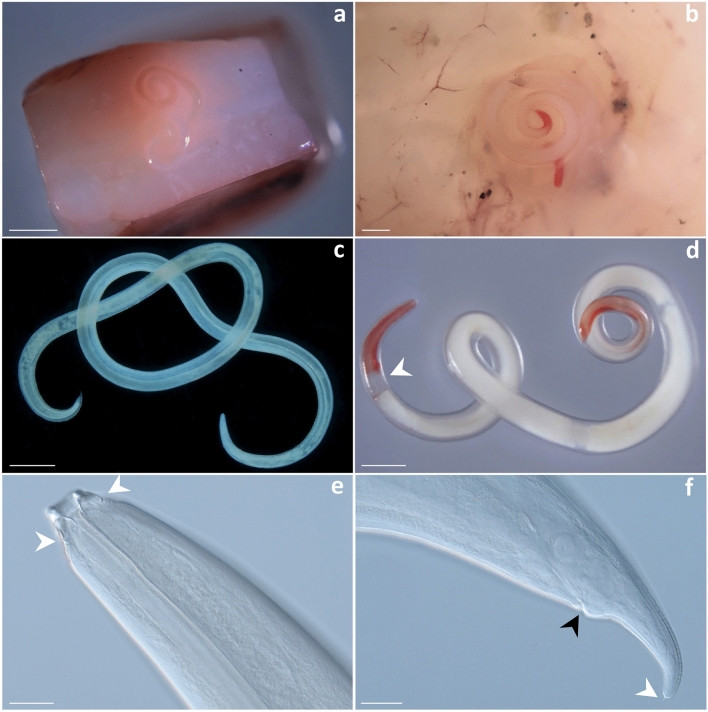
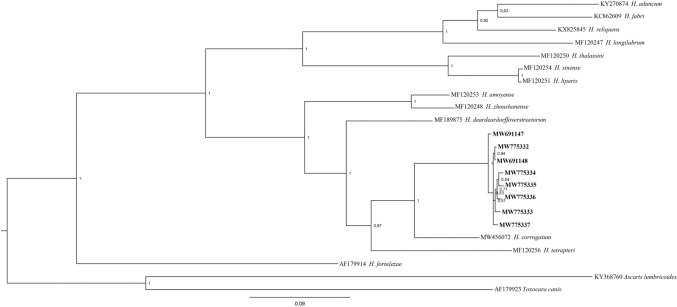
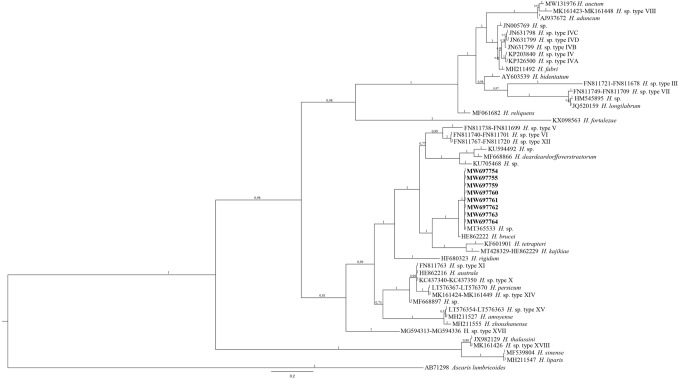
Ascaridoid nematodes comprise a wide range of heteroxenous parasites infecting top fish predators and marine mammals as definitive hosts, with crustaceans, squids, and fishes acting as intermediate/paratenic hosts. Limited data exist on the species and role of several intermediate and paratenic hosts in the life cycle of these parasites. In the aim of adding knowledge on the role of squid species in their life cycle, we have here investigated the larval ascaridoid nematodes collected from the deep-sea umbrella squid Histioteuthis bonnelli and the reverse jewel squid Histioteuthis reversa captured in the Central Mediterranean Sea (Tyrrhenian Sea). Morphological study and sequence analysis of the internal transcribed spacer (ITS) regions of the ribosomal DNA (rDNA) and the mitochondrial cytochrome c oxidase subunit 2 (mtDNA cox2) gene locus revealed the occurrence of Anisakis physeteris and of an unidentified species of the genus Lappetascaris. Sequence analysis revealed that specimens of Lappetascaris from both squid species matched at 100% sequences previously deposited in GenBank from larval ascaridoids collected in octopuses of the genus Eledone of the Mediterranean Sea. The Bayesian inference tree topology obtained from the analysis of the fragments amplified showed that Lappetascaris specimens were included in a major clade comprising Hysterothylacium species collected in fishes of the families Xiphiidae and Istiophoridae. As regards the site of infection in the squid host species, A. physeteris larvae predominated (60.7%) in the gonads, while those of Lappetascaris (76.3%) were found infecting the mantle musculature. The overall high values of parasitic load suggest both squid species as transmitting hosts of third stage larvae of Lappetascaris to top predator fishes, as well as the umbrella squid as an intermediate/paratenic host in the life cycle of A. physeteris in the Mediterranean Sea.
蛔形线虫包括广泛的异宿主寄生虫,感染顶级鱼类捕食者和海洋哺乳动物作为终末宿主,甲壳类动物、鱿鱼和鱼类作为中间/副宿主。关于这些寄生虫生活史中的几种中间和副宿主的物种和作用,数据有限。为了增加关于鱿鱼物种在其生活史中的作用的知识,我们在这里调查了从中地中海(第勒尼安海)捕获的深海伞鱿鱼Histioteuthis bonnelli 和反向宝石鱿鱼Histioteuthis reversa 中收集的幼虫蛔形线虫。核糖体 DNA(rDNA)内部转录间隔区(ITS)和线粒体细胞色素 c 氧化酶亚单位 2(mtDNA cox2)基因座的形态研究和序列分析揭示了存在 Anisakis physeteris 和 Lappetascaris 属的一个未识别物种。序列分析表明,两种鱿鱼物种的 Lappetascaris 标本与先前在 GenBank 中从地中海章鱼属 Eledone 中收集的幼虫蛔形线虫中存放的序列完全匹配。从扩增片段分析获得的贝叶斯推断树拓扑结构表明,Lappetascaris 标本包含在一个主要分支中,该分支包括在 Xiphiidae 和 Istiophoridae 科鱼类中收集的 Hysterothylacium 物种。关于鱿鱼宿主物种的感染部位,A. physeteris 幼虫主要(60.7%)在性腺中,而 Lappetascaris 的幼虫(76.3%)则在套膜肌肉中感染。寄生负荷的总体高值表明,这两种鱿鱼物种都是 Lappetascaris 的第三期幼虫的传播宿主,以及伞鱿鱼是地中海 A. physeteris 生活史中的中间/副宿主。