Márlon Juliano Romero Aliberti, Laboratorio de Investigacao Medica em Envelhecimento (LIM-66), Servico de Geriatria, Hospital das Clinicas, Faculdade de Medicina, Universidade de Sao Paulo. Av. Dr. Eneas de Carvalho Aguiar 155, 8º andar, Clinica Medica, LIM-66, Cerqueira Cesar, Sao Paulo - SP, 05403-000, Brazil. Tel.: +55-11-26618116. E-mail address:
J Nutr Health Aging. 2021;25(4):440-447. doi: 10.1007/s12603-020-1532-z.
The COVID-19 pandemic has led to abrupt restrictions of life-space mobility. The impact of shelter-in-place orders on older adults' health and well-being is still unclear.
To investigate the relationship between life-space mobility and quality of life (QoL) in older adults with and without frailty during the COVID-19 pandemic.
Multicenter prospective cohort study based on structured telephone interviews.
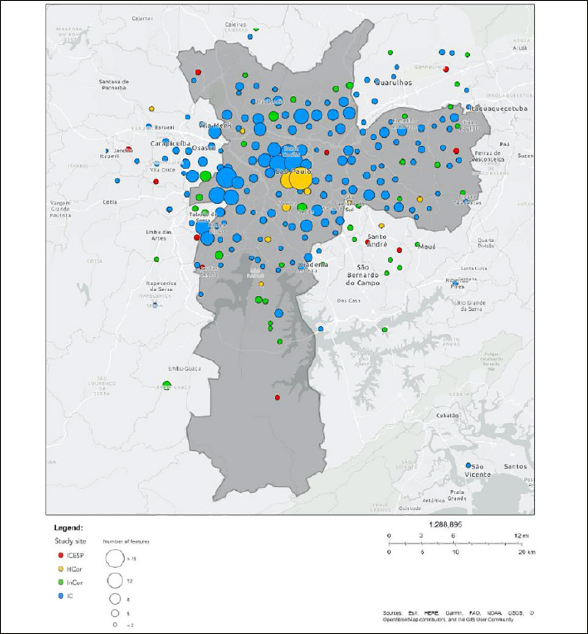
Four geriatric outpatient clinics in the metropolitan area of Sao Paulo, Brazil.
557 community-dwelling adults aged 60 years and older.
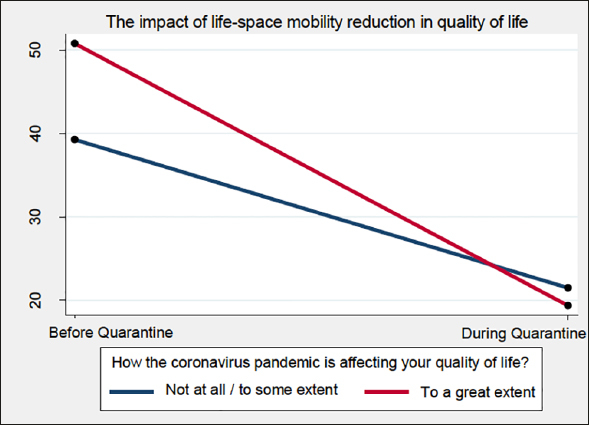
The Life-Space Assessment was used to measure community mobility before and during the COVID-19 pandemic, and a previously validated decrease of ≥ 5 points defined restricted life-space mobility. Frailty was assessed through the FRAIL (fatigue, resistance, ambulation, illnesses, and loss of weight) scale. The impact of shelter-in-place orders on QoL was evaluated with the question «How is the COVID-19 pandemic affecting your QoL?», to which participants could respond «not at all», «to some extent», or «to a great extent». We used ordinal logistic regressions to investigate the relationship between restricted life-space mobility and impact on QoL, adjusting our analyses for demographics, frailty, comorbidities, cognition, functionality, loneliness, depression, and anxiety. We explored whether frailty modified the association between life-space mobility and impact on QoL.
Participants were on average 80±8 years old, 65% were women, and 33% were frail. The COVID-19 quarantine led to a restriction of community mobility in 79% of participants and affected the QoL for 77% of participants. We found that restricted life-space mobility was associated with impact on QoL in older adults during the pandemic, although frailty modified the magnitude of the association (P-value for interaction=0.03). Frail participants who experienced restricted life-space mobility had twice the odds of reporting an impact on QoL when compared with non-frail individuals, with respective adjusted odds ratios of 4.20 (95% CI=2.36-7.50) and 2.18 (95% CI=1.33-3.58).
Older adults experienced substantial decreases in life-space mobility during the COVID-19 pandemic, and this unexpected change impacted their QoL. Providers should be particularly watchful for the consequences of abrupt life-space restrictions on frail individuals.
COVID-19 大流行导致生活空间流动性的急剧限制。就地避难令对老年人健康和福祉的影响尚不清楚。
调查 COVID-19 大流行期间,无虚弱和虚弱老年人的生活空间流动性与生活质量(QoL)之间的关系。
基于结构化电话访谈的多中心前瞻性队列研究。
巴西圣保罗大都市区的四个老年门诊。
557 名 60 岁及以上的社区居住成年人。
生活空间评估用于测量 COVID-19 大流行之前和期间的社区流动性,≥5 点的下降定义为限制生活空间流动性。通过 FRAIL(疲劳、抵抗力、行动、疾病和体重减轻)量表评估虚弱程度。通过问题“COVID-19 大流行如何影响您的生活质量?”评估就地避难令对生活质量的影响,参与者可以回答“根本没有”、“在某种程度上”或“在很大程度上”。我们使用有序逻辑回归来研究限制生活空间流动性与生活质量影响之间的关系,调整我们的分析以考虑人口统计学、虚弱、合并症、认知、功能、孤独、抑郁和焦虑。我们探索了虚弱是否改变了生活空间流动性与生活质量影响之间的关联。
参与者的平均年龄为 80±8 岁,65%为女性,33%为虚弱。COVID-19 隔离导致 79%的参与者社区流动性受限,77%的参与者生活质量受到影响。我们发现,在大流行期间,限制生活空间流动性与老年人的生活质量影响有关,尽管虚弱改变了关联的幅度(交互作用 P 值=0.03)。与非虚弱个体相比,经历限制生活空间流动性的虚弱参与者报告生活质量受到影响的可能性增加了一倍,相应的调整后比值比分别为 4.20(95%CI=2.36-7.50)和 2.18(95%CI=1.33-3.58)。
老年人在 COVID-19 大流行期间经历了生活空间流动性的大幅下降,这种意外的变化影响了他们的生活质量。提供者应特别注意突然限制生活空间对虚弱个体的后果。