Department of Pharmacology and Toxicology, College of Pharmacy, Qassim University, Buraydah 52571, Qassim, Kingdom of Saudi Arabia.
Mol Med Rep. 2021 Jun;23(6). doi: 10.3892/mmr.2021.12037. Epub 2021 Mar 31.
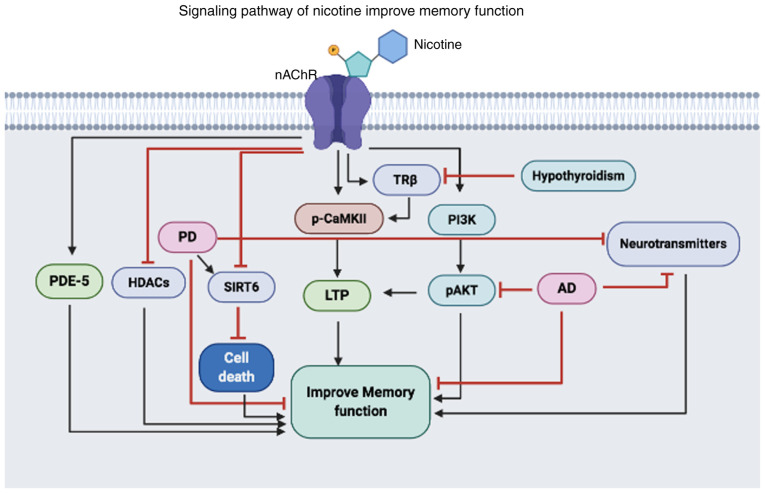
The health risks of nicotine are well known, but there is some evidence of its beneficial effects on cognitive function. The present review focused on the reported benefits of nicotine in the brain and summarizes the associated underlying mechanisms. Nicotine administration can improve cognitive impairment in Alzheimer's disease (AD), and dyskinesia and memory impairment in Parkinson's disease (PD). In terms of its mechanism of action, nicotine slows the progression of PD by inhibiting Sirtuin 6, a stress‑responsive protein deacetylase, thereby decreasing neuronal apoptosis and improving neuronal survival. In AD, nicotine improves cognitive impairment by enhancing protein kinase B (also referred to as Akt) activity and stimulating phosphoinositide 3‑kinase/Akt signaling, which regulates learning and memory processes. Nicotine may also activate thyroid receptor signaling pathways to improve memory impairment caused by hypothyroidism. In healthy individuals, nicotine improves memory impairment caused by sleep deprivation by enhancing the phosphorylation of calmodulin‑dependent protein kinase II, an essential regulator of cell proliferation and synaptic plasticity. Furthermore, nicotine may improve memory function through its effect on chromatin modification via the inhibition of histone deacetylases, which causes transcriptional changes in memory‑related genes. Finally, nicotine administration has been demonstrated to rescue long‑term potentiation in individuals with sleep deprivation, AD, chronic stress and hypothyroidism, primarily by desensitizing α7 nicotinic acetylcholine receptors. To conclude, nicotine has several cognitive benefits in healthy individuals, as well as in those with cognitive dysfunction associated with various diseases. However, further research is required to shed light on the effect of acute and chronic nicotine treatment on memory function.
尼古丁对健康的危害众所周知,但也有一些证据表明它对认知功能有益。本综述重点介绍了尼古丁在大脑中的报道益处,并总结了相关的潜在机制。尼古丁给药可改善阿尔茨海默病(AD)的认知障碍,以及帕金森病(PD)的运动障碍和记忆障碍。就其作用机制而言,尼古丁通过抑制应激反应蛋白去乙酰化酶 Sirtuin 6 来减缓 PD 的进展,从而减少神经元凋亡并改善神经元存活。在 AD 中,尼古丁通过增强蛋白激酶 B(也称为 Akt)活性和刺激磷酸肌醇 3-激酶/Akt 信号通路来改善认知障碍,该信号通路调节学习和记忆过程。尼古丁还可以激活甲状腺受体信号通路,以改善甲状腺功能减退引起的记忆障碍。在健康个体中,尼古丁通过增强钙调蛋白依赖性蛋白激酶 II 的磷酸化来改善睡眠剥夺引起的记忆障碍,钙调蛋白依赖性蛋白激酶 II 是细胞增殖和突触可塑性的重要调节因子。此外,尼古丁可能通过抑制组蛋白去乙酰化酶来影响染色质修饰,从而导致与记忆相关的基因发生转录变化,从而改善记忆功能。最后,已经证明尼古丁给药可以挽救睡眠剥夺、AD、慢性应激和甲状腺功能减退患者的长时程增强,主要是通过使α7 烟碱型乙酰胆碱受体脱敏。总之,尼古丁在健康个体以及与各种疾病相关的认知功能障碍个体中具有多种认知益处。然而,需要进一步的研究来阐明急性和慢性尼古丁治疗对记忆功能的影响。