Laboratory of Brain and Cognition, National Institute of Mental Health, National Institutes of Health, Bethesda, MD 20892, USA.
Department of Physiology and Pharmacology, Sapienza University of Rome, Rome, Italy.
Sci Adv. 2021 Mar 31;7(14). doi: 10.1126/sciadv.abe0716. Print 2021 Mar.
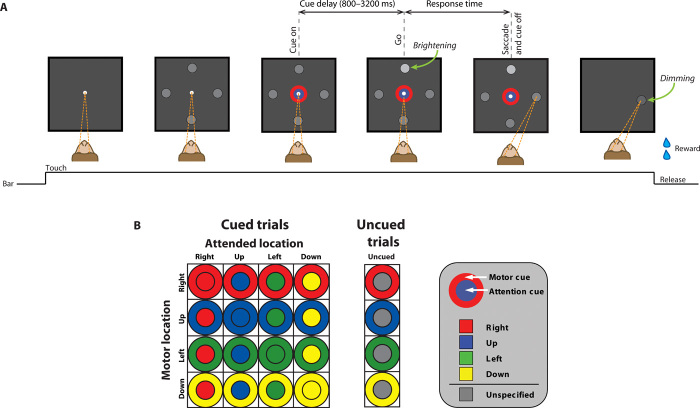
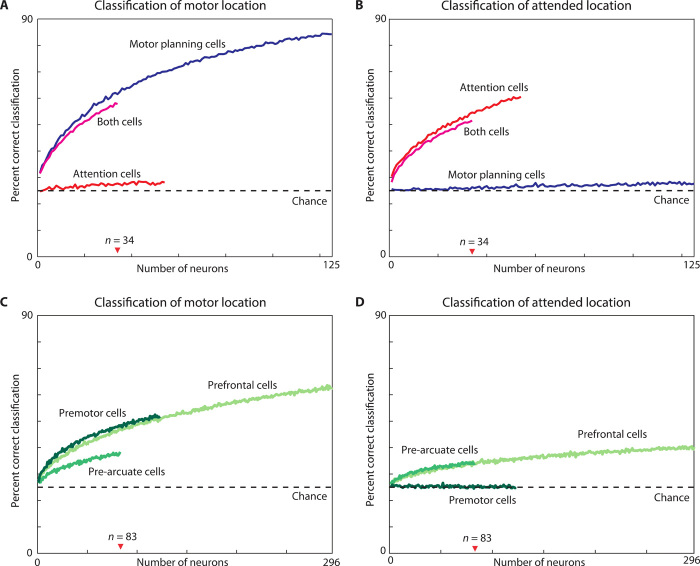
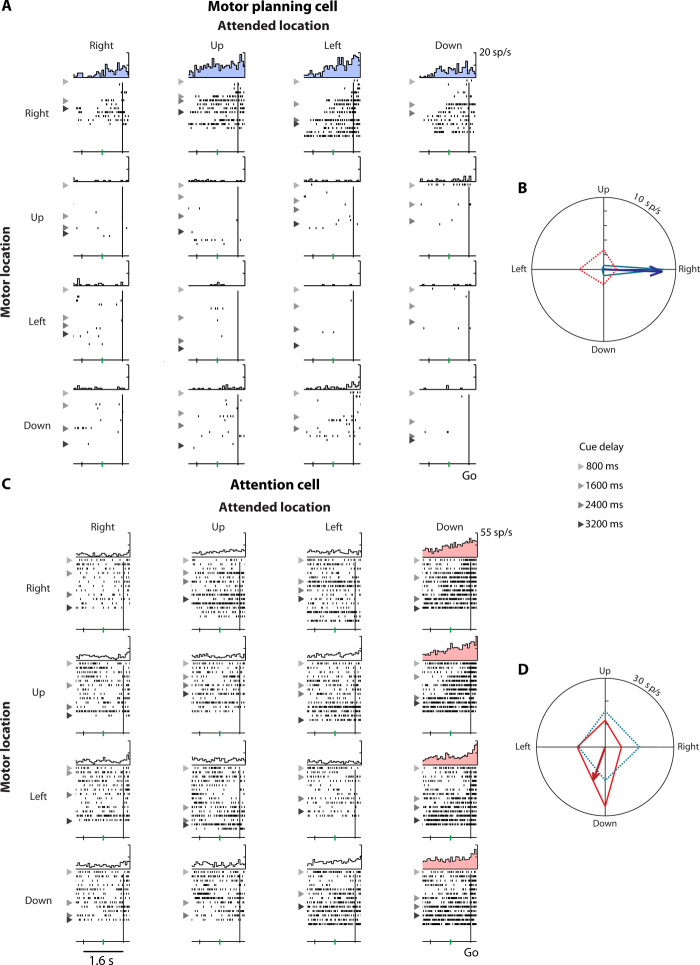
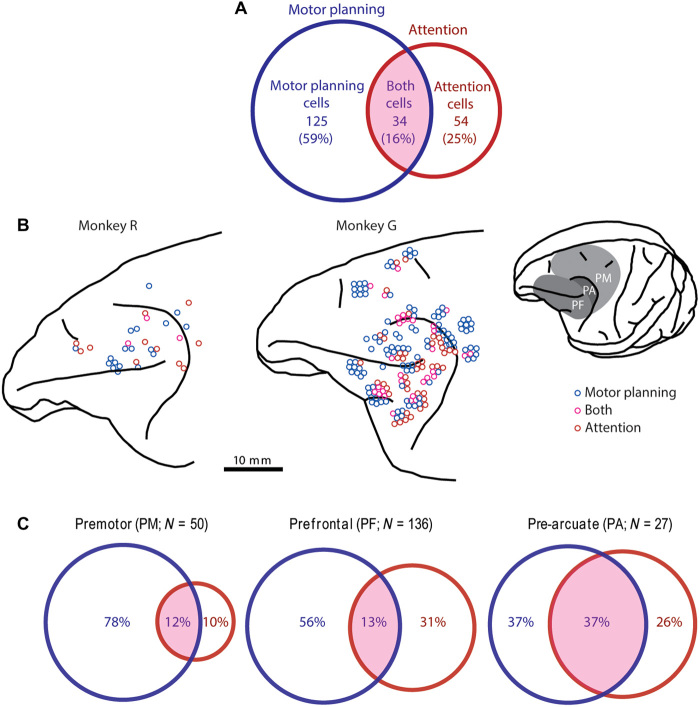
We investigated the spatial representation of covert attention and movement planning in monkeys performing a task that used symbolic cues to decouple the locus of covert attention from the motor target. In the three frontal areas studied, most spatially tuned neurons reflected either where attention was allocated or the planned saccade. Neurons modulated by both covert attention and the motor plan were in the minority. Such dual-purpose neurons were especially rare in premotor and prefrontal cortex but were more common just rostral to the arcuate sulcus. The existence of neurons that indicate where the monkey was attending but not its movement goal runs counter to the idea that the control of spatial attention is entirely reliant on the neuronal circuits underlying motor planning. Rather, the presence of separate neuronal populations for each cognitive process suggests that endogenous attention is under flexible control and can be dissociated from motor intention.
我们研究了猴子执行任务时的隐蔽注意力和运动规划的空间表示,该任务使用符号提示将隐蔽注意力的位置与运动目标解耦。在所研究的三个额叶区域中,大多数空间调谐神经元反映了注意力的分配位置或计划的扫视位置。由隐蔽注意力和运动计划共同调节的神经元占少数。在运动前和前额叶皮层中,这种两用神经元尤其罕见,但在弓状沟前方更为常见。表明猴子注意力所在位置但不表明其运动目标的神经元的存在与空间注意力的控制完全依赖于运动规划的神经元回路的观点相悖。相反,每个认知过程都有独立的神经元群体存在,这表明内源性注意力受到灵活控制,可以与运动意图分离。