Oreskovic Amy, Panpradist Nuttada, Marangu Diana, Ngwane M William, Magcaba Zanele P, Ngcobo Sindiswa, Ngcobo Zinhle, Horne David J, Wilson Douglas P K, Shapiro Adrienne E, Drain Paul K, Lutz Barry R
Department of Bioengineering, University of Washington, Seattle, Washington, USA.
Department of Paediatrics and Child Health, University of Nairobi, Nairobi, Kenya.
J Clin Microbiol. 2021 Jul 19;59(8):e0007421. doi: 10.1128/JCM.00074-21.
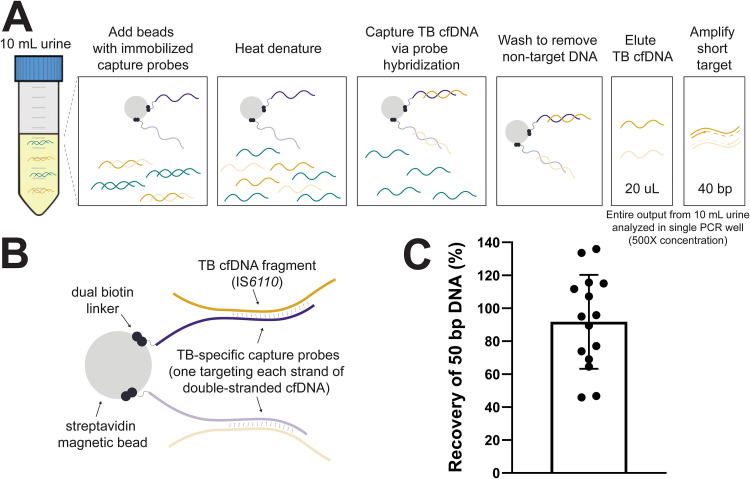
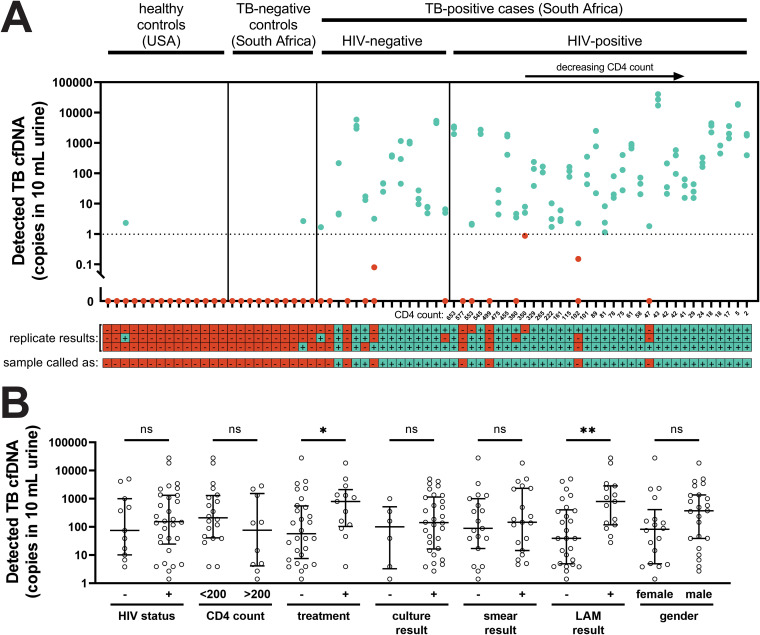
Transrenal urine cell-free DNA (cfDNA) is a promising tuberculosis (TB) biomarker, but is challenging to detect because of the short length (<100 bp) and low concentration of TB-specific fragments. We aimed to improve the diagnostic sensitivity of TB urine cfDNA by increasing recovery of short fragments during sample preparation. We developed a highly sensitive sequence-specific purification method that uses hybridization probes immobilized on magnetic beads to capture short TB cfDNA (50 bp) with 91.8% average efficiency. Combined with short-target PCR, the assay limit of detection was ≤5 copies of cfDNA in 10 ml urine. In a clinical cohort study in South Africa, our urine cfDNA assay had 83.7% sensitivity (95% CI: 71.0 to 91.5%) and 100% specificity (95% CI: 86.2 to 100%) for diagnosis of active pulmonary TB when using sputum Xpert MTB/RIF as the reference standard. The detected cfDNA concentration was 0.14 to 2,804 copies/ml (median 14.6 copies/ml) and was inversely correlated with CD4 count and days to culture positivity. Sensitivity was nonsignificantly higher in HIV-positive (88.2%) compared to HIV-negative patients (73.3%), and was not dependent on CD4 count. Sensitivity remained high in sputum smear-negative (76.0%) and urine lipoarabinomannan (LAM)-negative (76.5%) patients. With improved sample preparation, urine cfDNA is a viable biomarker for TB diagnosis. Our assay has the highest reported accuracy of any TB urine cfDNA test to date and has the potential to enable rapid non-sputum-based TB diagnosis across key underserved patient populations.
经肾无细胞尿液DNA(cfDNA)是一种很有前景的结核病(TB)生物标志物,但由于TB特异性片段长度短(<100bp)且浓度低,检测具有挑战性。我们旨在通过在样品制备过程中提高短片段的回收率来提高TB尿液cfDNA的诊断敏感性。我们开发了一种高度敏感的序列特异性纯化方法,该方法使用固定在磁珠上的杂交探针以91.8%的平均效率捕获短TB cfDNA(50bp)。结合短靶标PCR,检测限为10ml尿液中≤5份cfDNA。在南非的一项临床队列研究中,当以痰Xpert MTB/RIF作为参考标准时,我们的尿液cfDNA检测对活动性肺结核诊断的敏感性为83.7%(95%CI:71.0至91.5%),特异性为100%(95%CI:86.2至100%)。检测到的cfDNA浓度为0.14至2804份/ml(中位数14.6份/ml),与CD4计数和培养阳性天数呈负相关关系。HIV阳性患者(88.2%)相比HIV阴性患者(73.3%)的敏感性无显著更高,且不依赖于CD4计数。在痰涂片阴性(76.0%)和尿液脂阿拉伯甘露聚糖(LAM)阴性(76.5%)患者中敏感性仍然很高。通过改进样品制备,尿液cfDNA是一种可行的TB诊断生物标志物。我们的检测是迄今为止所有TB尿液cfDNA检测中报道的准确性最高的,并且有潜力在主要服务不足的关键患者群体中实现基于非痰液的快速TB诊断。