Amsterdam Rheumatology Center, AMC, Amsterdam, The Netherlands
Rheumatology, Zuyderland MC, Heerlen, The Netherlands.
RMD Open. 2021 Mar;7(1). doi: 10.1136/rmdopen-2021-001638.
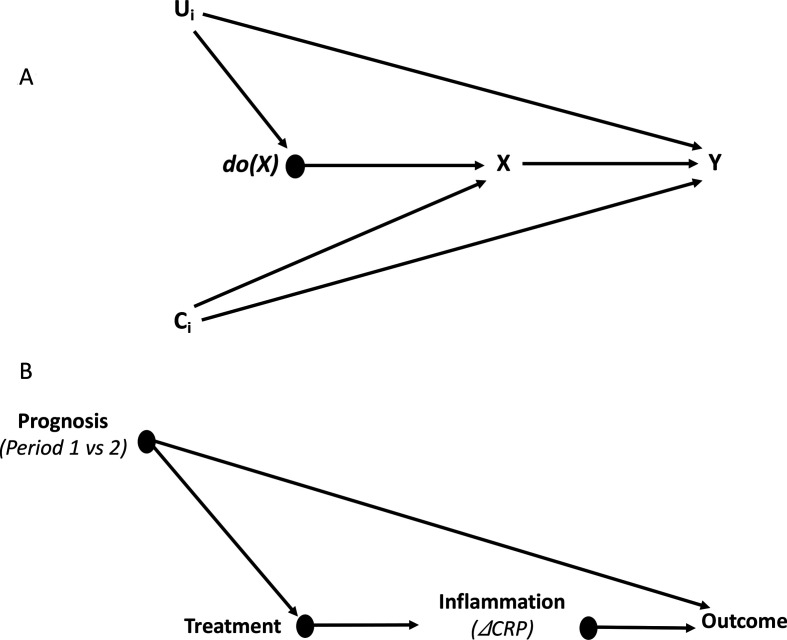
The CHIC study (COVID-19 High-intensity Immunosuppression in Cytokine storm syndrome) is a quasi-experimental treatment study exploring immunosuppressive treatment versus supportive treatment only in patients with COVID-19 with life-threatening hyperinflammation. Causal inference provides a means of investigating causality in non-randomised experiments. Here we report 14-day improvement as well as 30-day and 90-day mortality.
The first 86 patients (period 1) received optimal supportive care only; the second 86 patients (period 2) received methylprednisolone and (if necessary) tocilizumab, in addition to optimal supportive care. The main outcomes were 14-day clinical improvement and 30-day and 90-day survival. An 80% decline in C reactive protein (CRP) was recorded on or before day 13 (CRP >100 mg/L was an inclusion criterion). Non-linear mediation analysis was performed to decompose CRP-mediated effects of immunosuppression (defined as natural indirect effects) and non-CRP-mediated effects attributable to natural prognostic differences between periods (defined as natural direct effects).
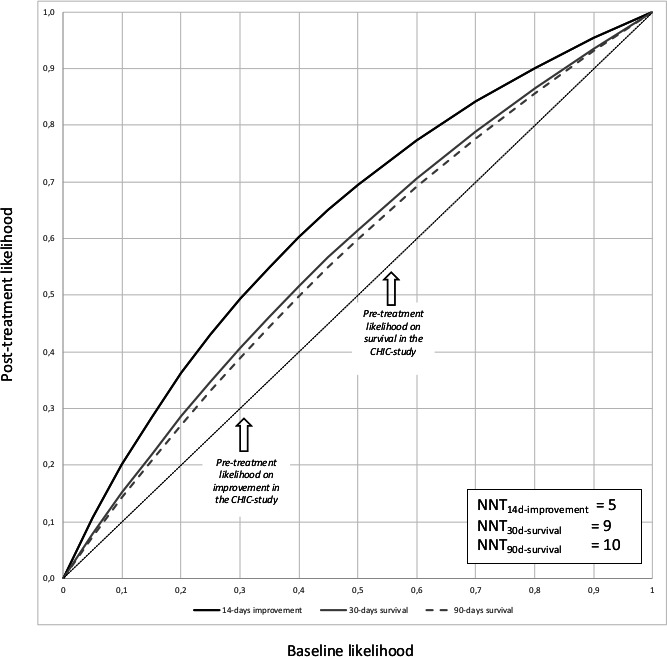
The natural direct (non-CRP-mediated) effects for period 2 versus period 1 showed an OR of 1.38 (38% better) for 14-day improvement and an OR of 1.16 (16% better) for 30-day and 90-day survival. The natural indirect (CRP-mediated) effects for period 2 showed an OR of 2.27 (127% better) for 14-day improvement, an OR of 1.60 (60% better) for 30-day survival and an OR of 1.49 (49% better) for 90-day survival. The number needed to treat was 5 for 14-day improvement, 9 for survival on day 30, and 10 for survival on day 90.
Causal inference with non-linear mediation analysis further substantiates the claim that a brief but intensive treatment with immunosuppressants in patients with COVID-19 and systemic hyperinflammation adds to rapid recovery and saves lives. Causal inference is an alternative to conventional trial analysis, when randomised controlled trials are considered unethical, unfeasible or impracticable.
CHIC 研究(COVID-19 细胞因子风暴中的高强度免疫抑制)是一项探索免疫抑制治疗与仅支持治疗的准实验治疗研究,适用于患有危及生命的过度炎症的 COVID-19 患者。因果推理为非随机实验中的因果关系研究提供了一种手段。在这里,我们报告了 14 天的改善情况以及 30 天和 90 天的死亡率。
前 86 名患者(第 1 期)仅接受最佳支持治疗;后 86 名患者(第 2 期)除最佳支持治疗外,还接受甲基强的松龙和(如有必要)托珠单抗治疗。主要结局为 14 天临床改善和 30 天及 90 天的存活率。第 13 天(CRP>100mg/L 是纳入标准)或之前记录到 C 反应蛋白(CRP)下降 80%。进行非线性中介分析以分解免疫抑制的 CRP 介导效应(定义为自然间接效应)和归因于期间自然预后差异的非 CRP 介导效应(定义为自然直接效应)。
第 2 期与第 1 期相比,自然直接(非 CRP 介导)效应显示 14 天改善的优势比(OR)为 1.38(改善 38%),30 天和 90 天存活的 OR 为 1.16(改善 16%)。第 2 期的自然间接(CRP 介导)效应显示 14 天改善的 OR 为 2.27(改善 127%),30 天存活的 OR 为 1.60(改善 60%),90 天存活的 OR 为 1.49(改善 49%)。14 天改善的治疗人数为 5,30 天存活的人数为 9,90 天存活的人数为 10。
使用非线性中介分析的因果推理进一步证实了在 COVID-19 和全身性炎症过度的患者中进行短暂但强化的免疫抑制治疗可加速恢复并挽救生命的说法。当认为随机对照试验不道德、不可行或不切实际时,因果推理是常规试验分析的替代方法。