Department of Healthcare Economics and Quality Management, Graduate School of Medicine, Kyoto University.
J Atheroscler Thromb. 2022 May 1;29(5):597-607. doi: 10.5551/jat.62746. Epub 2021 Apr 1.
The coronavirus disease 2019 (COVID-19) pandemic has left negative spillover effects on the entire health care system. Previous studies have suggested significant declines in cases of acute coronary syndrome (ACS) and primary percutaneous coronary intervention (PCI) during the COVID-19 pandemic.
We performed a quasi-experimental, retrospective cohort study of ACS hospitalisations by using a multi-institutional administrative claims database in Japan. We used interrupted time series analyses to ascertain impacts on cases, treatment approaches, and in-hospital mortality before and after Japan's state of emergency to respond to COVID-19. The primary outcome was the change in ACS cases per week.
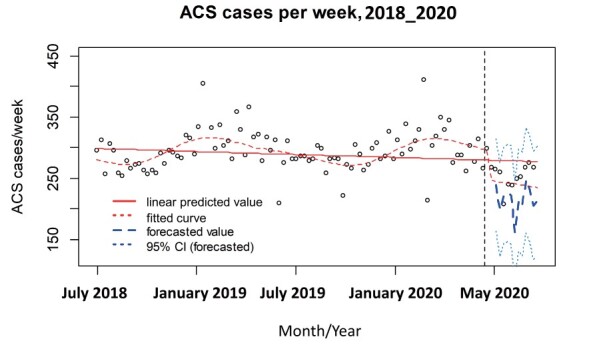
A total of 30,198 ACS cases (including 21,612 acute myocardial infarction and 8,586 unstable angina) were confirmed between 1 July 2018 and 30 June 2020. After the state of emergency, an immediate decrease was observed in ACS cases per week (-18.3%; 95% confidence interval, -13.1 to -23.5%). No significant differences were found in the severity of Killip classification (P=0.51) or cases of fibrinolytic therapy (P=0.74). The impact of the COVID-19 pandemic on in-hospital mortality in ACS patients was no longer observed after adjustment for clinical characteristics (adjusted odds ratio, 0.93; 95% confidence interval, 0.78 to 1.12; P=0.49).
We demonstrated the characteristics and trends of ACS cases in a Japanese population by applying interrupted time series analyses. Our findings provide significant insights into the association between COVID-19 and decreases in ACS hospitalisations during the pandemic.
2019 年冠状病毒病(COVID-19)大流行对整个医疗保健系统造成了负面影响。先前的研究表明,COVID-19 大流行期间急性冠状动脉综合征(ACS)和经皮冠状动脉介入治疗(PCI)的病例显著减少。
我们使用日本多机构行政索赔数据库,对 ACS 住院进行了准实验、回顾性队列研究。我们使用中断时间序列分析来确定在日本应对 COVID-19 发布紧急状态前后对病例、治疗方法和住院死亡率的影响。主要结果是每周 ACS 病例数的变化。
在 2018 年 7 月 1 日至 2020 年 6 月 30 日期间,共确诊了 30198 例 ACS 病例(包括 21612 例急性心肌梗死和 8586 例不稳定型心绞痛)。在紧急状态后,每周 ACS 病例数立即减少(-18.3%;95%置信区间,-13.1 至-23.5%)。Killip 分级的严重程度(P=0.51)或纤溶治疗的病例(P=0.74)无显著差异。调整临床特征后,COVID-19 大流行对 ACS 患者住院死亡率的影响不再明显(调整后比值比,0.93;95%置信区间,0.78 至 1.12;P=0.49)。
我们通过应用中断时间序列分析,展示了日本人群中 ACS 病例的特征和趋势。我们的研究结果为 COVID-19 与大流行期间 ACS 住院人数减少之间的关联提供了重要见解。