Yang Ping, Cao Ran, Bao Hua, Wu Xue, Yang Lingling, Zhu Dongqin, Zhang Lu, Peng Liming, Cai Yuefei, Zhang Weijun, Shao Yang
Department of Radiation Oncology, Tungwah Hospital of Sun Yat-Sen University, Dongguan, Guangdong, People's Republic of China.
Nanjing Geneseeq Technology Inc., Nanjing, Jiangsu, People's Republic of China.
Onco Targets Ther. 2021 Mar 25;14:2131-2138. doi: 10.2147/OTT.S293901. eCollection 2021.
Drug resistance caused by G1202R/G1202del mutation in anaplastic lymphoma kinase () represents a great challenge in the clinic. The effect of other mutation(s) at G1202 on the available tyrosine kinase inhibitors (TKIs) in the clinic remains unknown.
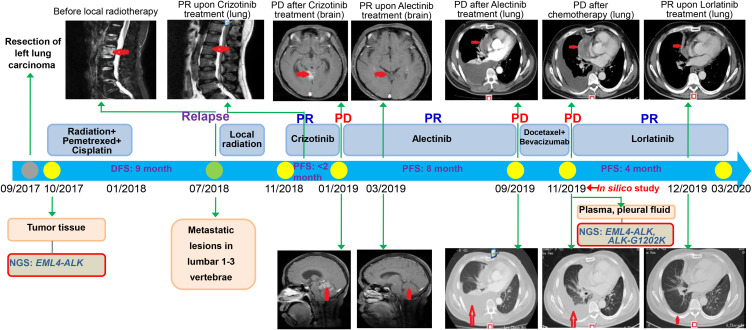
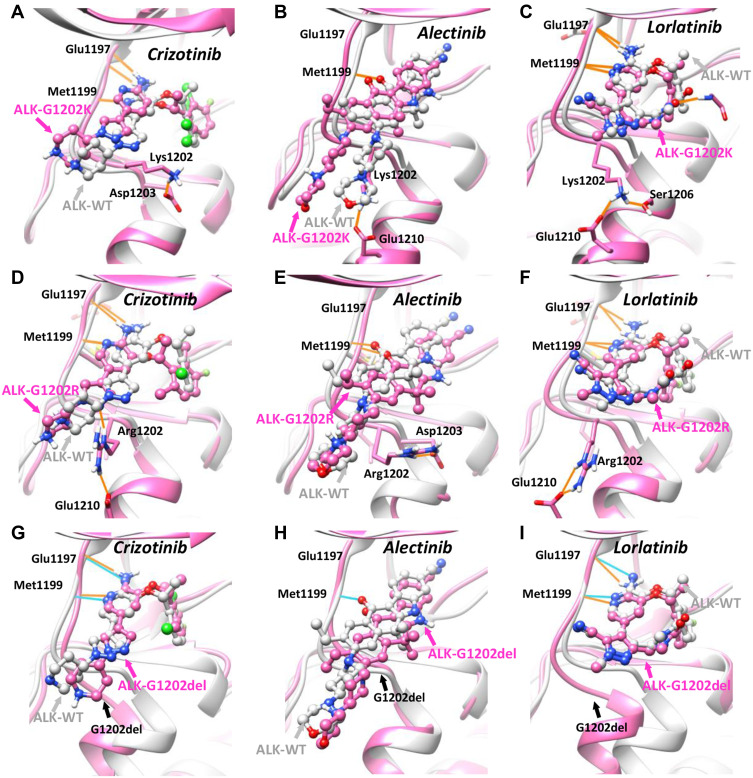
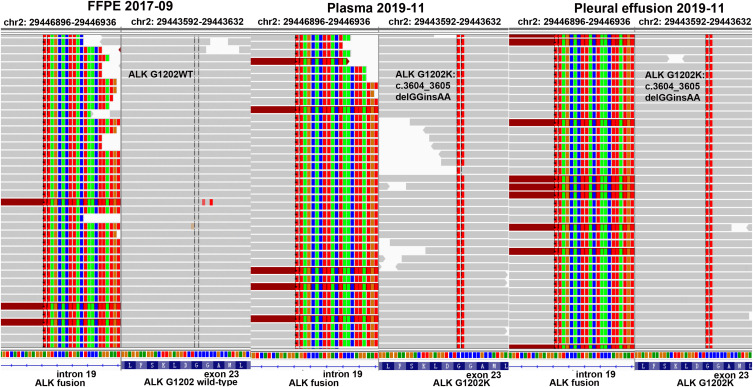
A 50-year-old Chinese male non-smoker with lung adenocarcinoma progressed with spinal metastasis after receiving chest radiation together with Pemetrexed and Cisplatin as adjuvant chemotherapy. Targeted next generation sequencing (NGS) identified gene fusion in the resected left lung tissue. Local radiation followed by Crizotinib were used in the following treatment and the spinal metastasis was found to shrink, but the progression free survival (PFS) only lasted for 2 months with the appearance of brain metastasis. Afterwards, the patient benefited from the therapy of Alectinib with a PFS of 8 months. Then he progressed with metastases in right lung and pleural, and did not show response to the chemotherapy with Docetaxel plus Bevacizumab. The targeted sequencing consistently identified gene fusion in both plasma and pleural effusion (PE), as well as a novel G1202K mutation (c.3604_3605delGGinsAA). Given the lack of established or known drug treatment for this novel mutation, we implemented molecular dynamics (MD) simulation-guided drug sensitivity prediction, which results suggested Lorlatinib remains potent against G1202K mutant ALK. Therefore, Lorlatinib was used as the fourth-line therapy, which lead to the considerable efficacy with improved performance status (PS) score and reduced lung metastases. The structural mechanism underlying G1202K-induced drug resistance to different ALK-TKIs was also discussed.
Our case suggested the -G1202K mutation may serve as a novel mechanism underlying the resistance to Alectinib, and provide direct evidence to support its sensitization to Lorlatinib. Our work represented an example of integrating in silico predictions into clinical practice.
间变性淋巴瘤激酶(ALK)中G1202R/G1202del突变引起的耐药性是临床上的一大挑战。G1202位点其他突变对临床可用酪氨酸激酶抑制剂(TKIs)的影响尚不清楚。
一名50岁中国男性非吸烟肺腺癌患者,在接受胸部放疗联合培美曲塞和顺铂辅助化疗后出现脊柱转移。靶向二代测序(NGS)在切除的左肺组织中检测到ALK基因融合。后续治疗采用局部放疗联合克唑替尼,脊柱转移灶缩小,但无进展生存期(PFS)仅持续2个月,随后出现脑转移。之后,患者接受阿来替尼治疗,PFS为8个月。然后他出现右肺和胸膜转移,对多西他赛联合贝伐单抗化疗无反应。靶向测序在血浆和胸腔积液(PE)中均检测到ALK基因融合,以及一种新的ALK G1202K突变(c.3604_3605delGGinsAA)。鉴于针对这种新突变缺乏既定或已知的药物治疗方法,我们实施了分子动力学(MD)模拟指导的药物敏感性预测,结果表明劳拉替尼对G1202K突变的ALK仍具有活性。因此,劳拉替尼被用作四线治疗,取得了显著疗效,患者的体能状态(PS)评分改善,肺转移灶减少。同时还讨论了G1202K诱导对不同ALK-TKIs耐药的结构机制。
我们的病例表明,ALK-G1202K突变可能是对阿来替尼耐药的新机制,并为其对劳拉替尼敏感提供了直接证据。我们的工作代表了将计算机模拟预测整合到临床实践中的一个实例。