Lyden Patrick D, Pryor Kent E, Minigh Jennifer, Davis Thomas P, Griffin John H, Levy Howard, Zlokovic Berislav V
Department of Physiology and Neuroscience, Keck School of Medicine, Zilkha Neurogenetic Institute, University of Southern California, Los Angeles, CA, United States.
ZZ Biotech LLC, Houston, TX, United States.
Front Neurol. 2021 Mar 15;12:593582. doi: 10.3389/fneur.2021.593582. eCollection 2021.
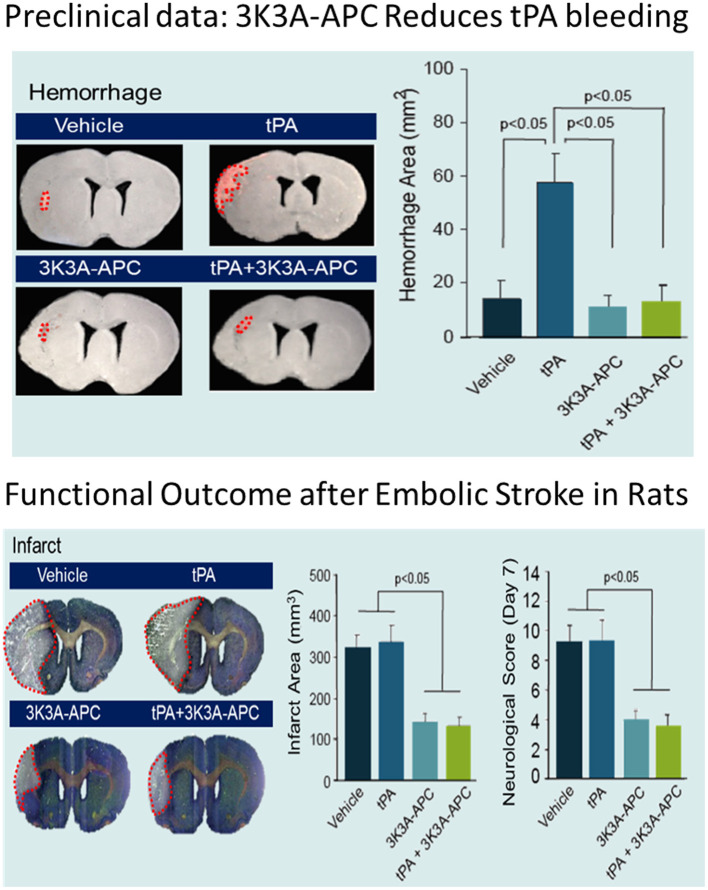
Ischemic stroke is the most widespread cause of disability and a leading cause of death in developed countries. To date, the most potent approved treatment for acute stroke is recanalization therapy with thrombolytic drugs such as tissue plasminogen activator (rt-PA or tPA) or endovascular mechanical thrombectomy. Although tPA and thrombectomy are widely available in the United States, it is currently estimated that only 10-20% of stroke patients get tPA treatment, in part due to restrictive selection criteria. Recently, however, tPA and thrombectomy selection criteria have loosened, potentially allowing more patients to qualify. The relatively low rate of treatment may also reflect the perceived risk of brain hemorrhage following treatment with tPA. In translational research and a single patient study, protease activated receptor 1 (PAR-1) targeted therapies given along with thrombolysis and thrombectomy appear to reduce hemorrhagic transformation after recanalization. Such adjuncts may likely enhance the availability of recanalization and encourage more physicians to use the recently expanded selection criteria for applying recanalization therapies. This narrative review discusses stroke therapies, the role of hemorrhagic transformation in producing poor outcomes, and presents the data suggesting that PAR-1 acting agents show promise for decreasing hemorrhagic transformation and improving outcomes.
缺血性中风是发达国家中导致残疾的最普遍原因和主要死因。迄今为止,治疗急性中风最有效的获批疗法是使用组织纤溶酶原激活剂(rt-PA或tPA)等溶栓药物进行再通治疗或血管内机械取栓术。尽管tPA和取栓术在美国广泛可用,但目前估计只有10%-20%的中风患者接受tPA治疗,部分原因是选择标准严格。然而,最近tPA和取栓术的选择标准有所放宽,可能会使更多患者符合条件。治疗率相对较低也可能反映出tPA治疗后脑出血的可感知风险。在转化研究和一项单病例研究中,与溶栓和取栓术同时使用的蛋白酶激活受体1(PAR-1)靶向疗法似乎可减少再通后的出血转化。此类辅助治疗可能会提高再通的可行性,并鼓励更多医生采用最近扩大的再通治疗选择标准。本叙述性综述讨论了中风治疗方法、出血转化在导致不良结局中的作用,并展示了数据表明PAR-1作用药物在减少出血转化和改善结局方面具有前景。