Mei Jie, Li Shao-Hua, Li Qi-Jiong, Sun Xu-Qi, Lu Liang-He, Lin Wen-Ping, Zheng Lie, Chen Min-Shan, Shi Ming, Wei Wei, Guo Rong-Ping
Sun Yat-Sen University Cancer Center, State Key Laboratory of Oncology in South China, Collaborative Innovation Center for Cancer Medicine, Guangzhou, 510060, People's Republic of China.
Department of Liver Surgery, Sun Yat-Sen University Cancer Center, Guangzhou, 510060, People's Republic of China.
J Hepatocell Carcinoma. 2021 Mar 25;8:167-176. doi: 10.2147/JHC.S298538. eCollection 2021.
Hepatic artery infusion chemotherapy (HAIC) and anti-programmed cell death protein-1 (PD-1) immunotherapy have shown promising outcomes in patients with advanced hepatocellular carcinoma (HCC), respectively. However, the combination of the two treatments has not been reported. In this study, we compared the efficacy of HAIC combined with anti-PD-1 immunotherapy (HAICAP) and HAIC in patients with advanced HCC.
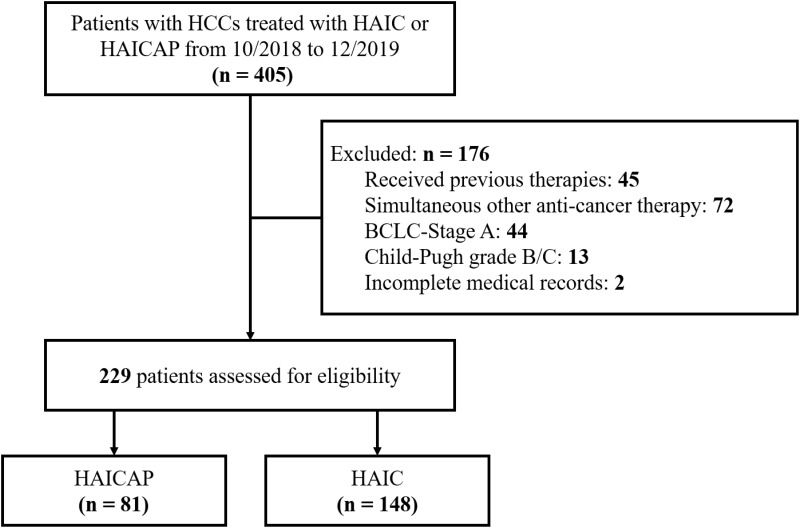
Between November 2018 and December 2019, advanced HCC patients that were treated with either HAICAP or HAIC were retrospectively recruited and reviewed for eligibility. Efficacy was evaluated according to tumor response and survival.
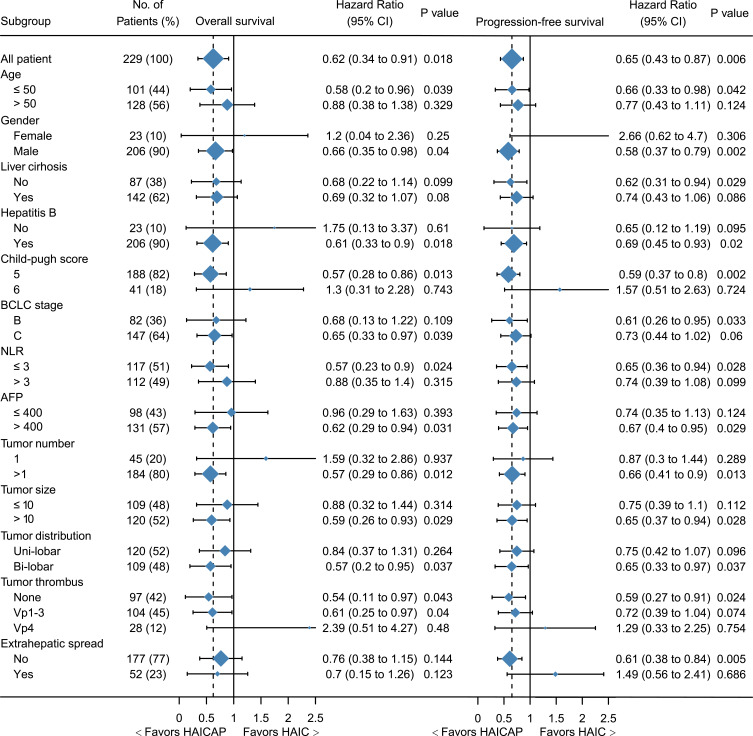
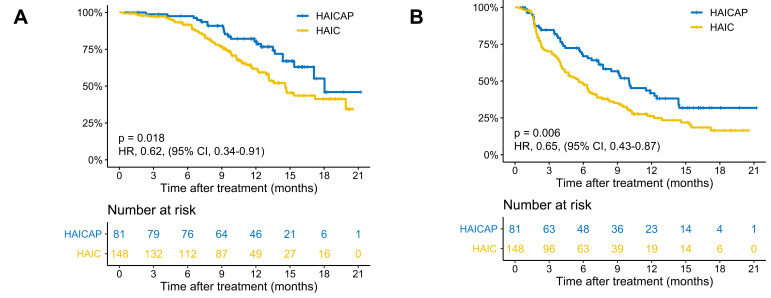
As a result, 229 patients were included in this study. Patients were divided into HAICAP group (n = 81) and HAIC group (n = 148) accordingly. The follow-up time ranged from 1.0 to 21.6 months, with a median of 11.0 months. The median overall survival was 18.0 months in the HAICAP group and 14.6 months in the HAIC group (p = 0.018; HR = 0.62; 95% CI 0.34-0.91). The median progression-free survival was 10.0 months in the HAICAP group and 5.6 months in the HAIC group (p = 0.006; HR = 0.65; 95% CI 0.43-0.87). The disease control rate in overall response (83% vs 66%; p = 0.006) and intrahepatic response (85% vs 74%, respectively; p = 0.045) were higher in the HAICAP group than in the HAIC group.
In comparison to HAIC, HAICAP was associated with a better treatment response and survival benefits for patients with advanced HCC.
肝动脉灌注化疗(HAIC)和抗程序性细胞死亡蛋白-1(PD-1)免疫疗法分别在晚期肝细胞癌(HCC)患者中显示出了有前景的疗效。然而,这两种治疗方法的联合应用尚未见报道。在本研究中,我们比较了HAIC联合抗PD-1免疫疗法(HAICAP)与HAIC在晚期HCC患者中的疗效。
在2018年11月至2019年12月期间,对接受HAICAP或HAIC治疗的晚期HCC患者进行回顾性招募并评估其 eligibility。根据肿瘤反应和生存情况评估疗效。
结果,本研究纳入了229例患者。患者相应地分为HAICAP组(n = 81)和HAIC组(n = 148)。随访时间为1.0至21.6个月,中位数为11.0个月。HAICAP组的中位总生存期为18.0个月,HAIC组为14.6个月(p = 0.018;HR = 0.62;95%CI 0.34 - 0.91)。HAICAP组的中位无进展生存期为10.0个月,HAIC组为5.6个月(p = 0.006;HR = 0.65;95%CI 0.43 - 0.87)。HAICAP组的总体反应疾病控制率(83%对66%;p = 0.006)和肝内反应疾病控制率(分别为85%对74%;p = 0.045)高于HAIC组。
与HAIC相比,HAICAP对晚期HCC患者具有更好的治疗反应和生存获益。